

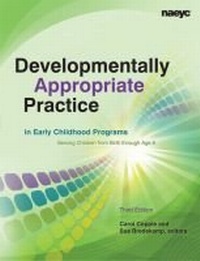
Developmentally Appropriate Practice in Early Childhood Programs
Serving Children From Birth Through Age 8
3rd Edition
Published on 29. January 2009
Book
Paperback/Softback
368 pages
978-1-928896-64-7 (ISBN)
Description
Since the first edition in 1987, NAEYC's book Developmentally Appropriate Practice in Early Childhood Programs has been an essential resource for the early child care field. Fully revised and expanded, the 2009 version comes with a supplementary CD containing readings on key topics, plus video examples showing developmentally appropriate practice in action.
Based on what the research says about development, learning, and effective practices, as well as what experience tells us about teaching intentionally, DAP articulates the principles that should guide our decision making. Chapters describe children from birth through age 8 in detail, with extensive examples of appropriate practice for infant/toddler, preschool, kindergarten, and primary levels.
Based on what the research says about development, learning, and effective practices, as well as what experience tells us about teaching intentionally, DAP articulates the principles that should guide our decision making. Chapters describe children from birth through age 8 in detail, with extensive examples of appropriate practice for infant/toddler, preschool, kindergarten, and primary levels.
Reviews / Votes
NAEYC could have taken the easy way out, made some cosmetic upgrades to the 1997 DAP edition, and republished it. Fortunately, the Association stayed on top of the rapidly changing body of knowledge and dug in to do the hard work. The result is a document that has the potential to be even more influential than the first two versions. That is saying a lot because the influence of NAEYC's position on developmentally appropriate practice has been immense.- Marilyn M. Smith, Council for Professional Recognition
More details
Edition
3rd Revised edition
Language
English
Place of publication
Washington DC
United States
Target group
Professional and scholarly
Edition type
Revised edition
Dimensions
Height: 229 mm
Width: 152 mm
Weight
835 gr
ISBN-13
978-1-928896-64-7 (9781928896647)
Copyright in bibliographic data and cover images is held by Nielsen Book Services Limited or by the publishers or by their respective licensors: all rights reserved.
Schweitzer Classification
Other editions
New editions
Susan Friedman | Brian L. Wright | Marie L. Masterson
Developmentally Appropriate Practice in Early Childhood Programs Serving Children from Birth Through Age 8, Fourth Edition (Fully Revised and Updated)
Book
01/2022
4th Edition
National Association for the Education of Young Children
€62.00
Article not available at the moment
Persons
Carol Copple is director of Publications and Initiatives in Educational Practice at NAEYC. She was on the faculty at Louisiana State University and the New School for Social Research. At the Educational Testing Service she co-developed and directed a research-based model for preschool education and conducted research on children's cognition. Her previous publications include Developmentally Appropriate Practice in Early Childhood Programs (Bredekamp & Copple 1997), Basics of Developmentally Appropriate Practice: An Introduction for Teachers of Children 3 to 6 (Bredekamp & Copple 2006), and Education the Young Thinker: Classroom Strategies for Cognitive Growth (Copple, Sigel, & Saunders 1984). She received her doctorate from Cornell University.
Sue Bredekamp is an early childhood education consultant in Washington, DC. She has consulted for NAEYC, the Council for Professional Recognition, the Head Start BUreau, and state and local departments of education, and served on the Committee on Early Childhood Mathematics of the National Research Council. She developed a satellite television course on early literacy, HeadsUp! Reading. While director of Accreditation and Professional Development at NAEYC (1981-1998), she coauthored major NAEYC position statements and publications, including accreditation standards, on developmentally appropriate practice, curriculum and assessment, and learning to read and write. Currently she is writing a textbook, to be titled Effective Practices in Early Childhood Education: Becoming an Intentional Teacher. Her doctorate is from the University of Maryland.
Sue Bredekamp is an early childhood education consultant in Washington, DC. She has consulted for NAEYC, the Council for Professional Recognition, the Head Start BUreau, and state and local departments of education, and served on the Committee on Early Childhood Mathematics of the National Research Council. She developed a satellite television course on early literacy, HeadsUp! Reading. While director of Accreditation and Professional Development at NAEYC (1981-1998), she coauthored major NAEYC position statements and publications, including accreditation standards, on developmentally appropriate practice, curriculum and assessment, and learning to read and write. Currently she is writing a textbook, to be titled Effective Practices in Early Childhood Education: Becoming an Intentional Teacher. Her doctorate is from the University of Maryland.
Content
Acknowledgments
Editors' Preface
About This Book
Key Messages of the Position Statement
NAEYC Position Statement
Developmentally Appropriate Practice in Early Childhood Programs Serving Children from Birth through Age 8
1. To Be an Excellent Teacher
2. Development in the First Three Years of Life
3. Developmentally Appropriate Practice in the Infant and Toddler Years-Ages 0-3: Examples to Consider
The Preschool Years
4. Developmentally Appropriate Practice in the Preschool Years-Ages 3-5: An Overview
5. Developmentally Appropriate Practice in the Preschool Years-Ages 3-5: Examples to Consider
The Kindergarten Year
6. Developmentally Appropriate Practice in the Kindergarten Year-Ages 5-6: An Overview
7. Developmentally Appropriate Practice in the Kindergarten Year-Ages 5-6: Examples to Consider
The Primary Grades
8. Developmentally Appropriate Practice in the Primary Grades-Ages 6-8: An Overview
9. Developmentally Appropriate Practice in the Primary Grades-Ages 6-8: Examples to Consider
10. Frequently Asked Questions about Developmentally
Appropriate Practice
References
Index
Editors' Preface
About This Book
Key Messages of the Position Statement
NAEYC Position Statement
Developmentally Appropriate Practice in Early Childhood Programs Serving Children from Birth through Age 8
1. To Be an Excellent Teacher
2. Development in the First Three Years of Life
3. Developmentally Appropriate Practice in the Infant and Toddler Years-Ages 0-3: Examples to Consider
The Preschool Years
4. Developmentally Appropriate Practice in the Preschool Years-Ages 3-5: An Overview
5. Developmentally Appropriate Practice in the Preschool Years-Ages 3-5: Examples to Consider
The Kindergarten Year
6. Developmentally Appropriate Practice in the Kindergarten Year-Ages 5-6: An Overview
7. Developmentally Appropriate Practice in the Kindergarten Year-Ages 5-6: Examples to Consider
The Primary Grades
8. Developmentally Appropriate Practice in the Primary Grades-Ages 6-8: An Overview
9. Developmentally Appropriate Practice in the Primary Grades-Ages 6-8: Examples to Consider
10. Frequently Asked Questions about Developmentally
Appropriate Practice
References
Index