

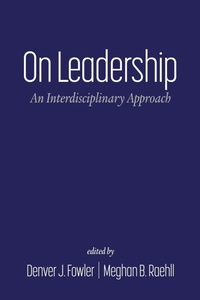
On Leadership
An Interdisciplinary Approach
Published on 20. October 2022
Book
Paperback/Softback
494 pages
979-8-88730-092-4 (ISBN)
Description
In On Leadership: An Interdisciplinary Approach editors Fowler and Raehll provide one of the most comprehensive books on interdisciplinary leadership approaches to date. Contributing authors from across the nation and around the globe include individuals from an array of sectors, including Education (PK-12 and Higher Education), Business, Public and Nonprofit Organizations, Government, Military, Law Enforcement, and the Healthcare Industry. With a focus on highlighting the best practices as it applies to effective leadership in any given organization, the book offers a much needed analysis of what it means to lead successfully in the 21st Century and beyond.
Reviews / Votes
If you are looking for a cutting-edge resource regarding interdisciplinary leadership, I highly recommend On Leadership! Each chapter has a rich perspective, which contributes to the interplay between one's context, value system, level of authenticity, perspectives, and unique experiences. I highly recommend On Leadership and look forward to using this in the leadership courses I teach."" - David De Jong, Dakota State University""As both a scholar in school leadership and a former school leader, I thought I knew just about everything about leadership, but after reading this book, I was delightfully enlightened about the practical application of leadership in varying contexts around the world. Organized in three sections, this book clearly presents the practical application of leadership through an interdisciplinary approach. Fowler and Raehll provide a rich text with contributions of authors in both PK-12 Schools and Higher Education, and this text would be a welcome addition to any educational leadership program."" - Sonya D. Hayes, The University of Tennessee, Knoxville
""Effective leadership development and corresponding leadership skills are not unique to any one profession, or leadership position. Effective leadership transcends all professions and effective leadership is evident in all effective leaders and leadership positions. Therefore, On Leadership: An Interdisciplinary Approach, is a timely must read for current and aspiring leaders. Siloed leadership development must be a thing of the past."" - Michael Schwanenberger, Northern Arizona University
""Undoubtedly forward-thinking content that will serve as key fundamentals in the future training of leaders in and out of the educational landscape. Centered on ethics and authenticity, this text truly represents a wholesome approach to modeling effective leadership practices in the 21st century."" - Alexandrea Horton, Former PreK-12 Educator
More details
Language
English
Place of publication
Charlotte
United States
Publishing group
Emerald Publishing Inc
Target group
Professional and scholarly
Dimensions
Height: 234 mm
Width: 156 mm
Thickness: 26 mm
Weight
743 gr
ISBN-13
979-8-88730-092-4 (9798887300924)
Copyright in bibliographic data and cover images is held by Nielsen Book Services Limited or by the publishers or by their respective licensors: all rights reserved.
Schweitzer Classification
Other editions
Additional editions
E-Book
01/2023
1st Edition
IAP - Information Age Publishing
€80.60
Available for download
Content
Introduction; Denver J. Fowler and Meghan B. Raehll.
Foreword; Christopher Colwell.
Section I: Cultivating Interdisciplinary Leadership.
Chapter 1. Developing the Interdisciplinary Leader: A Wholistic Leadership Approach; Valerie A. Storey.
Chapter 2. Developing Capacity for Leading in a Digitally Transformed World; Joe Lasley and Elizabeth Goryunova.
Chapter 3. The Interdisciplinary Acts of Leadership: Facilitating the Relationship Among the Head, Heart, Hands, and Holy; Stan Amaladas.
Chapter 4. Thoughtful Leadership: Developing Ethical and Authentic Leaders; Elizabeth Ostler.
Chapter 5. She Takes the Lead: Insights on the Shifting Landscape for Women in Leadership Roles; Kathryn Woods.
Chapter 6. Best Practices for Using Play in Business; Joe Lasley and Akshay Sateesh.
Section II: Higher Education And Beyond.
Chapter 7. Distinctive Characteristics in Interdisciplinary Academic Leadership Programs: A Multi-Program Case Study Analysis; Kathy L. Guthrie and Pei Hu.
Chapter 8. Higher Education in Crisis: Enabling Complexity Thinking and Adaptive Space for Ethical Decision-Making During the Time of COVID-19; Benjamin Brooks.
Chapter 9. Educational Reprogramming: Leadership Perceptions and Practice of Academic Program Directors in a College of Education During COVID-19; Joshua C. Tipton, Ashlee Hover, and Kyle Butler.
Chapter 10. Leadership in Education for Black Americans in Community Colleges; Aishwarya Joshi and Seneka R. Gainer.
Chapter 11. An Interdisciplinary STEM NIH Grant; Anne Katz and Karla-Sue C. Marriott.
Chapter 12. Adaptive Informal Education Leadership During COVID-19; Marlee J. Tavlin.
Chapter 13. Narrow-Minded Military Education and Opportunity Lost: On the Possibility of Developing Future Army Officer Expertise in Mission Command at a Military Boarding School; Richard Megahan.
Section III: Pre-K12 Education.
Chapter 14. Leading From the Ranks: Teacher Leader Sensemaking of a District-Supported Mentorship Initiative; Brianne Morettini and Lisa Vernon-Dotson.
Chapter 15. Developing Effective Professional Learning Communities for Senior Leaders; Marie Stephenson, Carla Solvason, Tracey France, and Paul Sheehan.
Chapter 16. School Board Leadership to Improve Student Outcomes; A. J. Crabill.
Chapter 17. Charter Schools and Crisis Leadership During COVID-19; David T. Marshall and Natalie M. Neugebauer.
Chapter 18. Serving Multiple Masters: Rural Ugandan Head Teachers Role in Attracting and Retaining Teachers; Gilbert Arinaitwe and John Williamson.
Chapter 19. Distributed Leadership in Tanzanian Secondary Schools: A Systematic Literature Review; Revocatus C. Kuluchumila.
Chapter 20. Primary Resources and Public Pedagogy: A Case Study for Teacher Professional Development; Minkie O. English.
Section IV: Exemplars In Interdisciplinary Leadership.
Chapter 21. The Mutual Engagement Leadership Model Implementation and Outcomes at Conway Regional Health System; Kateryna V. Pitchford.
Chapter 22. Becoming an Integrated Leader; Alyncia M. Bowen.
Chapter 23. Crossover Leadership: An Autoethnography on Interdisciplinary Leadership and Transformation; John Nestor.
About the Editors.
About the Contributors.
Foreword; Christopher Colwell.
Section I: Cultivating Interdisciplinary Leadership.
Chapter 1. Developing the Interdisciplinary Leader: A Wholistic Leadership Approach; Valerie A. Storey.
Chapter 2. Developing Capacity for Leading in a Digitally Transformed World; Joe Lasley and Elizabeth Goryunova.
Chapter 3. The Interdisciplinary Acts of Leadership: Facilitating the Relationship Among the Head, Heart, Hands, and Holy; Stan Amaladas.
Chapter 4. Thoughtful Leadership: Developing Ethical and Authentic Leaders; Elizabeth Ostler.
Chapter 5. She Takes the Lead: Insights on the Shifting Landscape for Women in Leadership Roles; Kathryn Woods.
Chapter 6. Best Practices for Using Play in Business; Joe Lasley and Akshay Sateesh.
Section II: Higher Education And Beyond.
Chapter 7. Distinctive Characteristics in Interdisciplinary Academic Leadership Programs: A Multi-Program Case Study Analysis; Kathy L. Guthrie and Pei Hu.
Chapter 8. Higher Education in Crisis: Enabling Complexity Thinking and Adaptive Space for Ethical Decision-Making During the Time of COVID-19; Benjamin Brooks.
Chapter 9. Educational Reprogramming: Leadership Perceptions and Practice of Academic Program Directors in a College of Education During COVID-19; Joshua C. Tipton, Ashlee Hover, and Kyle Butler.
Chapter 10. Leadership in Education for Black Americans in Community Colleges; Aishwarya Joshi and Seneka R. Gainer.
Chapter 11. An Interdisciplinary STEM NIH Grant; Anne Katz and Karla-Sue C. Marriott.
Chapter 12. Adaptive Informal Education Leadership During COVID-19; Marlee J. Tavlin.
Chapter 13. Narrow-Minded Military Education and Opportunity Lost: On the Possibility of Developing Future Army Officer Expertise in Mission Command at a Military Boarding School; Richard Megahan.
Section III: Pre-K12 Education.
Chapter 14. Leading From the Ranks: Teacher Leader Sensemaking of a District-Supported Mentorship Initiative; Brianne Morettini and Lisa Vernon-Dotson.
Chapter 15. Developing Effective Professional Learning Communities for Senior Leaders; Marie Stephenson, Carla Solvason, Tracey France, and Paul Sheehan.
Chapter 16. School Board Leadership to Improve Student Outcomes; A. J. Crabill.
Chapter 17. Charter Schools and Crisis Leadership During COVID-19; David T. Marshall and Natalie M. Neugebauer.
Chapter 18. Serving Multiple Masters: Rural Ugandan Head Teachers Role in Attracting and Retaining Teachers; Gilbert Arinaitwe and John Williamson.
Chapter 19. Distributed Leadership in Tanzanian Secondary Schools: A Systematic Literature Review; Revocatus C. Kuluchumila.
Chapter 20. Primary Resources and Public Pedagogy: A Case Study for Teacher Professional Development; Minkie O. English.
Section IV: Exemplars In Interdisciplinary Leadership.
Chapter 21. The Mutual Engagement Leadership Model Implementation and Outcomes at Conway Regional Health System; Kateryna V. Pitchford.
Chapter 22. Becoming an Integrated Leader; Alyncia M. Bowen.
Chapter 23. Crossover Leadership: An Autoethnography on Interdisciplinary Leadership and Transformation; John Nestor.
About the Editors.
About the Contributors.