

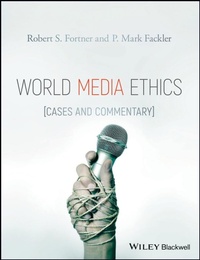
World Media Ethics
Cases and Commentary
1st Edition
Published on 28. July 2017
Book
Hardback
264 pages
978-1-118-98999-9 (ISBN)
Description
Emphasizing the intertwined concepts of freedom of the press and social responsibility, this is the first book to cover media ethics from a truly global perspective. Case studies on hot topics and issues of enduring importance in media studies are introduced and thoroughly analyzed, with particular focus on ones involving social media and public protest
Written by two global media ethics experts with extensive teaching experience, this work covers the whole spectrum of media, from news, film, and television, to advertising, PR, and digital media
End-of-chapter exercises, discussion questions, and commentary boxes from a global group of scholars reinforce student learning, engage readers, and offer diverse perspectives
Written by two global media ethics experts with extensive teaching experience, this work covers the whole spectrum of media, from news, film, and television, to advertising, PR, and digital media
End-of-chapter exercises, discussion questions, and commentary boxes from a global group of scholars reinforce student learning, engage readers, and offer diverse perspectives
More details
Language
English
Place of publication
Hoboken
United Kingdom
Publishing group
John Wiley and Sons Ltd
Target group
College/higher education
Product notice
sewn/stitched
Cloth over boards
Dimensions
Height: 249 mm
Width: 188 mm
Thickness: 18 mm
Weight
544 gr
ISBN-13
978-1-118-98999-9 (9781118989999)
Copyright in bibliographic data and cover images is held by Nielsen Book Services Limited or by the publishers or by their respective licensors: all rights reserved.
Schweitzer Classification
Other editions
Additional editions
Book
07/2017
Wiley
€84.00
Shipment within 15-20 days
E-Book
05/2017
Wiley-Blackwell
€65.99
Available for download
E-Book
05/2017
Wiley-Blackwell
€65.99
Available for download
Persons
Robert S. Fortner is Professor of Communication and Media at Palm Beach Atlantic University. He has published widely on international communication, global public diplomacy, the history of international media, media ethics, and media theory. Most recently, he is the co-editor of The Handbook of Media and Mass Communication Theory (2 volume set, Wiley-Blackwell, 2014) and The Handbook of Global Communication and Media Ethics (2 volume set, Wiley-Blackwell, 2011). He has extensive experience teaching, lecturing, and interacting with media practitioners in various countries around the world, from Moscow to Nairobi, and Abidjan to Ulan Bator.
P. Mark Fackler is Professor of Communication at Calvin College in the, USA, and has written extensively on communication and journalism ethics. He is the co-author of Media Ethics: Cases and Moral Reasoning (10th edition, 2016), Ethics for Public Communication (2011), and Ethics and Evil in the Public Sphere (2010). He is the co-editor of The Handbook of Media and Mass Communication Theory (2 volume set, Wiley-Blackwell, 2014) and The Handbook of Global Communication and Media Ethics (2 volume set, Wiley-Blackwell, 2011). He teaches communications ethics regularly in Kenya, Uganda, and Ethiopia, and publishes with African scholars on media ethics in that region
P. Mark Fackler is Professor of Communication at Calvin College in the, USA, and has written extensively on communication and journalism ethics. He is the co-author of Media Ethics: Cases and Moral Reasoning (10th edition, 2016), Ethics for Public Communication (2011), and Ethics and Evil in the Public Sphere (2010). He is the co-editor of The Handbook of Media and Mass Communication Theory (2 volume set, Wiley-Blackwell, 2014) and The Handbook of Global Communication and Media Ethics (2 volume set, Wiley-Blackwell, 2011). He teaches communications ethics regularly in Kenya, Uganda, and Ethiopia, and publishes with African scholars on media ethics in that region
Content
Preface vii
1 Introduction: Contexts for Ethical Decision-Making 1
2 Philosophical Perspectives on Ethical Decision-Making: The Individualist Traditions 19
3 Philosophical Perspectives on Ethical Decision-Making: The Collectivist Traditions 35
4 Ethics and Political Economy 54
5 Boundaries on Civil Discourse 75
6 Advertising, Public Relations, and Materialism 90
7 Global Entertainment 108
8 Media and the Political Process 121
9 The Rule of Law 138
10 Treasuring Persons, Protecting Institutions: The Protection of Minority Voices 149
11 Religion and Social Responsibility 169
12 War, Violence, and Media 179
13 Truth, Conflict, Chronic Problems, and Media Attention 190
14 Conclusion 205
Glossary 213
References 215
Index 243
1 Introduction: Contexts for Ethical Decision-Making 1
2 Philosophical Perspectives on Ethical Decision-Making: The Individualist Traditions 19
3 Philosophical Perspectives on Ethical Decision-Making: The Collectivist Traditions 35
4 Ethics and Political Economy 54
5 Boundaries on Civil Discourse 75
6 Advertising, Public Relations, and Materialism 90
7 Global Entertainment 108
8 Media and the Political Process 121
9 The Rule of Law 138
10 Treasuring Persons, Protecting Institutions: The Protection of Minority Voices 149
11 Religion and Social Responsibility 169
12 War, Violence, and Media 179
13 Truth, Conflict, Chronic Problems, and Media Attention 190
14 Conclusion 205
Glossary 213
References 215
Index 243