

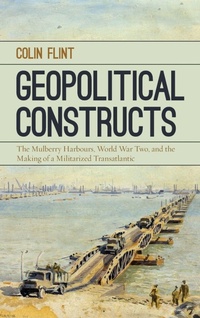
Geopolitical Constructs
The Mulberry Harbours, World War Two, and the Making of a Militarized Transatlantic
Published on 19. September 2016
Book
Hardback
226 pages
978-1-4422-6667-4 (ISBN)
Description
This innovative book tells a unique story about D-Day, one that does not concentrate on the soldiers who hit the beaches or the admirals and generals who commanded them. Instead, Colin Flint brings engineers, businessmen, and bureaucrats to center stage. Through them, he offers a different way of thinking about war, one that sees war as an ongoing set of processes in which seemingly isolated acts are part of broader historical developments. Developing the concept ofgeopolitical constructs to understand wars, the author connects specific events to long-term and global geopolitical arrangements.
Focusing on the construction of the Mulberry Harbours-massive artificial structures dragged across the English Channel in the immediate wake of the invading force-Flint illustrates how the process of making war links a vast array of people, institutions, and places, as well as past events and future outcomes. He argues that the people who designed and built the Harbours became geopolitical subjects by producing pieces of engineering that helped shape the course of World War Two and the Cold War that followed, which created a militarized trans-Atlantic that remains today. Using previously unpublished archival material to give voice to those who made the Mulberry Harbours and wartime strategy, this original study broadens the historical and geographical scope of how we understand war, showing how the everyday actions of individuals made, and were made by, geopolitical settings.
Focusing on the construction of the Mulberry Harbours-massive artificial structures dragged across the English Channel in the immediate wake of the invading force-Flint illustrates how the process of making war links a vast array of people, institutions, and places, as well as past events and future outcomes. He argues that the people who designed and built the Harbours became geopolitical subjects by producing pieces of engineering that helped shape the course of World War Two and the Cold War that followed, which created a militarized trans-Atlantic that remains today. Using previously unpublished archival material to give voice to those who made the Mulberry Harbours and wartime strategy, this original study broadens the historical and geographical scope of how we understand war, showing how the everyday actions of individuals made, and were made by, geopolitical settings.
Reviews / Votes
An impressive tour de force. Relying on meticulous research and unpublished archival material, Flint manages the daunting task of bringing a fresh and interesting insight to the events of D-Day. He does so by providing a multi-layered approach, which emphasizes the key social, political, economic, and geopolitical developments that were required in order to turn Churchill's vision of temporary harbors into actual bridges for the invasion of the Continent. He also does so by questioning the way in which we conceptualize war as events with well-defined geographies and timeframes. . . . By its interdisciplinary nature, [this book will] be a great source for scholars focused on European history, geography and politics in the twentieth century. * Europe Now * In sum, Geopolitical Constructs: The Mulberry Harbours, World War Two, and the Making of a Militarized Transatlantic is an impressive tour de force. Relying on meticulous research and unpublished archival material, Flint manages the daunting task of bringing a fresh and interesting insight to the events of D-Day.... [T]his book... should, by its inter-disciplinary nature, be a great source for scholars focused on European history, geography and politics in the twentieth Century. * Europe Now * In this meticulously detailed book, Colin Flint draws on extensive archival records to document the social and institutional networks that make war possible and in turn demonstrates how geopolitical subjects are themselves transformed by war. Geopolitical Constructs is a pathbreaking book that combines rigorous scholarship and theoretical acumen with skilled storytelling. -- James Tyner, Kent State University Geopolitical Constructs is a prime example of how the study of geopolitics has been bursting out of its traditional narrow perspectives. Colin Flint takes a crucial military event and contextualizes it in all its political, economic, and social complexity. The result of this well-researched study is an invaluable addition to our understanding of a widely known event that is both convincing and illuminating. -- Peter Taylor Colin Flint's new book excavates the history of World War Two in ways that will be surprising to many people who thought they knew that history forward and backward. More importantly, he does so in a way that provocatively highlights the material infrastructures that stitched together the transatlantic alliance and re-made the postwar geopolitical order. -- Jason Dittmer, University College London Colin Flint's Geopolitical Constructs provides an innovative, and at times, heart-felt examination of the men and women responsible for the invention and implementation of the Mulberry Harbours - a set of artificial harbours integral to D-Day planning. Both historical and geographical, it shows what can be done when you follow people, objects and places and their mutual entanglements. The Mulberry Harbours may not be as well-known as the Bailey bridge but it was integral to Allied efforts to defeat Nazi Germany. Highly recommended. -- Klaus Dodds, Royal Holloway University of London; author of Border WarsMore details
Language
English
Place of publication
United States
Publishing group
Bloomsbury Publishing Plc
Target group
Professional and scholarly
Illustrations
3 Maps
Dimensions
Height: 235 mm
Width: 157 mm
Thickness: 18 mm
Weight
524 gr
ISBN-13
978-1-4422-6667-4 (9781442266674)
Copyright in bibliographic data and cover images is held by Nielsen Book Services Limited or by the publishers or by their respective licensors: all rights reserved.
Schweitzer Classification
Other editions
Additional editions
Colin Flint
Geopolitical Constructs
The Mulberry Harbours, World War Two, and the Making of a Militarized Transatlantic
E-Book
09/2016
1st Edition
Rowman & Littlefield Publishers
€98.99
Available for download
Colin Flint
Geopolitical Constructs
The Mulberry Harbours, World War Two, and the Making of a Militarized Transatlantic
E-Book
09/2016
1st Edition
Rowman & Littlefield Publishers
€98.99
Available for download
Person
Colin Flint is a political geographer and professor in the Department of Political Science, Utah State University.
Content
List of Figures
Acknowledgments
Chapter One: Introduction: The Mulberry Harbours and Ways to Think About War
Chapter Two: Geopolitical Constructs: Understanding Global Geopolitical
Change
Chapter Three: The Scope of the Mulberry Harbour Project: Demanded by
Strategy, Made by Committee
Chapter Four: Bureaucratic Construct: "Millions spent on a plan which had not
been approved"
Chapter Five: Good Geopolitical Subjects: "Did we, Sir, do well?"
Chapter Six: The Business of Making the Mulberry Harbours: "War may be
an intensification in the development of our lives"
Chapter Seven: Making Places: "You are probably aware that a scheme has been
prepared"
Chapter Eight: Making Regions: From "bridge" to "unsinkable aircraft carrier"
Chapter Nine: Conclusion: The Legacies of Geopolitical Constructs
Bibliography
About the Author
Acknowledgments
Chapter One: Introduction: The Mulberry Harbours and Ways to Think About War
Chapter Two: Geopolitical Constructs: Understanding Global Geopolitical
Change
Chapter Three: The Scope of the Mulberry Harbour Project: Demanded by
Strategy, Made by Committee
Chapter Four: Bureaucratic Construct: "Millions spent on a plan which had not
been approved"
Chapter Five: Good Geopolitical Subjects: "Did we, Sir, do well?"
Chapter Six: The Business of Making the Mulberry Harbours: "War may be
an intensification in the development of our lives"
Chapter Seven: Making Places: "You are probably aware that a scheme has been
prepared"
Chapter Eight: Making Regions: From "bridge" to "unsinkable aircraft carrier"
Chapter Nine: Conclusion: The Legacies of Geopolitical Constructs
Bibliography
About the Author