


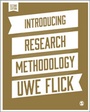
Introducing Research Methodology
A Beginner's Guide to Doing a Research Project
1st Edition
Published on 11. March 2011
Book
Hardback
296 pages
978-1-84920-780-5 (ISBN)
Description
In this new book, specifically written for first time researchers, Uwe Flick, author of the highly successful Introduction to Qualitative Research, focuses on the process of producing an undergraduate research project. Introducing Research Methodology: A Beginner's Guide to Doing a Research Project gives readers the fundamental data collection and analysis skills that they need for their first project, as well as a good understanding of the research process as a whole. It covers both quantitative and qualitative methods, and contains lots of real life examples from the author's own research. Its contents include:
- reading and reviewing the literature
- research design
- writing up
- research ethics
As well as practical research techniques, Flick provides a basic explanation of methodological issues such as epistemology, the quantitative/qualitative debate and the wider social role of research, linking these to real world issues and examples and the actual task of researching and writing a project.
- reading and reviewing the literature
- research design
- writing up
- research ethics
As well as practical research techniques, Flick provides a basic explanation of methodological issues such as epistemology, the quantitative/qualitative debate and the wider social role of research, linking these to real world issues and examples and the actual task of researching and writing a project.
Reviews / Votes
This book provides an extremely useful guide to the basics of research, such as the fundamental characteristics of quantitative and qualitative research and their associated research questions. It is written in an accessible style without the complicated use of terms and details that often shroud research methods books. It is orientated toward the beginner who may not be familiar with the language of quantitative and qualitative research and who may be an undergraduate in the social sciences. It balances nicely attention to both quantitative and qualitative research, providing legitimacy for both approachesJohn W Creswell
University of Nebraska-Lincoln
What makes this guide special is the way in which it is structured and the style used for explanations and clarifications... The book enjoys the benefits of Flick's personal research experience, but also his personal experience in teaching research methodology and supervising students' research projects. The book is addressed to young researchers at the beginning of their career. It represents a clear overview of the main approaches used in social research. Even though research methodology specific to social sciences can be seen as overwhelming in the eyes of the beginners, this book manages to overcome this drawback and create positive orientation for readers to learn. It offers logical and clear guidance, revealing the route that any high quality research needs to follow.
Sorana Saveanu
Journal of Social Research and Policy
This book's main strengths are its range of topics and issues, firstly it brings the reader up to date with recent research methods such as e-research, online interviewing and virtual ethnography. Secondly, it is brief enough to understand the issues and challenges in research projects, but detailed enough to help one make key decisions. Thirdly, its use of real-life examples helps to contextualise issues in conducting research projects. Fourthly, there are many references at the end of each chapter to direct the reader to further resources.
Chloe Sharp
SRA News
More details
Edition
First Edition
Language
English
Place of publication
London
United Kingdom
Target group
College/higher education
Dimensions
Height: 232 mm
Width: 186 mm
Weight
698 gr
ISBN-13
978-1-84920-780-5 (9781849207805)
Copyright in bibliographic data and cover images is held by Nielsen Book Services Limited or by the publishers or by their respective licensors: all rights reserved.
Schweitzer Classification
Other editions
New editions
Book
04/2015
2nd Edition
SAGE Publications Ltd
€144.10
Article exhausted; check for reprint
Person
Uwe Flick is Senior Professor of Qualitative Research in Social Science and Education at the Freie Universitaet Berlin, Germany. He is a trained psychologist and sociologist and received his PhD from the Freie Universitaet Berlin in 1988 and his Habilitation from the Technical University Berlin in 1994. He has been Professor of Qualitative Research at Alice Salomon University of Applied Sciences in Berlin, Germany and at the University of Vienna, Austria. Previously, he was Adjunct Professor at the Memorial University of Newfoundland in St. John's, Canada; a Lecturer in research methodology at the Freie Universitaet Berlin; a Reader and Assistant Professor in qualitative methods and evaluation at the Technical University Berlin; and Associate Professor and Head of the Department of Medical Sociology at the Hannover Medical School. He has held visiting appointments at the London School of Economics, the Ecole des Hautes Etudes en Sciences Sociales in Paris, Cambridge University (UK), Memorial University of St John's (Canada), University of Lisbon (Portugal), Institute of Higher Studies in Vienna, in Italy and Sweden, and the School of Psychology at Massey University, Auckland (New Zealand). His main research interests are qualitative methods, social representations in the fields of individual and public health, vulnerability in fields like youth homelessness or (forced) migration and chronical illness in everyday live. He is the editor of The SAGE Handbook of Qualitative Research Design (2 Vols.; Sage 2022). The SAGE Handbook of Qualitative Data Analysis (Sage, 2014), The SAGE Qualitative Research Kit (Sage, 2nd edn, 2018), A Companion to Qualitative Research (Sage, 2004), Psychology of the Social (Cambridge University Press, 1998). His most recent publications are the seventh edition of An Introduction to Qualitative Research (Sage, 2023), Doing Grounded Theory (Sage, 2018), Doing Triangulation and Mixed Methods (Sage, 2018), The SAGE Handbook of Qualitative Data Collection (editor, Sage, 2018), the third edition of Introducing Research Methodology - Thinking Your Way through Your Research Project (Sage, 2020) and Doing Interview Research - The Essential How To Guide (Sage 2022). In 2019, Uwe Flick received the Lifetime Award in Qualitative Inquiry at the 15th International Congress of Qualitative Inquiry.
Content
PART ONE: ORIENTATION
Why Social Research?
From Research Idea to Research Question
Reading and Reviewing the Literature
PART TWO: PLANNING AND DESIGN
Planning Social Research: Steps of the Research Process
Designing Social Research
Deciding Your Methods
PART THREE: WORKING WITH DATA
Gathering Data: Quantitative and Qualitative Approaches
Analyzing Quantitative and Qualitative Data
E-Research: Doing Social Research Online
Integrated Social Research: Combination of Different Approaches
PART FOUR: REFLECTION AND WRITING
What Is Good Research? Evaluating Your Research Project
Ethical Issues in Social Research
Writing Research and Using Results
Why Social Research?
From Research Idea to Research Question
Reading and Reviewing the Literature
PART TWO: PLANNING AND DESIGN
Planning Social Research: Steps of the Research Process
Designing Social Research
Deciding Your Methods
PART THREE: WORKING WITH DATA
Gathering Data: Quantitative and Qualitative Approaches
Analyzing Quantitative and Qualitative Data
E-Research: Doing Social Research Online
Integrated Social Research: Combination of Different Approaches
PART FOUR: REFLECTION AND WRITING
What Is Good Research? Evaluating Your Research Project
Ethical Issues in Social Research
Writing Research and Using Results