

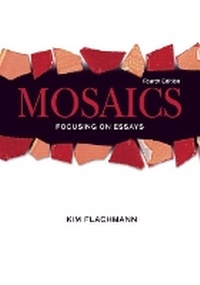
Mosaics
Focusing On Essays
4th Edition
Published on 13. March 2007
Book
Paperback/Softback
864 pages
978-0-13-239505-2 (ISBN)
Description
For Developmental English, Basic Skills or Remedial Writing courses, or low-level Freshman Composition.
Mosaics: Focusing on Essays illustrates how the companion skills of reading and writing are parts of a larger, interrelated process that moves back and forth through the tasks of prereading and reading, prewriting and writing, and revising and editing.
Experience tells us that students have the best chance of succeeding in college if they learn how to respond productively to the varying academic demands made on them throughout the curriculum. One extremely important part of this process is being able to analyze ideas and think critically about issues in many different subject areas. Mosaics: Focusing on Essays illustrates how the companion skills of reading and writing are parts of a larger, interrelated process that moves back and forth through the tasks of prereading and reading, prewriting and writing, and revising and editing. This book encourages students to discover how the "mosaics" of their own reading and writing processes work together to form a coherent whole. By demonstrating the interrelationship among thinking, reading, and writing on progressively more difficulty levels, Mosaics promises to help prepare students for success in college throughout the curriculum.
This text ships automatically with MyWritngLab.
Mosaics: Focusing on Essays illustrates how the companion skills of reading and writing are parts of a larger, interrelated process that moves back and forth through the tasks of prereading and reading, prewriting and writing, and revising and editing.
Experience tells us that students have the best chance of succeeding in college if they learn how to respond productively to the varying academic demands made on them throughout the curriculum. One extremely important part of this process is being able to analyze ideas and think critically about issues in many different subject areas. Mosaics: Focusing on Essays illustrates how the companion skills of reading and writing are parts of a larger, interrelated process that moves back and forth through the tasks of prereading and reading, prewriting and writing, and revising and editing. This book encourages students to discover how the "mosaics" of their own reading and writing processes work together to form a coherent whole. By demonstrating the interrelationship among thinking, reading, and writing on progressively more difficulty levels, Mosaics promises to help prepare students for success in college throughout the curriculum.
This text ships automatically with MyWritngLab.
More details
Edition
4th edition
Language
English
Place of publication
United States
Publishing group
Pearson Education (US)
Target group
Professional and scholarly
Dimensions
Height: 232 mm
Width: 191 mm
Weight
1247 gr
ISBN-13
978-0-13-239505-2 (9780132395052)
Copyright in bibliographic data and cover images is held by Nielsen Book Services Limited or by the publishers or by their respective licensors: all rights reserved.
Schweitzer Classification
Other editions
New editions
Book
01/2010
4th Edition
Longman Inc
€78.47
Article exhausted; check for reprint
Previous edition
Book
03/2004
3rd Edition
Pearson
€51.98
Article exhausted; check for reprint
Person
In her own words, this is how Kim Flachmann describes her academic life story and devotion to students and teaching:
"I am a St. Louis kid who moved west and fell in love with California. My passion is teaching writing and helping people understand its importance in our society today.
I earned my B.A. in English at Washington University in my hometown and then started teaching at Morton College in Chicago, where I began a Developmental Writing program in 1969. Three years later, I came to California State University, Bakersfield, where I currently direct the Writing Program. I enjoy teaching writing through my books and my classes.
I can't imagine any mission more important to the success of a society than literacy. Teaching people who to understand words they encounter and how to express their most cherished ideas can relieve their personal frustration, rejuvenate their self-esteem, provide them with skills they need to succeed, and ultimately raise the quality of all our lives. I feel truly privileged to be involved in such a life-changing passion."
"I am a St. Louis kid who moved west and fell in love with California. My passion is teaching writing and helping people understand its importance in our society today.
I earned my B.A. in English at Washington University in my hometown and then started teaching at Morton College in Chicago, where I began a Developmental Writing program in 1969. Three years later, I came to California State University, Bakersfield, where I currently direct the Writing Program. I enjoy teaching writing through my books and my classes.
I can't imagine any mission more important to the success of a society than literacy. Teaching people who to understand words they encounter and how to express their most cherished ideas can relieve their personal frustration, rejuvenate their self-esteem, provide them with skills they need to succeed, and ultimately raise the quality of all our lives. I feel truly privileged to be involved in such a life-changing passion."
Content
Part I Reading and Writing: An Overview
Chapter 1 Reading and Writing in College
Chapter2 The Reading Process
Chapter3 Reading Critically
Chapter4 The Writing Process
Chapter5 Preparing to Write
Chapter6 Writing Effectively
Chapter 7 Revising and Editing
Part II Reading and Writing Effective Essays
Chapter8 Describing
Chapter9 Narrating
Chapter10 Illustrating
Chapter11 Analyzing a Process
Chapter12 Comparing and Contrasting
Chapter13 Dividing and Classifying
Chapter14 Defining
Chapter15 Analyzing Causes and Effects
Chapter16 Arguing
Part III The Research Paper
Chapter17 Recognizing a Research Paper
Chapter18 Avoiding Plagiarism
Chapter19 Finding Sources
Chapter20 Writing a Research Paper
Chapter21 Documenting Sources
Chapter22 Revising and Editing a Research Paper
Chapter23 Writing Workshop
PartIV The Handbook
CHAPTER 24 Introduction
Unit 1 Sentences
Chapter25 Subjects and Verbs
Chapter26 Fragments
Chapter27 Fused Sentences and Comma Splices
Unit 2 Verbs
Chapter28 Regular and Irregular Verbs
Chapter29 Verb Tense
Chapter30 Subject-Verb Agreement
Chapter31 More on Verbs
Unit 3 Pronouns
Chapter32 Pronoun Problems
Chapter33 Pronoun Reference and Point of View
Chapter34 Pronoun Agreement
Unit 4 Modifiers
Chapter35 Adjectives
Chapter36 Adverbs
Chapter37 Modifier Errors
Unit 5 Punctuation
Chapter38 End Punctuation
Chapter39 Commas
Chapter40 Apostrophes
Chapter41 Quotation Marks
Chapter42 Other Punctuation Marks
Unit 6 Mechanics
Chapter43 Capitalization
Chapter44 Abbreviations and Numbers
Unit 7 Effective Sentences
Chapter45 Varying Sentence Structure
Chapter46 Parallelism
Chapter47 Combining Sentences
Unit 8 Choosing the Right Words
Chapter48 Standard and Nonstandard English
Chapter49 Easily Confused Words
Chapter50 Spelling
UNIT TESTS
APPENDICES
CREDITS
INDEX
Chapter 1 Reading and Writing in College
Chapter2 The Reading Process
Chapter3 Reading Critically
Chapter4 The Writing Process
Chapter5 Preparing to Write
Chapter6 Writing Effectively
Chapter 7 Revising and Editing
Part II Reading and Writing Effective Essays
Chapter8 Describing
Chapter9 Narrating
Chapter10 Illustrating
Chapter11 Analyzing a Process
Chapter12 Comparing and Contrasting
Chapter13 Dividing and Classifying
Chapter14 Defining
Chapter15 Analyzing Causes and Effects
Chapter16 Arguing
Part III The Research Paper
Chapter17 Recognizing a Research Paper
Chapter18 Avoiding Plagiarism
Chapter19 Finding Sources
Chapter20 Writing a Research Paper
Chapter21 Documenting Sources
Chapter22 Revising and Editing a Research Paper
Chapter23 Writing Workshop
PartIV The Handbook
CHAPTER 24 Introduction
Unit 1 Sentences
Chapter25 Subjects and Verbs
Chapter26 Fragments
Chapter27 Fused Sentences and Comma Splices
Unit 2 Verbs
Chapter28 Regular and Irregular Verbs
Chapter29 Verb Tense
Chapter30 Subject-Verb Agreement
Chapter31 More on Verbs
Unit 3 Pronouns
Chapter32 Pronoun Problems
Chapter33 Pronoun Reference and Point of View
Chapter34 Pronoun Agreement
Unit 4 Modifiers
Chapter35 Adjectives
Chapter36 Adverbs
Chapter37 Modifier Errors
Unit 5 Punctuation
Chapter38 End Punctuation
Chapter39 Commas
Chapter40 Apostrophes
Chapter41 Quotation Marks
Chapter42 Other Punctuation Marks
Unit 6 Mechanics
Chapter43 Capitalization
Chapter44 Abbreviations and Numbers
Unit 7 Effective Sentences
Chapter45 Varying Sentence Structure
Chapter46 Parallelism
Chapter47 Combining Sentences
Unit 8 Choosing the Right Words
Chapter48 Standard and Nonstandard English
Chapter49 Easily Confused Words
Chapter50 Spelling
UNIT TESTS
APPENDICES
CREDITS
INDEX