

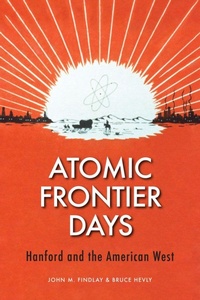
Atomic Frontier Days
Hanford and the American West
Published on 18. May 2011
Book
Paperback/Softback
384 pages
978-0-295-99097-2 (ISBN)
Description
Outstanding Title by Choice Magazine
On the banks of the Pacific Northwest's greatest river lies the Hanford nuclear reservation, an industrial site that appears to be at odds with the surrounding vineyards and desert. The 586-square-mile compound on the Columbia River is known both for its origins as part of the Manhattan Project, which made the first atomic bombs, and for the monumental effort now under way to clean up forty-five years of waste from manufacturing plutonium for nuclear weapons. Hanford routinely makes the news, as scientists, litigants, administrators, and politicians argue over its past and its future.
It is easy to think about Hanford as an expression of federal power, a place apart from humanity and nature, but that view distorts its history. Atomic Frontier Days looks through a wider lens, telling a complex story of production, community building, politics, and environmental sensibilities. In brilliantly structured parallel stories, the authors bridge the divisions that accompany Hanford's headlines and offer perspective on today's controversies. Influenced as much by regional culture, economics, and politics as by war, diplomacy, and environmentalism, Hanford and the Tri-Cities of Richland, Pasco, and Kennewick illuminate the history of the modern American West.
On the banks of the Pacific Northwest's greatest river lies the Hanford nuclear reservation, an industrial site that appears to be at odds with the surrounding vineyards and desert. The 586-square-mile compound on the Columbia River is known both for its origins as part of the Manhattan Project, which made the first atomic bombs, and for the monumental effort now under way to clean up forty-five years of waste from manufacturing plutonium for nuclear weapons. Hanford routinely makes the news, as scientists, litigants, administrators, and politicians argue over its past and its future.
It is easy to think about Hanford as an expression of federal power, a place apart from humanity and nature, but that view distorts its history. Atomic Frontier Days looks through a wider lens, telling a complex story of production, community building, politics, and environmental sensibilities. In brilliantly structured parallel stories, the authors bridge the divisions that accompany Hanford's headlines and offer perspective on today's controversies. Influenced as much by regional culture, economics, and politics as by war, diplomacy, and environmentalism, Hanford and the Tri-Cities of Richland, Pasco, and Kennewick illuminate the history of the modern American West.
Reviews / Votes
"An outstanding contribution to our knowledge of the Atomic West and its role in the nation's history. Equally important, the authors provide an important corrective to recent historical accounts of the topic."- George E. Webb (Pacific Northwest Quarterly) "Their coauthored work effectively blends the history of the nuclear complex with the histories of environmentalism, community identity, regionalism, and politics . . . Atomic Frontier Days pushes the boundaries of atomic bomb history into new, exciting directions."
- Jason Krupar (Technology and Culture) "Atomic Frontier Days goes beyond simplistic narratives of a triumph or tragedy. . . . Unlike many histories of the American nuclear weapons programs, which tend to focus on the secret and isolated nature of the enterprise, this book situates Hanford firmly in a regional, political, social, and economic context."
- Andrew Jenks (Southern California Quarterly) "The book is richly informed by primary sources. It may well be the definitive treatment of Hanford and its ongoing controversies."
- Michael L. Johnson (Journal of American History) "[Findlay and Hevly] chronicle the legacy of the atom and how the citizens of this unique region coped with war, economic and ecological challenges, and dependence on federal largesse and corporate power."
- Robin Lindley (Pacific Northwest Inlander) "The account is well organized and written, and the scholarship is superb and well documented. . . . An excellent resource for those interested in or studying the influence of technology on urban communities. Summing Up: Highly recommended."
(Choice) "It's an informative, detailed view of the complicated forces that created and shaped Hanford, and how that is not entirely atypical of how the West was won and sometimes lost."
- Knute Berger (Crosscut) "It lays out the roller-coaster of boom and bust cycles as Hanford struggled to stay relevant and the community attempted to maintain a solid economic footing-a process that continues today . . ."
- Annette Cary (Tri-City Herald)
More details
Series
Language
English
Place of publication
Seattle
United States
Target group
College/higher education
Product notice
Paperback (trade)
Illustrations
34 illus., 2 maps
Dimensions
Height: 224 mm
Width: 149 mm
Thickness: 25 mm
Weight
560 gr
ISBN-13
978-0-295-99097-2 (9780295990972)
Copyright in bibliographic data and cover images is held by Nielsen Book Services Limited or by the publishers or by their respective licensors: all rights reserved.
Schweitzer Classification
Other editions
Additional editions
E-Book
10/2011
1st Edition
University of Washington Press
€33.99
Available for download
Persons
John M. Findlay is professor of history at the University of Washington. His focus is social and urban history. Bruce Hevly is associate professor of history at the University of Washington. His focus is history of science and technology.
Content
One
Plutonium, Production, and Pollution
Hanford's Career as Federal Enclave
Two
The Atomic City of the West
Richland and the Tri-Cities
Three
The Politics of Hanford
Warfare and Welfare
Four
Hanford and the Columbia River Basin
Economy and Ecology
Epilogue
Appendix 1
Appendix 2
Appendix 3
Appendix 4
Note on Sources
Abbreviations Used in Notes
Notes
Bibliographic Essay
Index
Plutonium, Production, and Pollution
Hanford's Career as Federal Enclave
Two
The Atomic City of the West
Richland and the Tri-Cities
Three
The Politics of Hanford
Warfare and Welfare
Four
Hanford and the Columbia River Basin
Economy and Ecology
Epilogue
Appendix 1
Appendix 2
Appendix 3
Appendix 4
Note on Sources
Abbreviations Used in Notes
Notes
Bibliographic Essay
Index