

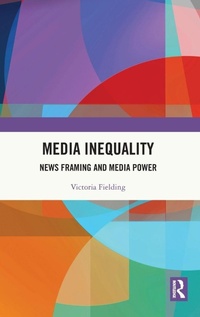
Media Inequality
News Framing and Media Power
1st Edition
Published on 4. September 2024
Book
Hardback
250 pages
978-1-032-65954-1 (ISBN)
Description
News media notionally underpins a vibrant and diverse democracy by representing political, industrial and social conflict to mass audiences. Yet, few studies measure how equitably journalists frame public contestation. Despite framing theory's extensive use in media and communication scholarship, little is known about how frames are created and disseminated - how frames are built - to explain how and why journalists frame news the way they do.
Media Inequality proposes that frame building occurs through a two-step process of frame adoption and replication. This two-step frame-building process is explored by identifying the newspaper master narratives used in five historical industrial dispute case studies. These master narratives are then mapped to public narratives used by unionised firefighters and their employer in the Australian case of the 2016 Victorian Country Fire Authority industrial dispute. By theorising about the causes of journalists' inequitable framing of contested narratives, Media Inequality tells the story of unconscious structural media bias, interrogates the power of news media to reinforce dominant frames, offers valuable theoretical perspectives about the influence of media power on the accumulation of power in society, and provides lessons for groups communicating in competitive contexts.
Media Inequality is thus valuable to scholars, academics and research students in the fields of journalism, communication, and media, particularly scholars interested in how journalists represent political, industrial, and social contestation.
Media Inequality proposes that frame building occurs through a two-step process of frame adoption and replication. This two-step frame-building process is explored by identifying the newspaper master narratives used in five historical industrial dispute case studies. These master narratives are then mapped to public narratives used by unionised firefighters and their employer in the Australian case of the 2016 Victorian Country Fire Authority industrial dispute. By theorising about the causes of journalists' inequitable framing of contested narratives, Media Inequality tells the story of unconscious structural media bias, interrogates the power of news media to reinforce dominant frames, offers valuable theoretical perspectives about the influence of media power on the accumulation of power in society, and provides lessons for groups communicating in competitive contexts.
Media Inequality is thus valuable to scholars, academics and research students in the fields of journalism, communication, and media, particularly scholars interested in how journalists represent political, industrial, and social contestation.
More details
Series
Language
English
Place of publication
London
United Kingdom
Publishing group
Taylor & Francis Ltd
Target group
Professional and scholarly
Professional Reference
Illustrations
37 s/w Abbildungen, 37 s/w Photographien bzw. Rasterbilder, 17 s/w Tabellen
17 Tables, black and white; 37 Halftones, black and white; 37 Illustrations, black and white
Dimensions
Height: 240 mm
Width: 161 mm
Thickness: 19 mm
Weight
561 gr
ISBN-13
978-1-032-65954-1 (9781032659541)
Copyright in bibliographic data and cover images is held by Nielsen Book Services Limited or by the publishers or by their respective licensors: all rights reserved.
Schweitzer Classification
Other editions
Additional editions
Book
05/2026
1st Edition
Routledge
€57.00
Shipment within 10-20 days
E-Book
09/2024
1st Edition
Routledge
€60.49
Available for download
E-Book
09/2024
1st Edition
Routledge
€60.49
Available for download
Person
Victoria Fielding researches the influence of contested public narratives on media narratives and the influence of journalism on democracy. Dr Fielding is a lecturer in Strategic Communication at the University of Adelaide, South Australia. She has also worked in professional marketing and communications for 18 years. Dr Fielding has a Bachelor of Commerce (Marketing and Management) from the University of Adelaide, a First Class Honours degree in Arts (Communication and Media) and a PhD from the University of South Australia.
Content
1. Introduction - industrial relations and the media marketplace of ideas Chapter 2. Introducing narrative frame building 3. Historical industrial disputes: master narratives of empathy and authority 4. An authority story: the 2016 Country Fire Authority dispute 5. Step one of media inequality in frame building: frame adoption 6. Step two of media inequality in frame building: frame replication 7. Media inequality - Frame building bias and media power