

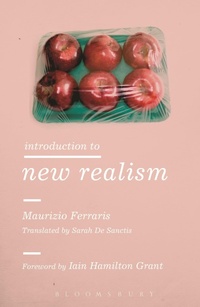
Introduction to New Realism
Published on 18. December 2014
Book
Paperback/Softback
168 pages
978-1-4725-9594-2 (ISBN)
Description
Introduction to New Realism provides an overview of the movement of contemporary thought named New Realism, by its creator and most celebrated practitioner, Maurizio Ferraris. Sharing significant concerns and features with Speculative Realism and Object Oriented Ontology, New Realism can be said to be one of the most prescient philosophical positions today. Its desire to overcome the postmodern antirealism of Kantian origin, and to reassert the importance of truth and objectivity in the name of a new Enlightenment, has had an enormous resonance both in Europe and in the US. Introduction to New Realism is the first volume dedicated to exposing this continental movement to an anglophone audience.
Featuring a foreword by the eminent contemporary philosopher and leading exponent of Speculative Realism, Iain Hamilton Grant, the book begins by tracing the genesis of New Realism, and outlining its central theoretical tenets, before opening onto three distinct sections. The first, 'Negativity', is a critique of the postmodern idea that the world is constructed by our conceptual schemas, all the more so as we have entered the age of digitality and virtuality. The second thesis, 'positivity', proposes the fundamental ontological assertion of New Realism, namely that not only are there parts of reality that are independent of thought, but these parts are also able to act causally over thought and the human world. The third thesis, 'normativity,' applies New Realism to the sphere of the social world. Finally, an afterword written by two young scholars explains in more detail the relationship between New Realism and other forms of contemporary realism.
Featuring a foreword by the eminent contemporary philosopher and leading exponent of Speculative Realism, Iain Hamilton Grant, the book begins by tracing the genesis of New Realism, and outlining its central theoretical tenets, before opening onto three distinct sections. The first, 'Negativity', is a critique of the postmodern idea that the world is constructed by our conceptual schemas, all the more so as we have entered the age of digitality and virtuality. The second thesis, 'positivity', proposes the fundamental ontological assertion of New Realism, namely that not only are there parts of reality that are independent of thought, but these parts are also able to act causally over thought and the human world. The third thesis, 'normativity,' applies New Realism to the sphere of the social world. Finally, an afterword written by two young scholars explains in more detail the relationship between New Realism and other forms of contemporary realism.
Reviews / Votes
This is a philosophy which is adequate to dealing with the push and pressure of the cosmos. In returning to perception on its own ontological terms, it opens up a philosophy that can matter to us. * Philosophy Now * The book will be indispensable to anyone seeking to understand this relatively unknown, continental realist philosopher, to the speculative realist community with whom Ferraris' thinking has many affinities, and of strong interest to those curious about the realist turn in continental philosophy in general ... This is the ideal text for new readers of the realist turn. * Review 31 *More details
Language
English
Place of publication
London
United Kingdom
Publishing group
Bloomsbury Publishing PLC
Target group
College/higher education
Dimensions
Height: 198 mm
Width: 129 mm
Thickness: 9 mm
Weight
186 gr
ISBN-13
978-1-4725-9594-2 (9781472595942)
Copyright in bibliographic data and cover images is held by Nielsen Book Services Limited or by the publishers or by their respective licensors: all rights reserved.
Schweitzer Classification
Other editions
Additional editions

Maurizio Ferraris
Introduction to New Realism
E-Book
12/2014
1st Edition
Bloomsbury Academic
€28.49
Available for download

Maurizio Ferraris
Introduction to New Realism
E-Book
12/2014
1st Edition
Bloomsbury Academic
€28.49
Available for download
Person
Maurizio Ferraris is a Professor of Philosophy at the University of Turin, Italy where he is also the Director of the LabOnt (Laboratory for Ontology).
Content
Foreword, by Iain Hamilton Grant.
Introduction
Part 1: Negativity
Part 2: Positivity
Part 3: Normativity
Afterword
Bibliography
Index
Introduction
Part 1: Negativity
Part 2: Positivity
Part 3: Normativity
Afterword
Bibliography
Index