

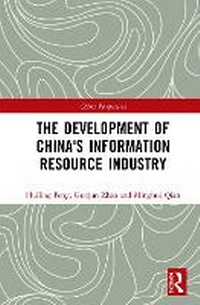
The Development of China's Information Resource Industry
1st Edition
Published on 13. December 2021
Book
392 pages
978-1-032-17278-1 (ISBN)
Description
The industrialization of information resources has been a growing trend across the world in recent years, especially in China, where the information resource industry (IRI) has expanded exponentially for over more than a decade.
While analysing the development conditions of China's IRI, this two-volume set clearly defines the implications and strategic value of the industry, summarizes basic IRI theories, and clarifies the history of its development and special regional characteristics within the Chinese context. Drawing on the statistics and measurement of various economic indicators of IRI, the authors propose four stages of development: a germination period; an initial development period; a subsequent rapid development period; and lastly, a steady development period.
At the same time, the set draws upon various theoretical models such as the "Dynamic Resource Triangle" model, the "Information Resource Industrial Symbiosis" model, the value chain model and the explanation model of information consumption in order to shed light on IRI's elements and the optimization of its management. In addition, the authors present the Information Resource Industry Development Index (IRIDI) to evaluate IRI's development in different provinces and cities across Mainland China and monitor its dynamics from the point of view of industrial value and the external environment.
While the set lays a solid theoretical foundation for the growth of China's IRI, it will also give international readers a clear picture of China's emerging industries in the current era.
As an emerging strategic industry in China, the information resource industry (IRI) has had and will continue to have a growing impact on economic and social development. Focusing on the special characteristics of IRI policies in China, this set provides an in-depth discussion of the major directions, methods, and paths of development for IRI policies via a comprehensive analysis of the structural, organizational, promotional policies and policy instruments of China's IRI.
Concentrating on policy instruments, the set, for the first time, provides a systematic, all-rounded review of China's IRI policies that have been released to date, and proposes a "China Information Resource Industry Policy Library" comprising six types of IRI policy documents: organizational, information, regulatory, incentives, market, and social. The whole contributes to a comprehensive understanding of the application of various IRI policies in China, and also supports the decision making behind and building of industrial policies.
While analysing the development conditions of China's IRI, this two-volume set clearly defines the implications and strategic value of the industry, summarizes basic IRI theories, and clarifies the history of its development and special regional characteristics within the Chinese context. Drawing on the statistics and measurement of various economic indicators of IRI, the authors propose four stages of development: a germination period; an initial development period; a subsequent rapid development period; and lastly, a steady development period.
At the same time, the set draws upon various theoretical models such as the "Dynamic Resource Triangle" model, the "Information Resource Industrial Symbiosis" model, the value chain model and the explanation model of information consumption in order to shed light on IRI's elements and the optimization of its management. In addition, the authors present the Information Resource Industry Development Index (IRIDI) to evaluate IRI's development in different provinces and cities across Mainland China and monitor its dynamics from the point of view of industrial value and the external environment.
While the set lays a solid theoretical foundation for the growth of China's IRI, it will also give international readers a clear picture of China's emerging industries in the current era.
As an emerging strategic industry in China, the information resource industry (IRI) has had and will continue to have a growing impact on economic and social development. Focusing on the special characteristics of IRI policies in China, this set provides an in-depth discussion of the major directions, methods, and paths of development for IRI policies via a comprehensive analysis of the structural, organizational, promotional policies and policy instruments of China's IRI.
Concentrating on policy instruments, the set, for the first time, provides a systematic, all-rounded review of China's IRI policies that have been released to date, and proposes a "China Information Resource Industry Policy Library" comprising six types of IRI policy documents: organizational, information, regulatory, incentives, market, and social. The whole contributes to a comprehensive understanding of the application of various IRI policies in China, and also supports the decision making behind and building of industrial policies.
More details
Series
Language
English
Place of publication
London
United Kingdom
Publishing group
Taylor & Francis Ltd
Target group
College/higher education
Illustrations
46 s/w Abbildungen
46 Illustrations, black and white
Dimensions
Height: 234 mm
Width: 156 mm
Weight
370 gr
ISBN-13
978-1-032-17278-1 (9781032172781)
Copyright in bibliographic data and cover images is held by Nielsen Book Services Limited or by the publishers or by their respective licensors: all rights reserved.
Schweitzer Classification
Other editions
Additional editions
Huiling Feng | Guojun Zhao | Minghui Qian
The Development of China's Information Resource Industry
E-Book
09/2021
1st Edition
Routledge
€119.99
Available for download
Huiling Feng | Guojun Zhao | Minghui Qian
The Development of China's Information Resource Industry
Book
03/2020
1st Edition
Routledge
€359.61
Shipment within 15-20 days
Persons
Ms. Feng Huiling, a professor of School of Information Resource Management at Renmin University of China, specialized in information resource management, archival science, electronic document management, digital memory.
Zhao Guojun, the Professor of School of Information Resource Management at Renmin University of China, specialized in e-government affairs and IRI policies.
Qian Minghui, the Associate Professor of School of Information Resource Management at Renmin University of China, specialized in information resource industry and management.
Zhao Guojun, the Professor of School of Information Resource Management at Renmin University of China, specialized in e-government affairs and IRI policies.
Qian Minghui, the Associate Professor of School of Information Resource Management at Renmin University of China, specialized in information resource industry and management.
Content
List of figures. List of tables. Foreword I. Foreword II. Preface Chapter I Information Resource Industry and Its Strategic Value Chapter II Basic Theories on Development of Information Resource Industry Chapter III Development Trajectory of China's Information Resource Industry Chapter IV Supply-Demand Relation of China's Information Resource Industry Chapter V Structure Features of China's Information Resource Industry Chapter VI Regional Features of China's Information Resource Industry Chapter VII Evaluation on the Development of China's Information Resource Industry Afterword. References. Index
List of figures. List of tables. Preface Chapter I Introduction to Chinese Policies for Information Resource Industry Chapter II System of Integration Among Diverse Chinese Policies for Information Resource Industry Chapter III China's Structural Policies for Information Resource Industry Chapter IV China's Organizational Policies for Information Resource Industry Chapter V China's Promotional Policies for Information Resource Industry Chapter VI Application of Policy Instruments for Information Resource Industry Afterword. References. Index
List of figures. List of tables. Preface Chapter I Introduction to Chinese Policies for Information Resource Industry Chapter II System of Integration Among Diverse Chinese Policies for Information Resource Industry Chapter III China's Structural Policies for Information Resource Industry Chapter IV China's Organizational Policies for Information Resource Industry Chapter V China's Promotional Policies for Information Resource Industry Chapter VI Application of Policy Instruments for Information Resource Industry Afterword. References. Index