

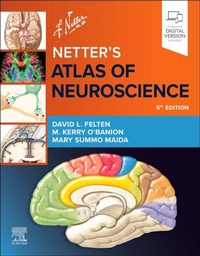
Netter's Atlas of Neuroscience
5th Edition
Will be published approx. on 1. December 2026
Book
Paperback/Softback
560 pages
978-0-443-38053-2 (ISBN)
Description
Delivering the essential information students need for both basic science and clinical programs in an exquisitely illustrated text, Netter's Atlas of Neuroscience, 5th Edition, is an ideal resource for any student of neuroanatomy, neuroscience, or other medical or science disciplines involving the nervous system. From neurons to motor and sensory systems to global neural function and dysfunction, this award-winning text approaches this complex topic from multiple perspectives. Illustrations by Frank H. Netter, MD, and others following in his tradition are framed by concise, expert text and accompanied by neuroimaging, photomicrographs, summary diagrams, and clinical correlations.
Presents organizational and summarized neurosciences information, enabling readers to review complex concepts, functions, and systems in several contexts
Offers a new understanding of the circuitry of the cortex, cerebellum, and basal ganglion, as well as additional clinical coverage of seizures, cerebral palsy, meningitis, vertigo, and more
Includes new artwork covering primary afferents, neuropeptides, and small molecule messengers; neurotransmitter-related circuitry through the basal ganglia; autism spectrum disorder; ADHD, and more
Provides an overview of the basic features of cellular and molecular neuroscience; peripheral nerves, spinal cord, brain stem and cerebellum, and the brain; reviews the neural vasculature, meninges and cerebrospinal fluid, and developmental neuroscience
Focuses on foundational concepts as well as clinically relevant discussions
Digital access includes labeled brain stem sections and a dozen videos
An eBook version is included with purchase. The eBook allows you to access all of the text and figures, with the ability to search, make notes and highlights, and have content read aloud
Evolve Instructor site with test bank and image bank (with and without labels) is available to instructors through their Elsevier sales rep or via request at https://evolve.elsevier.com
Presents organizational and summarized neurosciences information, enabling readers to review complex concepts, functions, and systems in several contexts
Offers a new understanding of the circuitry of the cortex, cerebellum, and basal ganglion, as well as additional clinical coverage of seizures, cerebral palsy, meningitis, vertigo, and more
Includes new artwork covering primary afferents, neuropeptides, and small molecule messengers; neurotransmitter-related circuitry through the basal ganglia; autism spectrum disorder; ADHD, and more
Provides an overview of the basic features of cellular and molecular neuroscience; peripheral nerves, spinal cord, brain stem and cerebellum, and the brain; reviews the neural vasculature, meninges and cerebrospinal fluid, and developmental neuroscience
Focuses on foundational concepts as well as clinically relevant discussions
Digital access includes labeled brain stem sections and a dozen videos
An eBook version is included with purchase. The eBook allows you to access all of the text and figures, with the ability to search, make notes and highlights, and have content read aloud
Evolve Instructor site with test bank and image bank (with and without labels) is available to instructors through their Elsevier sales rep or via request at https://evolve.elsevier.com
More details
Series
Edition
5th edition
Language
English
Place of publication
London
United Kingdom
Publishing group
Elsevier Health Sciences
Target group
College/higher education
Product notice
Paperback (trade)
Unsewn / adhesive bound
Illustrations
Approx. 480 illustrations (480 in full color); Illustrations
Dimensions
Height: 276 mm
Width: 216 mm
ISBN-13
978-0-443-38053-2 (9780443380532)
Copyright in bibliographic data and cover images is held by Nielsen Book Services Limited or by the publishers or by their respective licensors: all rights reserved.
Schweitzer Classification
Other editions
Previous edition
David L. Felten | Michael K. O'Banion | Mary Summo Maida
Netter's Atlas of Neuroscience
Book
09/2021
4th Edition
Elsevier
€68.50
Shipment within 10-15 days
Persons
DAVID L. FELTEN, MD, PhD, is Assoc. Dean of Clinical Sciences and Prof. Neurosciences at UMHS. He's former VP for Research and Medical Director of Research at William Beaumont Health System and Founding Associate Dean for their School of Medicine. He previously served as Dean of Grad Med Ed at Seton Hall; Founding Executive Director of the Susan Samueli Center for Integrative Medicine and Prof of Anatomy and Neurobiology at UC Irvine; Founding Director of the Center for Neuroimmunology at Loma Linda School of Medicine; and the Kilian J. and Caroline F. Schmitt Professor and Chair of Department of Neurobiology, and Director of Markey Charitable Trust Institute for Neurobiology and Neurodegenerative Diseases and Aging at U of Rochester. His pioneering studies of autonomic innervation of lymphoid organs and neural-immune signaling underling psychoneuroimmunology has been featured on Bill Moyer's, "Healing and the Mind,? "20/20,? and many other media venues. He served for over a decade on NBME, including Chair of the Neurosciences Committee for the USMLE.
Author
Distinguished Scholar in Residence, Division of Applied Health and Wellness, Keuka College, Keuka Park, New York, USA
Professor and Interim Chair, Department of Neurobiology and Anatomy, Director of the Medical Scientist Training Program, University of Rochester School of Medicine, Rochester, New York, USA
Adjunct Professor of Neurobiology and Anatomy, University of Rochester School of Medicine, Rochester, New York, USA
Content
1. Neurons and Their Properties
2. Skull and Meninges
3. Brain
4. Brainstem and Cerebellum
5. Spinal Cord
6. Ventricles and the Cerebrospinal Fluid
7. Vasculature
8. Developmental Neuroscience
9. Peripheral Nervous System
10. Spinal Cord
11. Brainstem and Cerebellum
12. Diencephalon
13. Telencephalon
14. Sensory Systems
15. Motor Systems
16. Autonomic-Hypothalamic-Limbic systems
17. Global Brain Functions
2. Skull and Meninges
3. Brain
4. Brainstem and Cerebellum
5. Spinal Cord
6. Ventricles and the Cerebrospinal Fluid
7. Vasculature
8. Developmental Neuroscience
9. Peripheral Nervous System
10. Spinal Cord
11. Brainstem and Cerebellum
12. Diencephalon
13. Telencephalon
14. Sensory Systems
15. Motor Systems
16. Autonomic-Hypothalamic-Limbic systems
17. Global Brain Functions