

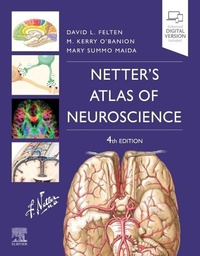
Netter's Atlas of Neuroscience
4th Edition
Published on 24. September 2021
Book
Paperback/Softback
536 pages
978-0-323-75654-9 (ISBN)
Description
Ideal for any student of neuroanatomy, neuroscience, or other medical or science disciplines involving the nervous system, Netter's Atlas of Neuroscience, 4th Edition, is a highly visual, clinically oriented exploration of structure and function-from neurons to motor and sensory systems to global neural function and dysfunction. This award-winning text approaches this complex topic from three perspectives: Neuroscience Overview, Regional Neuroscience, and Systemic Neuroscience. Illustrations by Frank H. Netter, MD, and others following in his tradition are framed by concise, expert text and accompanied by neuroimaging, photomicrographs, and summary diagrams.
Combines Netter and Netter-like illustrations, and beautiful molecular and cellular illustrations, with succinct text and clinical points, delivering the essential information students need for both basic science and clinical programs.
Presents organizational and summarized neurosciences information, enabling students to review complex concepts, functions, and systems in several contexts.
Provides an overview of the basic features of cellular and molecular neuroscience; peripheral nerves, spinal cord, brain stem and cerebellum, and the brain; reviews the neural vasculature, meninges and cerebrospinal fluid, and developmental neuroscience.
Highlights cross-sectional spinal cord and brain stem anatomy and side-by-side comparisons of Netter illustrations and MRIs of axial and coronal brain sections, including extensive clinical correlations.
Focuses on foundational concepts as well as clinically relevant discussions.
Expands basic neural connectivity and functional roles of limbic structures and behavior.
Reviews Global Neural Functions and Disorders in a brand new chapter with more than a dozen new art plates.
Includes many new art plates covering current topics including neural foundations of addiction, dementias, several neuropsychiatric disorders, consciousness, coma and its assessment, sleep regulation, postnatal and adult neurogenesis, endogenous opioid systems, endogenous cannabinoid systems, and others.
Enhanced eBook version included with purchase. Your enhanced eBook allows you to access all of the text, figures, and references from the book on a variety of devices.
Combines Netter and Netter-like illustrations, and beautiful molecular and cellular illustrations, with succinct text and clinical points, delivering the essential information students need for both basic science and clinical programs.
Presents organizational and summarized neurosciences information, enabling students to review complex concepts, functions, and systems in several contexts.
Provides an overview of the basic features of cellular and molecular neuroscience; peripheral nerves, spinal cord, brain stem and cerebellum, and the brain; reviews the neural vasculature, meninges and cerebrospinal fluid, and developmental neuroscience.
Highlights cross-sectional spinal cord and brain stem anatomy and side-by-side comparisons of Netter illustrations and MRIs of axial and coronal brain sections, including extensive clinical correlations.
Focuses on foundational concepts as well as clinically relevant discussions.
Expands basic neural connectivity and functional roles of limbic structures and behavior.
Reviews Global Neural Functions and Disorders in a brand new chapter with more than a dozen new art plates.
Includes many new art plates covering current topics including neural foundations of addiction, dementias, several neuropsychiatric disorders, consciousness, coma and its assessment, sleep regulation, postnatal and adult neurogenesis, endogenous opioid systems, endogenous cannabinoid systems, and others.
Enhanced eBook version included with purchase. Your enhanced eBook allows you to access all of the text, figures, and references from the book on a variety of devices.
More details
Series
Edition
4th edition
Language
English
Place of publication
Philadelphia
United States
Target group
College/higher education
Illustrations
461 illustrations (461 in full color); Illustrations
Dimensions
Height: 273 mm
Width: 215 mm
Thickness: 22 mm
Weight
1542 gr
ISBN-13
978-0-323-75654-9 (9780323756549)
Copyright in bibliographic data and cover images is held by Nielsen Book Services Limited or by the publishers or by their respective licensors: all rights reserved.
Schweitzer Classification
Other editions
New editions

David L. Felten | Michael K. O'Banion | Mary Summo Maida
Netter's Atlas of Neuroscience
Book
approx. 12/2026
5th Edition
Churchill Livingstone
€67.00
Not yet published
Additional editions
MD Felten | Ph. D. O'Banion M. D. | Mary Summo Maida Ph. D.
Netter's Atlas of Neuroscience E-Book
Netter's Atlas of Neuroscience E-Book
E-Book
08/2021
4th Edition
Elsevier
€48.99
Available for download
Previous edition
David L. Felten | Michael K. O'Banion | Mary Summo Maida
Netter's Atlas of Neuroscience
Book
11/2015
3rd Edition
Elsevier
€53.22
Article exhausted; check for reprint
Persons
DAVID L. FELTEN, MD, PhD, is Assoc. Dean of Clinical Sciences and Prof. Neurosciences at UMHS. He's former VP for Research and Medical Director of Research at William Beaumont Health System and Founding Associate Dean for their School of Medicine. He previously served as Dean of Grad Med Ed at Seton Hall; Founding Executive Director of the Susan Samueli Center for Integrative Medicine and Prof of Anatomy and Neurobiology at UC Irvine; Founding Director of the Center for Neuroimmunology at Loma Linda School of Medicine; and the Kilian J. and Caroline F. Schmitt Professor and Chair of Department of Neurobiology, and Director of Markey Charitable Trust Institute for Neurobiology and Neurodegenerative Diseases and Aging at U of Rochester. His pioneering studies of autonomic innervation of lymphoid organs and neural-immune signaling underling psychoneuroimmunology has been featured on Bill Moyer's, "Healing and the Mind,? "20/20,? and many other media venues. He served for over a decade on NBME, including Chair of the Neurosciences Committee for the USMLE.
Author
Distinguished Scholar in Residence, Division of Applied Health and Wellness, Keuka College, Keuka Park, New York, USA
Professor and Interim Chair, Department of Neurobiology and Anatomy, Director of the Medical Scientist Training Program, University of Rochester School of Medicine, Rochester, New York, USA
Adjunct Professor of Neurobiology and Anatomy, University of Rochester School of Medicine, Rochester, New York, USA
Content
Blue is new
Section I Overview of the Nervous System
Neurons and Their Properties
Anatomical and Molecular Properties
Neuronal Ultrastructure
Molecular Techniques for Studying Neurons
Genetic Models for Studying Neurological Diseases
Electrical Properties
Neurotransmitter and Signaling Properties
Endogenous Opioid Systems
Cannabinoid Systems
Neuropeptide Neurotransmitters
Amino Acid Neurotransmitters
Skull and Meninges
Brain
Brain Stem and Cerebellum
Spinal Cord
Ventricles and the Cerebrospinal Fluid
Vasculature
Arterial System
Venous System
Developmental Neuroscience
Postnatal and Adult Neurogenesis
Sex Steroid Influences on Brain Development
Maternal and Neonatal Stress Influences on the Developing Nervous System
Fetal Alcohol Syndrome
Section II Regional Neuroscience
Peripheral Nervous System
Introduction and Basic Organization
Somatic Nervous System
Somatosensory System Nuclear Neuronal Organization
Autonomic Nervous System
Spinal Cord
Spinal Cord Cross-Section Cytoarchitecture
Columnar Organization and Neural Sheet Structure in Spinal Cord
Spinal Cord LMN Organization of Inputs and Local Connections
Brain Stem and Cerebellum
Brain Stem Cross-Sectional Anatomy
Lateral View of Whole Brain and Brain Stem
Cerebral Cortex Nissl-Stained Histological Sections
Periaqueductal Gray
Cranial Nerves and Cranial Nerve Nuclei
Reticular Formation
Raphe Nuclei and Locus Coeruleus
Dendrite Bundles and their Functional Role
Cerebellum
Diencephalon
Telencephalon
Section III Systemic Neuroscience
Sensory Systems
Somatosensory Systems
Trigeminal Sensory System
Sensory System for Taste
Auditory System
Vestibular System
Visual System
Motor Systems
Lower Motor Neurons
Upper Motor Neurons
Cerebellum
Basal Ganglia
Autonomic-Hypothalamic-Limbic Systems
Autonomic Nervous System
Hypothalamus and Pituitary
Anterior Pituitary Hormone and Target Feedback
Hypothalamus: Afferent and Efferent Pathways
Estrogen and Androgen Effects on Behavior
Glucocorticoid Effects in the Periphery and Central Consequences
Catecholamine Effects in the Periphery and Central Consequences
Oxytocin and Vasopressin Effects on Behavior
Limbic System
Olfactory System
Orbitofronal Cortex
Prefrontal Cortex
Amygdala and Behavior
Ventral Tegmental Area and Mesolimbic and Mesocortical Systems
Nucleus Accumbens
Bed Nucleus of the Stria Terminalis
Insular Cortex
Nucleus Basalis of Meynert
Circumventricular Organs
Section IV Global Brain Functions
Dementias
Alzheimer's Disease and Its Mechanisms
Neuropsychiatric Disorders
Schizophrenia
Unipolar and Bipolar Depression
Panic and Anxiety Disorders
Post-Traumati Stress (PTSD)
Tramatic Brain Injury (TBI)
Brain Substrates and Addictive Behaviors
Opioid Addiction and Abuse
Aging and the Nervous System
Memory and Concentration
Consciousness
Focus and Attention
Coma
Music and the Brain
Section I Overview of the Nervous System
Neurons and Their Properties
Anatomical and Molecular Properties
Neuronal Ultrastructure
Molecular Techniques for Studying Neurons
Genetic Models for Studying Neurological Diseases
Electrical Properties
Neurotransmitter and Signaling Properties
Endogenous Opioid Systems
Cannabinoid Systems
Neuropeptide Neurotransmitters
Amino Acid Neurotransmitters
Skull and Meninges
Brain
Brain Stem and Cerebellum
Spinal Cord
Ventricles and the Cerebrospinal Fluid
Vasculature
Arterial System
Venous System
Developmental Neuroscience
Postnatal and Adult Neurogenesis
Sex Steroid Influences on Brain Development
Maternal and Neonatal Stress Influences on the Developing Nervous System
Fetal Alcohol Syndrome
Section II Regional Neuroscience
Peripheral Nervous System
Introduction and Basic Organization
Somatic Nervous System
Somatosensory System Nuclear Neuronal Organization
Autonomic Nervous System
Spinal Cord
Spinal Cord Cross-Section Cytoarchitecture
Columnar Organization and Neural Sheet Structure in Spinal Cord
Spinal Cord LMN Organization of Inputs and Local Connections
Brain Stem and Cerebellum
Brain Stem Cross-Sectional Anatomy
Lateral View of Whole Brain and Brain Stem
Cerebral Cortex Nissl-Stained Histological Sections
Periaqueductal Gray
Cranial Nerves and Cranial Nerve Nuclei
Reticular Formation
Raphe Nuclei and Locus Coeruleus
Dendrite Bundles and their Functional Role
Cerebellum
Diencephalon
Telencephalon
Section III Systemic Neuroscience
Sensory Systems
Somatosensory Systems
Trigeminal Sensory System
Sensory System for Taste
Auditory System
Vestibular System
Visual System
Motor Systems
Lower Motor Neurons
Upper Motor Neurons
Cerebellum
Basal Ganglia
Autonomic-Hypothalamic-Limbic Systems
Autonomic Nervous System
Hypothalamus and Pituitary
Anterior Pituitary Hormone and Target Feedback
Hypothalamus: Afferent and Efferent Pathways
Estrogen and Androgen Effects on Behavior
Glucocorticoid Effects in the Periphery and Central Consequences
Catecholamine Effects in the Periphery and Central Consequences
Oxytocin and Vasopressin Effects on Behavior
Limbic System
Olfactory System
Orbitofronal Cortex
Prefrontal Cortex
Amygdala and Behavior
Ventral Tegmental Area and Mesolimbic and Mesocortical Systems
Nucleus Accumbens
Bed Nucleus of the Stria Terminalis
Insular Cortex
Nucleus Basalis of Meynert
Circumventricular Organs
Section IV Global Brain Functions
Dementias
Alzheimer's Disease and Its Mechanisms
Neuropsychiatric Disorders
Schizophrenia
Unipolar and Bipolar Depression
Panic and Anxiety Disorders
Post-Traumati Stress (PTSD)
Tramatic Brain Injury (TBI)
Brain Substrates and Addictive Behaviors
Opioid Addiction and Abuse
Aging and the Nervous System
Memory and Concentration
Consciousness
Focus and Attention
Coma
Music and the Brain