

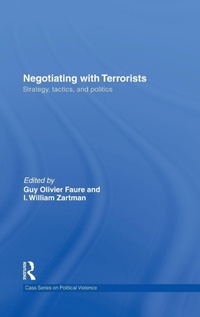
Negotiating with Terrorists
Strategy, Tactics, and Politics
1st Edition
Published on 1. February 2010
Book
Hardback
252 pages
978-0-415-56629-2 (ISBN)
Description
This edited volume addresses the important issue of negotiating with terrorists, and offers recommendations for best practice and processes.
Hostage negotiation is the process of trying to align two often completely polarised parties. Authorities view hostage taking as unacceptable demands made by unacceptable means. However terrorists view their actions as completely justified, even on moral and religious grounds. If they are to try and reconcile these two sides, it is essential for hostage negotiators to understand terrorist culture, the hostage takers' profiles, their personality, their view of the world and also the authorities, their values and their framing of the problem raised by the taking of hostages.
Although not advocating negotiating with terrorists, the volume seeks to analyse when, why, and how it is done. Part I deals with the theory and quantifiable data produced from analysis of hostage situations, while Part II explores several high profile case studies and the lessons that can be learnt from them.
This volume will be of great interest to students of terrorism studies, conflict management, negotiation, security studies and IR in general.
I William Zartman is the Jacob Blaustein Distinguished Professor Emeritus of International Organization and Conflict Resolution and former Director of the Conflict Management and African Studies Programs, at the Paul H. Nitze School of Advanced International Studies, Johns Hopkins University, Washington, DC. He is a member of the Steering Committee of the Processes of International Negotiation (PIN) Program at the International Institute of Applied Systems Analysis (IIASA) in Laxenburg, Austria. He is author/editor of over 20 books on negotiation, conflict and mediation.
Guy Olivier Faure is Professor of Sociology at the Sorbonne University, Paris I, and a member of the Steering Committee of the Processes of International Negotiation (PIN) Program at the International Institute of Applied Systems Analysis (IIASA) in Laxenburg, Austria. He has served as an advisor to French government on hostage negotiations.
Hostage negotiation is the process of trying to align two often completely polarised parties. Authorities view hostage taking as unacceptable demands made by unacceptable means. However terrorists view their actions as completely justified, even on moral and religious grounds. If they are to try and reconcile these two sides, it is essential for hostage negotiators to understand terrorist culture, the hostage takers' profiles, their personality, their view of the world and also the authorities, their values and their framing of the problem raised by the taking of hostages.
Although not advocating negotiating with terrorists, the volume seeks to analyse when, why, and how it is done. Part I deals with the theory and quantifiable data produced from analysis of hostage situations, while Part II explores several high profile case studies and the lessons that can be learnt from them.
This volume will be of great interest to students of terrorism studies, conflict management, negotiation, security studies and IR in general.
I William Zartman is the Jacob Blaustein Distinguished Professor Emeritus of International Organization and Conflict Resolution and former Director of the Conflict Management and African Studies Programs, at the Paul H. Nitze School of Advanced International Studies, Johns Hopkins University, Washington, DC. He is a member of the Steering Committee of the Processes of International Negotiation (PIN) Program at the International Institute of Applied Systems Analysis (IIASA) in Laxenburg, Austria. He is author/editor of over 20 books on negotiation, conflict and mediation.
Guy Olivier Faure is Professor of Sociology at the Sorbonne University, Paris I, and a member of the Steering Committee of the Processes of International Negotiation (PIN) Program at the International Institute of Applied Systems Analysis (IIASA) in Laxenburg, Austria. He has served as an advisor to French government on hostage negotiations.
Reviews / Votes
"An important collection of papers analyzing when, why, and how governments and NGOs can negotiate with terrorist groups, including recommendations for best practice in negotiation processes." - Joshua Sinai, 'Terrorism Bookshelf: Top 150 Books on Terrorism and Counterterrorism', Perspectives on Terrorism, Vol. 6, No. 2 (2012)More details
Series
Language
English
Place of publication
London
United Kingdom
Publishing group
Taylor & Francis Ltd
Target group
College/higher education
Professional and scholarly
Product notice
Paper over boards
Illustrations
3 s/w Zeichnungen, 35 s/w Tabellen
35 Tables, black and white; 3 Line drawings, black and white
Dimensions
Height: 240 mm
Width: 161 mm
Thickness: 18 mm
Weight
546 gr
ISBN-13
978-0-415-56629-2 (9780415566292)
Copyright in bibliographic data and cover images is held by Nielsen Book Services Limited or by the publishers or by their respective licensors: all rights reserved.
Schweitzer Classification
Other editions
Additional editions
Book
06/2011
1st Edition
Routledge
€71.90
Shipment within 15-20 days
E-Book
02/2010
1st Edition
Routledge
€64.49
Available for download
E-Book
02/2010
1st Edition
Routledge
€64.49
Available for download
Persons
Guy Olivier Faure is Professor of Sociology at the Sorbonne University, Paris V, and a member of the Steering Committee of the Processes of International Negotiation (PIN) Program at the International Institute of Applied Systems Analysis (IIASA) in Laxenburg, Austria. He has served as an advisor on hostage negotiations. He has authored and co-authored fifteen books on negotiation and conflict resolution. His works have been translated into twelve languages.
I. William Zartman is the Jacob Blaustein Distinguished Professor Emeritus of International Organization and Conflict Resolution and former Director of the Conflict Management and African Studies Programs, at the Paul H. Nitze School of Advanced International Studies, Johns Hopkins University, Washington, DC. He is a member of the Steering Committee of the Processes of International Negotiation (PIN) Program at the International Institute of Applied Systems Analysis (IIASA) in Laxenburg, Austria. He is author or editor of over twenty books on negotiation, conflict, and mediation.
I. William Zartman is the Jacob Blaustein Distinguished Professor Emeritus of International Organization and Conflict Resolution and former Director of the Conflict Management and African Studies Programs, at the Paul H. Nitze School of Advanced International Studies, Johns Hopkins University, Washington, DC. He is a member of the Steering Committee of the Processes of International Negotiation (PIN) Program at the International Institute of Applied Systems Analysis (IIASA) in Laxenburg, Austria. He is author or editor of over twenty books on negotiation, conflict, and mediation.
Content
Introduction GO Faure and I. William Zartman Part 1: How to Negotiate: Kidnapping the Kidnappers Introductionto Part 1 1. Guidelines for Negotiators with Terrorists Laurent Combalbert 2. Quantitative and Qualitative Aspects of Kidnapping and Hostage Negotiation Alex Schmid and P. Flemming 3. Talking to the Devil David Pinder Part 2: Practical/Tactical: Freeing the Hostages Introduction to Part 2 4. Terrorist Negotiating Strategy in Lebanon Karen Feste 5. Negotiating in Beslan and Beyond Adam Dolnik 6. Negotiating Visible and Hidden Agendas Victor Kremenyuk 7. Negotiating The Grand Swap in Khandahar P. Sahadevan Part 3: Conclusions 8. Lessons for Practice GO Faure and I. William Zartman. Bibliography