

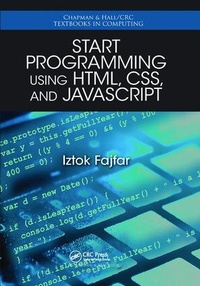
Start Programming Using HTML, CSS, and JavaScript
1st Edition
Published on 2. August 2017
Book
Hardback
468 pages
978-1-138-41290-3 (ISBN)
Description
A Beginner's Guide to Computer Programming
Start Programming Using HTML, CSS, and JavaScript is a manual for undergraduate students in engineering and the natural sciences to discover how computer programming works. Using a dialog format between two students and a professor, the text teaches students how the mainstream web languages HTML, CSS, and JavaScript interact and how to harness their capabilities in practical settings.
Each chapter focuses on a specific theme supported by a gradual development of engaging worked examples of live web documents and applications using the three languages. Students can follow most of the examples and experiments using any modern browser and plain text editor. A practical homework problem is included at the end of every chapter and then is discussed at the beginning of the next chapter. In addition, a related keywords list helps students review key topics.
By focusing on important established principles and concrete examples, this introductory book shows students how to write cleaner and more easily maintainable code. It augments the basic language syntax and rules with contents and structure while keeping the material simple and manageable.
Start Programming Using HTML, CSS, and JavaScript is a manual for undergraduate students in engineering and the natural sciences to discover how computer programming works. Using a dialog format between two students and a professor, the text teaches students how the mainstream web languages HTML, CSS, and JavaScript interact and how to harness their capabilities in practical settings.
Each chapter focuses on a specific theme supported by a gradual development of engaging worked examples of live web documents and applications using the three languages. Students can follow most of the examples and experiments using any modern browser and plain text editor. A practical homework problem is included at the end of every chapter and then is discussed at the beginning of the next chapter. In addition, a related keywords list helps students review key topics.
By focusing on important established principles and concrete examples, this introductory book shows students how to write cleaner and more easily maintainable code. It augments the basic language syntax and rules with contents and structure while keeping the material simple and manageable.
More details
Series
Language
English
Place of publication
London
United Kingdom
Publishing group
Taylor & Francis Ltd
Target group
College/higher education
Dimensions
Height: 254 mm
Width: 178 mm
Weight
1300 gr
ISBN-13
978-1-138-41290-3 (9781138412903)
Copyright in bibliographic data and cover images is held by Nielsen Book Services Limited or by the publishers or by their respective licensors: all rights reserved.
Schweitzer Classification
Other editions
Additional editions
Iztok Fajfar
Start Programming Using HTML, CSS, and JavaScript
E-Book
10/2015
1st Edition
Chapman & Hall/CRC
€138.99
Available for download
Iztok Fajfar
Start Programming Using HTML, CSS, and JavaScript
E-Book
10/2015
1st Edition
Chapman & Hall/CRC
€138.99
Available for download
Iztok Fajfar
Start Programming Using HTML, CSS, and JavaScript
Book
09/2015
1st Edition
Chapman & Hall/CRC
€144.80
Shipment within 15-20 days
Person
Iztok Fajfar is an associate professor in the Faculty of Electrical Engineering at the University of Ljubljana, Slovenia. A programmer and writer, he teaches computer programming at all levels, from assembly to object-oriented. His research topics include evolutionary algorithms, particularly genetic programming. He earned a PhD in electrical engineering from the University of Ljubljana.
Content
Content and Structure. Building a Sound Structure. Presentation. More Control over Style. Understanding CSS Boxes. Behavior. Controlling Program Flow. Introducing Objects. Understanding Arrays and Strings. Understanding Functions. Building Your Own Objects. Using JavaScript to Control the Browser. User Interface. Appendices. Index.