

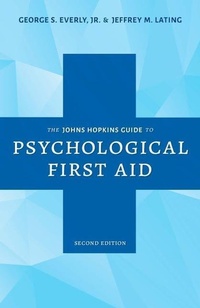
The Johns Hopkins Guide to Psychological First Aid
2nd Edition
Published on 27. September 2022
Book
Paperback/Softback
312 pages
978-1-4214-4399-7 (ISBN)
Description
Learn the essential skills of psychological first aid from the experts-the creators of the Johns Hopkins RAPID PFA method.
Psychological first aid, or PFA, is designed to mitigate the effects of acute stress and trauma and assist those in crisis to cope effectively. PFA can be applied in emergencies, including disasters, terrorist attacks, and the COVID-19 pandemic. In the second edition of this essential guide, George S. Everly, Jr., and Jeffrey M. Lating draw on their experiences in Kuwait after the Gulf War, in New York City after the September 11 attacks, and during the COVID-19 pandemic to describe the principles and practices of PFA in an easy-to-follow, prescriptive, and practical manner. Informed by current events, the second edition includes updated chapters as well as three completely new chapters on
* cultural awareness
* PFA considerations with children
* the use of PFA to facilitate community mental health and resilience
Aimed at mental health practitioners, first responders, and global health disaster teams such as Medecins Sans Frontieres and the World Health Organization, but also beneficial to those with little or no previous mental health training, The Johns Hopkins Guide to Psychological First Aid thoroughly explains RAPID PFA. RAPID, a unique evidence-informed and evidence-based PFA method, follows a set of easily understood principles. In each chapter, Everly and Lating-who have traveled nationally and internationally to teach the RAPID PFA model in numerous public health, fire, police, military, business, and faith-based settings-provide a step-by-step approach and include a key point summary. A unifying case exemplifies each phase of the RAPID PFA model in an ongoing dialogue that presents ideal PFA responses, examples of common mistakes, and various outcomes.
Psychological first aid, or PFA, is designed to mitigate the effects of acute stress and trauma and assist those in crisis to cope effectively. PFA can be applied in emergencies, including disasters, terrorist attacks, and the COVID-19 pandemic. In the second edition of this essential guide, George S. Everly, Jr., and Jeffrey M. Lating draw on their experiences in Kuwait after the Gulf War, in New York City after the September 11 attacks, and during the COVID-19 pandemic to describe the principles and practices of PFA in an easy-to-follow, prescriptive, and practical manner. Informed by current events, the second edition includes updated chapters as well as three completely new chapters on
* cultural awareness
* PFA considerations with children
* the use of PFA to facilitate community mental health and resilience
Aimed at mental health practitioners, first responders, and global health disaster teams such as Medecins Sans Frontieres and the World Health Organization, but also beneficial to those with little or no previous mental health training, The Johns Hopkins Guide to Psychological First Aid thoroughly explains RAPID PFA. RAPID, a unique evidence-informed and evidence-based PFA method, follows a set of easily understood principles. In each chapter, Everly and Lating-who have traveled nationally and internationally to teach the RAPID PFA model in numerous public health, fire, police, military, business, and faith-based settings-provide a step-by-step approach and include a key point summary. A unifying case exemplifies each phase of the RAPID PFA model in an ongoing dialogue that presents ideal PFA responses, examples of common mistakes, and various outcomes.
More details
Edition
second edition
Language
English
Place of publication
Baltimore, MD
United States
Target group
College/higher education
Edition type
Revised edition
Product notice
Paperback (trade)
Illustrations
2 s/w Zeichnungen
2 Line drawings, black and white
Dimensions
Height: 213 mm
Width: 138 mm
Thickness: 21 mm
Weight
438 gr
ISBN-13
978-1-4214-4399-7 (9781421443997)
DOI
10.56021/9781421444000
Copyright in bibliographic data and cover images is held by Nielsen Book Services Limited or by the publishers or by their respective licensors: all rights reserved.
Schweitzer Classification
Other editions
Additional editions
George S. Everly | Jeffrey M. Lating
The Johns Hopkins Guide to Psychological First Aid
E-Book
09/2022
2nd Edition
Johns Hopkins University Press
€25.99
Available for download
Previous edition
George S. Everly | Jeffrey M. Lating
The Johns Hopkins Guide to Psychological First Aid
Book
05/2017
Johns Hopkins University Press
€25.38
Article exhausted; check for reprint
Persons
George S. Everly, Jr. (SEVERNA PARK, MD), is an associate professor of psychiatry and behavioral sciences at Johns Hopkins School of Medicine and an adjunct professor of international health at Johns Hopkins Bloomberg School of Public Health. He is a former member of Johns Hopkins Center for Public Health Preparedness. Jeffrey M. Lating (SPARKS, MD) is a professor of psychology at Loyola University Maryland. Everly and Lating are the coauthors of A Clinical Guide to the Treatment of the Human Stress Response and Personality-Guided Therapy for Posttraumatic Stress Disorder.
Content
Preface: How Did We Get Here?
Acknowledgments
Part I. Psychological First Aid: First, Study the Science
Chapter 1. Psychological First Aid: Definition, History, and Foundational Research
Chapter 2. Structure and Mechanisms of Psychological First Aid
Chapter 3. Psychological Consequences of Trauma: What You Will Encounter in the Field
Chapter 4. In the Wake of Disaster: The Large-Scale Context for PFA
Part II. Psychological First Aid: Practicing the Art
Chapter 5. R-Rapport and Reflective Listening: Establishing a Relationship
Chapter 6. A-Assessment: Listening to the Story
Chapter 7. P-Psychological Triage: Prioritization
Chapter 8. I-Intervention: Tactics to Stabilize and Mitigate Acute Distress
Chapter 9. D-Disposition: Facilitating Access to Continued Care
Part III. Psychological First Aid: Further Considerations
Chapter 10. RAPID PFA Considerations with Children
Chapter 11. Cultural Awareness and Psychological First Aid
Chapter 12. Expanding Surge Capacity: Strengthening the Fabric of Community Mental Health Services
Chapter 13. Self-Care: Taking Care of Others Begins (and Ends) with Taking Care of Yourself
References
Appendix: A Breathing Technique
Index
Acknowledgments
Part I. Psychological First Aid: First, Study the Science
Chapter 1. Psychological First Aid: Definition, History, and Foundational Research
Chapter 2. Structure and Mechanisms of Psychological First Aid
Chapter 3. Psychological Consequences of Trauma: What You Will Encounter in the Field
Chapter 4. In the Wake of Disaster: The Large-Scale Context for PFA
Part II. Psychological First Aid: Practicing the Art
Chapter 5. R-Rapport and Reflective Listening: Establishing a Relationship
Chapter 6. A-Assessment: Listening to the Story
Chapter 7. P-Psychological Triage: Prioritization
Chapter 8. I-Intervention: Tactics to Stabilize and Mitigate Acute Distress
Chapter 9. D-Disposition: Facilitating Access to Continued Care
Part III. Psychological First Aid: Further Considerations
Chapter 10. RAPID PFA Considerations with Children
Chapter 11. Cultural Awareness and Psychological First Aid
Chapter 12. Expanding Surge Capacity: Strengthening the Fabric of Community Mental Health Services
Chapter 13. Self-Care: Taking Care of Others Begins (and Ends) with Taking Care of Yourself
References
Appendix: A Breathing Technique
Index