

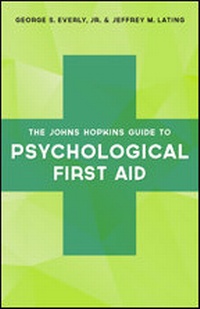
The Johns Hopkins Guide to Psychological First Aid
Published on 27. May 2017
Book
Paperback/Softback
232 pages
978-1-4214-2271-8 (ISBN)
Description
Psychological first aid, or PFA, is designed to mitigate the effects of acute stress and trauma and assist those in crisis to cope effectively with adversity. PFA is designed to be applied in emergencies, including disasters and terrorist attacks. In this essential guide, George S. Everly, Jr., developer of the Johns Hopkins RAPID PFA method, and Jeffrey M. Lating, his collaborator in its implementation, describe the principles and practices underpinning this psychological model in an easy-to-follow, prescriptive, and practical manner. They explain the history of PFA and persuasively demonstrate its powerful versatility. Mental health practitioners can apply PFA in all settings. It can also be used as a public-health tool to address mental health needs following critical incidents and as a means for building community resilience. Aimed at mental health practitioners, all first responders, and global health disaster teams such as Medecins Sans Frontieres and the World Health Organization, The Johns Hopkins Guide to Psychological First Aid is the first book to thoroughly explain RAPID PFA.
RAPID, a unique theoretically grounded and evidence-based PFA method, follows a set of easily understood principles. In each chapter, Everly and Lating provide a step-by-step approach and include a key point summary to emphasize essential elements. A unifying case exemplifies each phase of the RAPID PFA model in an ongoing dialogue that presents ideal PFA responses, examples of common mistakes, and various outcomes. In addition to their counseling experience in Kuwait after the Gulf War and in New York City after the September 11 attacks, the authors have traveled nationally and internationally to teach the RAPID PFA method in numerous public health, fire, police, military, and faith-based settings. Beneficial to those with little or no previous mental health training, this book is an essential tool for people who want to learn, to practice, or to retain their ability to use psychological first aid effectively.
RAPID, a unique theoretically grounded and evidence-based PFA method, follows a set of easily understood principles. In each chapter, Everly and Lating provide a step-by-step approach and include a key point summary to emphasize essential elements. A unifying case exemplifies each phase of the RAPID PFA model in an ongoing dialogue that presents ideal PFA responses, examples of common mistakes, and various outcomes. In addition to their counseling experience in Kuwait after the Gulf War and in New York City after the September 11 attacks, the authors have traveled nationally and internationally to teach the RAPID PFA method in numerous public health, fire, police, military, and faith-based settings. Beneficial to those with little or no previous mental health training, this book is an essential tool for people who want to learn, to practice, or to retain their ability to use psychological first aid effectively.
Reviews / Votes
This guide is appropriate for all psychology students and others in the mental health fields; teachers, police officers, and firefighters will also find it helpful. Recomended. * Choice * The book uses worked examples to engage the reader and help bring the [RAPID response] model to life in real situations. * Journal of Psychiatric Intensive Care * In their two part, nine-chapter book-aimed at the medical community and general public alike- Everly and Lating present an exhaustively sourced yet crisply written analysis of RAPID PFA and its successful application, including sample exchanges between a provider and a distressed individual to demonstrate how the process is done. * Johns Hopkins Medicine *More details
Language
English
Place of publication
Baltimore, MD
United States
Target group
College/higher education
Product notice
Paperback (trade)
Illustrations
2 s/w Abbildungen
2 Illustrations, black and white
Dimensions
Height: 216 mm
Width: 140 mm
Thickness: 14 mm
Weight
295 gr
ISBN-13
978-1-4214-2271-8 (9781421422718)
Copyright in bibliographic data and cover images is held by Nielsen Book Services Limited or by the publishers or by their respective licensors: all rights reserved.
Schweitzer Classification
Other editions
New editions
George S. Everly | Jeffrey M. Lating
The Johns Hopkins Guide to Psychological First Aid
Book
09/2022
2nd Edition
Johns Hopkins University Press
€26.50
Shipment within 10-20 days
Additional editions
George S. Everly | Jeffrey M. Lating
The Johns Hopkins Guide to Psychological First Aid
E-Book
05/2017
Johns Hopkins University Press
€18.99
Available for download
Persons
George S. Everly, Jr., is an associate professor of psychiatry and behavioral sciences at the Johns Hopkins School of Medicine, an adjunct professor of international health at the Johns Hopkins Bloomberg School of Public Health, and a professor of psychology at Loyola University Maryland. He is a former member of the Johns Hopkins Center for Public Health Preparedness. Jeffrey M. Lating is a professor of psychology at Loyola University Maryland. Everly and Lating are the coauthors of A Clinical Guide to the Treatment of the Human Stress Response and Personality-Guided Therapy for Posttraumatic Stress Disorder.
Content
Preface
Acknowledgments
Part I. Psychological First Aid
Chapter 1. Psychological First Aid
Defining Psychological First Aid
Development of the PFA Concept
PFA
PFA Recommended
Core Competencies of PFA
Validation of the Johns Hopkins RAPID PFA Model
Chapter 2. Psychological Consequences of Trauma
Posttraumatic Stress Disorder
Depression
Generalized Anxiety
Panic Disorder
Substance Use
Psychophysiological Stress Syndromes
Chapter 3. In the Wake of Disaster
Types of Disasters
Natural Disasters
Technological Disasters
Human-Made Disasters
War-Related Syndromes
Factors That Increase Severity
Part II. Psychological First Aid
Chapter 4. R-Establishing Rapport and Reflective Listening
First Things First
Empathy and Rapport
The Empathic Cascade
Historical Development
Mechanisms of Action
Demonstration of the R in RAPID Model
Chapter 5. A-Assessment
Screening
Appraisal
Cognitive Indicia
Emotional Indicia
Behavioral Indicia
Spiritual Indicia
Physiological Indicia
Demonstration of the A in RAPID Model
Key Point Summary
References
Chapter 6. P-Psychological Triage
Urgency!
Psychological or Behavioral Instability
Putting It All Together
Demonstration of the P in RAPID Model
Chapter 7. I-Intervention Tactics to Stabilize and Mitigate Acute Distress
Explanatory Guidance
Anticipatory Guidance
Cognitive Reframing
Stress Management
Instillation of a Future Orientation-Hope
Enlisting the Support of Family and Friends
Delay Making Any Life-Altering Decisions/Changes
Faith-Based Intervention in PFA
When in Doubt . . .
Caution!
Demonstration of the I in RAPID Model
Chapter 8. D-Disposition and Facilitating Access to Continued Care
Where Do We Go from Here?
Encouragement
Resources
Demonstration of the D in RAPID Model
Follow-Up and Disposition
Chapter 9. Self-Care
The Need for Self-Care
Terminology
Risk Factors
Self-Care
Developing a Plan
Appendix
Index
Acknowledgments
Part I. Psychological First Aid
Chapter 1. Psychological First Aid
Defining Psychological First Aid
Development of the PFA Concept
PFA
PFA Recommended
Core Competencies of PFA
Validation of the Johns Hopkins RAPID PFA Model
Chapter 2. Psychological Consequences of Trauma
Posttraumatic Stress Disorder
Depression
Generalized Anxiety
Panic Disorder
Substance Use
Psychophysiological Stress Syndromes
Chapter 3. In the Wake of Disaster
Types of Disasters
Natural Disasters
Technological Disasters
Human-Made Disasters
War-Related Syndromes
Factors That Increase Severity
Part II. Psychological First Aid
Chapter 4. R-Establishing Rapport and Reflective Listening
First Things First
Empathy and Rapport
The Empathic Cascade
Historical Development
Mechanisms of Action
Demonstration of the R in RAPID Model
Chapter 5. A-Assessment
Screening
Appraisal
Cognitive Indicia
Emotional Indicia
Behavioral Indicia
Spiritual Indicia
Physiological Indicia
Demonstration of the A in RAPID Model
Key Point Summary
References
Chapter 6. P-Psychological Triage
Urgency!
Psychological or Behavioral Instability
Putting It All Together
Demonstration of the P in RAPID Model
Chapter 7. I-Intervention Tactics to Stabilize and Mitigate Acute Distress
Explanatory Guidance
Anticipatory Guidance
Cognitive Reframing
Stress Management
Instillation of a Future Orientation-Hope
Enlisting the Support of Family and Friends
Delay Making Any Life-Altering Decisions/Changes
Faith-Based Intervention in PFA
When in Doubt . . .
Caution!
Demonstration of the I in RAPID Model
Chapter 8. D-Disposition and Facilitating Access to Continued Care
Where Do We Go from Here?
Encouragement
Resources
Demonstration of the D in RAPID Model
Follow-Up and Disposition
Chapter 9. Self-Care
The Need for Self-Care
Terminology
Risk Factors
Self-Care
Developing a Plan
Appendix
Index