

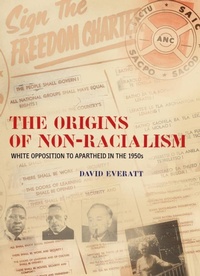
The Origins of Non-Racialism
White Opposition to Apartheid in the 1950s
Published on 1. June 2009
Book
Paperback/Softback
288 pages
978-1-86814-500-3 (ISBN)
Description
How did South Africa embrace "non-racialism"?
After centuries of white domination and decades of increasingly savage repression, freedom came to South Africa far later than elsewhere in the continent - and yet was marked by a commitment to non-racialism. Nelson Mandela's Cabinet and government were made up of women and men of all races, and many spoke of the birth of a new 'Rainbow Nation'. How did this come about? How did an African nationalist liberation movement resisting apartheid - a universally denounced violent expression of white supremacy - open its doors to other races, and whites in particular? And what did non-racialism mean? This is the real 'miracle' of South Africa: that at the height of white supremacy and repression, black and white democrats - in their different organisations, coming from vastly different backgrounds and traditions - agreed on one thing: that the future for South Africa would be non-racial.
After centuries of white domination and decades of increasingly savage repression, freedom came to South Africa far later than elsewhere in the continent - and yet was marked by a commitment to non-racialism. Nelson Mandela's Cabinet and government were made up of women and men of all races, and many spoke of the birth of a new 'Rainbow Nation'. How did this come about? How did an African nationalist liberation movement resisting apartheid - a universally denounced violent expression of white supremacy - open its doors to other races, and whites in particular? And what did non-racialism mean? This is the real 'miracle' of South Africa: that at the height of white supremacy and repression, black and white democrats - in their different organisations, coming from vastly different backgrounds and traditions - agreed on one thing: that the future for South Africa would be non-racial.
Reviews / Votes
This book is a path-breaking study of the emergence of non-racialism, considering a range of strands: some pursing liberal paths, others working for national liberation or communism. It is a painstaking insight into the Congress Movement and the Communist Party, then operating underground, as well as the Liberal Party, drawing on widespread oral and archival material. - Raymond Suttner, UNISA, author of The ANC UndergroundMore details
Language
English
Place of publication
Johannesburg
South Africa
Target group
College/higher education
Professional and scholarly
Product notice
Paperback (trade)
Dimensions
Height: 221 mm
Width: 159 mm
Thickness: 22 mm
Weight
509 gr
ISBN-13
978-1-86814-500-3 (9781868145003)
Copyright in bibliographic data and cover images is held by Nielsen Book Services Limited or by the publishers or by their respective licensors: all rights reserved.
Schweitzer Classification
Other editions
Additional editions
E-Book
06/2009
Abingdon Press
€29.49
Available for download
Person
David Everatt is the Head of the Wits School of Governance at the University of the Witwatersrand in Johannesburg.
Content
Whites and the ANC 1945-1950; the emergence of white opposition to apartheid, 1950-1952; multiracialism - communist plot or anti-communist ploy?; From CPSA to SACP via CST: Socialist responses to African Nationalism, 1952-1954; The South African congress of democrats; the liberal party of South Africa; overhauling liberalisml whites and the congress of the people; the freedom charter and the politics of non-racialism, 1956-1960.