

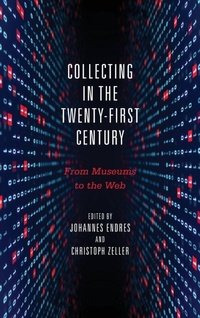
Collecting in the Twenty-First Century
From Museums to the Web
Published on 13. May 2022
Book
Hardback
242 pages
978-1-57113-970-2 (ISBN)
Description
An interdisciplinary volume of essays identifying the impact of technology on the age-old cultural practice of collecting as well as the opportunities and pitfalls of collecting in the digital era.
Seminal to the rise of human cultures, the practice of collecting is an expression of individual and societal self-understanding. Through collections, cultures learn and grow. The introduction of digital technology has accelerated this process and at the same time changed how, what, and why we collect. Ever-expanding storage capacities and the accumulation of unprecedented amounts of data are part of a highly complex information economy in which collecting has become even more important for the formation of the past, present, and future. Museums, libraries, and archives have adapted to the requirements of a digital environment, as has anyone who browses the internet and stores information on hard drives or cloud servers. In turn, companies follow the digital footprint we leave behind. Today, collecting includes not only physical objects but also the binary code that allows for their virtual representation on screen. Collecting in the Twenty-First Century identifies the impact of technology, both new and old, on the cultural practice of collecting as well as the challenges and opportunities of collecting in the digital era. Scholars from German Studies, Media Studies, Museum Studies, Sound Studies, Information Technology, and Art History as well as librarians and preservationists offer insights into the most recent developments in collecting practices.
Seminal to the rise of human cultures, the practice of collecting is an expression of individual and societal self-understanding. Through collections, cultures learn and grow. The introduction of digital technology has accelerated this process and at the same time changed how, what, and why we collect. Ever-expanding storage capacities and the accumulation of unprecedented amounts of data are part of a highly complex information economy in which collecting has become even more important for the formation of the past, present, and future. Museums, libraries, and archives have adapted to the requirements of a digital environment, as has anyone who browses the internet and stores information on hard drives or cloud servers. In turn, companies follow the digital footprint we leave behind. Today, collecting includes not only physical objects but also the binary code that allows for their virtual representation on screen. Collecting in the Twenty-First Century identifies the impact of technology, both new and old, on the cultural practice of collecting as well as the challenges and opportunities of collecting in the digital era. Scholars from German Studies, Media Studies, Museum Studies, Sound Studies, Information Technology, and Art History as well as librarians and preservationists offer insights into the most recent developments in collecting practices.
Reviews / Votes
[T]he theoretical underpinnings, issues raised, and points made throughout the volume are useful beyond their immediate applications. They pose questions of access, data collection, ethics, and economics that will interest scholars of the history of collections, museum studies, digital humanities, library and information sciences, and related fields of literary theory and criticism and media studies. -- J. Decker * CHOICE * What does it mean to collect in the digital age?" . . . This question encapsulates the sentiment at the heart of this excellent edited collection. . . . Across the entirety of the volume, it becomes clear that collecting in the digital age has become about collecting data, and in particular, collecting data about people, which has explicitly political and economic implications. * ARCHIVES AND RECORDS *More details
Language
English
Place of publication
Columbia, MD
United States
Publishing group
Boydell & Brewer Ltd
Target group
Professional and scholarly
Product notice
Cloth over boards
Illustrations
11 b/w illus.
Dimensions
Height: 235 mm
Width: 157 mm
Thickness: 18 mm
Weight
507 gr
ISBN-13
978-1-57113-970-2 (9781571139702)
Copyright in bibliographic data and cover images is held by Nielsen Book Services Limited or by the publishers or by their respective licensors: all rights reserved.
Schweitzer Classification
Other editions
Additional editions
Unknown | Johannes Endres | Christoph Zeller
Collecting in the Twenty-First Century
From Museums to the Web
E-Book
05/2022
1st Edition
Boydell & Brewer
€48.99
Available for download
E-Book
05/2022
1st Edition
De Gruyter
€48.99
Available for download
Persons
JOHANNES ENDRES is Professor of Comparative Literature and Art History at the University of California, Riverside. CHRISTOPH ZELLER is Professor and Chair of the Department of German, Russian and East European Studies at Vanderbilt University. ROLF J. GOEBEL is Distinguished Professor of German, Emeritus, at the University of Alabama in Huntsville.
Content
Introduction: Collecting in the Digital Age - Christoph Zeller
1: Collecting: Defining the Subject - Johannes Endres
PART I. Spaces of Collecting
2: Collector as Curator: Collecting in the Post-Internet Age - Boris Groys
3: Should Libraries Still Be Charged with Collecting in a Digital Environment? - Michael Knoche
4: Museums and Collecting as/and Media in the Digital Age - Peter M. McIsaac
PART II. Recollection
5: Quality Storage: Collecting as a Technique of Reading - Nikolaus Wegmann
6: Phenomenology of Memory in an Age of Big Data - Clifford B. Anderson
7: Collecting the Cultural Memory of Palmyra - Erin L. Thompson
8: Conservation in the Digital Age - Jessica Walthew
PART III. Virtuality
9: Music and the Limits of Collectibility - Rolf J. Goebel
10: Cat Art and Climate Change: Collecting in the Data Anthropocene - Edward Dawson
PART IV. Economics
11: Doomed to Collect: Dataveillance as Inner Logic of the Internet - Roberto Simanowski
12: Data Collection in the Age of Surveillance Capitalism - Douglas C. Schmidt
Notes on the Contributors
Index
1: Collecting: Defining the Subject - Johannes Endres
PART I. Spaces of Collecting
2: Collector as Curator: Collecting in the Post-Internet Age - Boris Groys
3: Should Libraries Still Be Charged with Collecting in a Digital Environment? - Michael Knoche
4: Museums and Collecting as/and Media in the Digital Age - Peter M. McIsaac
PART II. Recollection
5: Quality Storage: Collecting as a Technique of Reading - Nikolaus Wegmann
6: Phenomenology of Memory in an Age of Big Data - Clifford B. Anderson
7: Collecting the Cultural Memory of Palmyra - Erin L. Thompson
8: Conservation in the Digital Age - Jessica Walthew
PART III. Virtuality
9: Music and the Limits of Collectibility - Rolf J. Goebel
10: Cat Art and Climate Change: Collecting in the Data Anthropocene - Edward Dawson
PART IV. Economics
11: Doomed to Collect: Dataveillance as Inner Logic of the Internet - Roberto Simanowski
12: Data Collection in the Age of Surveillance Capitalism - Douglas C. Schmidt
Notes on the Contributors
Index