

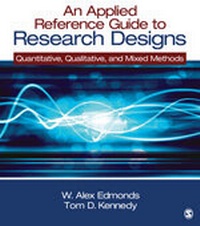
An Applied Reference Guide to Research Designs
Quantitative, Qualitative, and Mixed Methods
1st Edition
Published on 14. March 2012
Book
Paperback/Softback
240 pages
978-1-4522-0509-0 (ISBN)
Description
This reference book visually presents, with consistent terminology, quantitative, qualitative, and mixed methods research designs in education and the social and behavioural sciences in a way that students and researchers can readily understand and accurately apply in their own investigations.
The book improves one's ability to conceptualize, construct, test, problem solve and acquire knowledge, all of which are characteristics of scientific inquiry and the creative process required when conducting research. It covers the most practical and common research designs currently used in educational and the social and behavioural sciences.
The book improves one's ability to conceptualize, construct, test, problem solve and acquire knowledge, all of which are characteristics of scientific inquiry and the creative process required when conducting research. It covers the most practical and common research designs currently used in educational and the social and behavioural sciences.
Reviews / Votes
"This is a scholarly, useful presentation on research design. I applaud the book's wide range of clearly defined research concepts." -- Daniel L. Stufflebeam "A clear and succinct overview of research designs. This guide provides an organized visual layout of the various designs and approaches used for research in qualitative methods." -- Ronald J. Chenail "It is important to remember that it is the design and not the statistic that is the basis for inference, making the study of of vital importance, and this book is an invaluable resource for both social scientists and aspiring social scientists." -- Paul E. Spector "The array of approaches is impressively inclusive; an excellent guide for a student seeking a methodology." -- Ralph E. Swan "The strength of this text lies in its succinct go-to style. For me, it is like the APA Publication Manual in that it will be a resource for not only classroom learning, but also for faculty research and article review." -- John L. Garland "The presentation of research scenario examples including design and probable statistical analyses is one thing often missing in general research texts. I also like the design and analyses depicted in pictorial/graphical format, which allows ease in understanding." -- Rebecca Keele "The topics progress in a logical order although [it] allows flexibility to read stand-alone topics. It is a reference text that one can readily turn to and refer to as a guide." -- Theodore D. Joseph "The text does has two distinct strengths: it covers in depth a topic that needs to be addressed and few other books have this level of detail; and it does a very nice job of visually presenting various examples of research design. This text is both practical and useful for students." -- Peter M. Jonas "This text's information is readily accessible and organized with great examples to guide students. The literature based examples are really helpful." -- Betty Carter Dorr "It fills a huge void in the field of psychology in providing students and professors with a survey of research designs that are most appropriate to answering the many different and wide range of questions that students are now interested in pursuing." -- Cynthia E. Winston 'Using a wide range of visual aids (diagrams and visual models) and real-world examples, the authors provide readers with a self-contained package by which they can decide on what design to select for their study, and how to employ their selected design to address their research questions.This book is recommended to those seeking to develop their understanding of research design and wishing to adopt appropriate designs to conduct credible research, particularly in the areas of the social and behavioural sciences. ' -- Maryam Nazari & G.E. Gorman * Online Information Review *
More details
Language
English
Place of publication
Thousand Oaks
United States
Target group
College/higher education
Dimensions
Height: 232 mm
Width: 187 mm
Weight
397 gr
ISBN-13
978-1-4522-0509-0 (9781452205090)
Copyright in bibliographic data and cover images is held by Nielsen Book Services Limited or by the publishers or by their respective licensors: all rights reserved.
Schweitzer Classification
Other editions
New editions
W. Alex Edmonds | Thomas D. Kennedy
An Applied Guide to Research Designs
Quantitative, Qualitative, and Mixed Methods
Book
07/2016
2nd Edition
SAGE Publications Inc
€169.36
Shipment within 10-20 days
Persons
W. Alex Edmonds, PhD, BCB, is currently an associate professor of research at Nova Southeastern University in Davie, Florida. He graduated from Florida State University and received his doctoral degree in Educational Psychology with a minor in Statistics and Measurement. Over the years, Dr. Edmonds has applied his knowledge of research design, measurement, and assessment in both field and laboratory examinations. He has published extensively in a variety of areas such as psychophysiology and educational psychology. His primary interest revolves around applying unique methodological and statistical techniques as a means to exploring the relationship between emotions, physiology and performance in a variety of domains. He also has over 10 years of experience in applying biofeedback in field and research applications. While in graduate school, he conducted his field work with the track and field team at Florida State and started using biofeedback for research and practice during this time. He has utilized biofeedback extensively with various types of athletes for performance enhancement, as well as stress-regulation techniques for individuals with type 2 diabetes and pain management for patients suffering from chronic pain. Dr. Edmonds is certified through the Biofeedback Certification International Alliance in general biofeedback.
Tom D. Kennedy, PhD, BCB, is currently an associate professor of research at Nova Southeastern University in Davie, Florida. He received his PhD in Counseling Psychology from the University of Miami and his MA in Clinical Psychology from Southern Methodist University. He has been a faculty member at NSU for five years where he has developed and taught research and statistics courses. He is the Institutional Review Board representative for the School of Education. His clinical experience consists of providing neuropsychological assessments, behavioral medicine interventions, and group therapy in inpatient and outpatient settings, including the following: the University of Texas Southwestern Medical Center, University of Miami Mailman Center for Child Development, Jackson Memorial Hospital, University of Miami Institute for Individual and Family Therapy, and the Dallas County Jail. His research interests include two convergent tracks, one focusing on at-risk children and adolescents and the other exploring biofeedback and other complementary and alternative medicine interventions. He has been the recipient of multiple grants and provides evaluation and grant writing services for various organizations in south Florida. He has published and presented in the areas of juvenile crime, psychophysiology, and research methodology. Dr. Kennedy is a licensed psychologist PY 8307 and is certified through the Biofeedback Certification International Alliance in general biofeedback and maintains a small private practice for children and adolescence.
Tom D. Kennedy, PhD, BCB, is currently an associate professor of research at Nova Southeastern University in Davie, Florida. He received his PhD in Counseling Psychology from the University of Miami and his MA in Clinical Psychology from Southern Methodist University. He has been a faculty member at NSU for five years where he has developed and taught research and statistics courses. He is the Institutional Review Board representative for the School of Education. His clinical experience consists of providing neuropsychological assessments, behavioral medicine interventions, and group therapy in inpatient and outpatient settings, including the following: the University of Texas Southwestern Medical Center, University of Miami Mailman Center for Child Development, Jackson Memorial Hospital, University of Miami Institute for Individual and Family Therapy, and the Dallas County Jail. His research interests include two convergent tracks, one focusing on at-risk children and adolescents and the other exploring biofeedback and other complementary and alternative medicine interventions. He has been the recipient of multiple grants and provides evaluation and grant writing services for various organizations in south Florida. He has published and presented in the areas of juvenile crime, psychophysiology, and research methodology. Dr. Kennedy is a licensed psychologist PY 8307 and is certified through the Biofeedback Certification International Alliance in general biofeedback and maintains a small private practice for children and adolescence.
Content
List of Tables, Figures, and Diagrams
Foreword, by Paul E. Spector
Preface
Acknowledgments
About the Authors
Chapter 1. The Scientific Method and Relevant Components
Part I. Quantitative Methods for Experimental and Quasi-Experimental Research
Chapter 2. Between-Subjects Approach
Chapter 3. Regression-Discontinuity Approach
Chapter 4. Within-Subjects Approach
Chapter 5. Factorial Designs
Chapter 6. Solomon N-Group Designs
Chapter 7. Single-Case Approach
Part II. Quantitative Methods for Nonexperimental Research
Chapter 8. Ex Post Facto and Posttest-Only Designs
Chapter 9. Observational Approach
Chapter 10. Survey Approach
Part III. Qualitative Methods
Chapter 11. Grounded Theory Approach
Chapter 12. Ethnographic Approach
Chapter 13. Narrative Approach
Chapter 14. Phenomenological Approach
Part IV. Mixed Methods
Chapter 15. Convergent-Parallel Approach
Chapter 16. Embedded Approach
Chapter 17. Explanatory-Sequential Approach
Chapter 18. Exploratory-Sequential Approach
Chapter 19. Mixed Methods, Case Studies, and Single-Case Approaches
Chapter 20. Conclusion
Appendix A. Less Common Designs for Experimental and Quasi-Experimental Research
Appendix B. Types of Case Study Designs
Appendix C. Five Types of Mixed Methods Designs
References
Author Index
Subject Index
Foreword, by Paul E. Spector
Preface
Acknowledgments
About the Authors
Chapter 1. The Scientific Method and Relevant Components
Part I. Quantitative Methods for Experimental and Quasi-Experimental Research
Chapter 2. Between-Subjects Approach
Chapter 3. Regression-Discontinuity Approach
Chapter 4. Within-Subjects Approach
Chapter 5. Factorial Designs
Chapter 6. Solomon N-Group Designs
Chapter 7. Single-Case Approach
Part II. Quantitative Methods for Nonexperimental Research
Chapter 8. Ex Post Facto and Posttest-Only Designs
Chapter 9. Observational Approach
Chapter 10. Survey Approach
Part III. Qualitative Methods
Chapter 11. Grounded Theory Approach
Chapter 12. Ethnographic Approach
Chapter 13. Narrative Approach
Chapter 14. Phenomenological Approach
Part IV. Mixed Methods
Chapter 15. Convergent-Parallel Approach
Chapter 16. Embedded Approach
Chapter 17. Explanatory-Sequential Approach
Chapter 18. Exploratory-Sequential Approach
Chapter 19. Mixed Methods, Case Studies, and Single-Case Approaches
Chapter 20. Conclusion
Appendix A. Less Common Designs for Experimental and Quasi-Experimental Research
Appendix B. Types of Case Study Designs
Appendix C. Five Types of Mixed Methods Designs
References
Author Index
Subject Index