

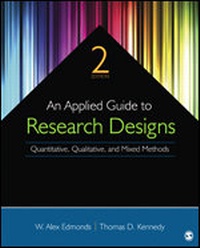
An Applied Guide to Research Designs
Quantitative, Qualitative, and Mixed Methods
2nd Edition
Published on 12. July 2016
Book
Paperback/Softback
392 pages
978-1-4833-1727-4 (ISBN)
Description
The Second Edition of An Applied Guide to Research Designs offers researchers in the social and behavioral sciences guidance for selecting the most appropriate research design to apply in their study. Using consistent terminology, the authors visually present a range of research designs used in quantitative, qualitative, and mixed methods to help readers conceptualize, construct, test, and problem solve in their investigation. The Second Edition features revamped and expanded coverage of research designs, new real-world examples and references, a new chapter on action research, and updated ancillaries.
Reviews / Votes
"This text is intellectually stimulating and challenges students to take a comprehensive approach to their understanding of research designs and concepts. I appreciate the high expectations that the authors have for their readers to fully understand the nature and depth of the research process." -- Rebekah Cole "I find this text to be especially clear in its approach, while the use of examples and sample exercises would be highly effective for practical, in-class learning. Additionally, the text would be an excellent resource as students put together their research designs, and it would likely work well alongside a more theoretical companion text." -- Jennifer E. Dalton "The research study examples provided in connection to each research design reflect an additional strength to this text. What I like about this text is that it contains a comprehensive view of designs, without bias regarding one paradigm being better than the other." -- Donna Schnorr "This is a very useful, practical, and well-devised textbook." -- Micheal NewellMore details
Edition
2nd Revised edition
Language
English
Place of publication
Thousand Oaks
United States
Target group
College/higher education
Edition type
Revised edition
Dimensions
Height: 232 mm
Width: 187 mm
Weight
703 gr
ISBN-13
978-1-4833-1727-4 (9781483317274)
Copyright in bibliographic data and cover images is held by Nielsen Book Services Limited or by the publishers or by their respective licensors: all rights reserved.
Schweitzer Classification
Other editions
Previous edition
W. Alex Edmonds | Thomas D. Kennedy
An Applied Reference Guide to Research Designs
Quantitative, Qualitative, and Mixed Methods
Book
03/2012
1st Edition
SAGE Publications Inc
€90.57
Article exhausted; check for reprint
Persons
W. Alex Edmonds, PhD, BCB, is currently an associate professor of research at Nova Southeastern University in Davie, Florida. He graduated from Florida State University and received his doctoral degree in Educational Psychology with a minor in Statistics and Measurement. Over the years, Dr. Edmonds has applied his knowledge of research design, measurement, and assessment in both field and laboratory examinations. He has published extensively in a variety of areas such as psychophysiology and educational psychology. His primary interest revolves around applying unique methodological and statistical techniques as a means to exploring the relationship between emotions, physiology and performance in a variety of domains. He also has over 10 years of experience in applying biofeedback in field and research applications. While in graduate school, he conducted his field work with the track and field team at Florida State and started using biofeedback for research and practice during this time. He has utilized biofeedback extensively with various types of athletes for performance enhancement, as well as stress-regulation techniques for individuals with type 2 diabetes and pain management for patients suffering from chronic pain. Dr. Edmonds is certified through the Biofeedback Certification International Alliance in general biofeedback.
Tom D. Kennedy, PhD, BCB, is currently an associate professor of research at Nova Southeastern University in Davie, Florida. He received his PhD in Counseling Psychology from the University of Miami and his MA in Clinical Psychology from Southern Methodist University. He has been a faculty member at NSU for five years where he has developed and taught research and statistics courses. He is the Institutional Review Board representative for the School of Education. His clinical experience consists of providing neuropsychological assessments, behavioral medicine interventions, and group therapy in inpatient and outpatient settings, including the following: the University of Texas Southwestern Medical Center, University of Miami Mailman Center for Child Development, Jackson Memorial Hospital, University of Miami Institute for Individual and Family Therapy, and the Dallas County Jail. His research interests include two convergent tracks, one focusing on at-risk children and adolescents and the other exploring biofeedback and other complementary and alternative medicine interventions. He has been the recipient of multiple grants and provides evaluation and grant writing services for various organizations in south Florida. He has published and presented in the areas of juvenile crime, psychophysiology, and research methodology. Dr. Kennedy is a licensed psychologist PY 8307 and is certified through the Biofeedback Certification International Alliance in general biofeedback and maintains a small private practice for children and adolescence.
Tom D. Kennedy, PhD, BCB, is currently an associate professor of research at Nova Southeastern University in Davie, Florida. He received his PhD in Counseling Psychology from the University of Miami and his MA in Clinical Psychology from Southern Methodist University. He has been a faculty member at NSU for five years where he has developed and taught research and statistics courses. He is the Institutional Review Board representative for the School of Education. His clinical experience consists of providing neuropsychological assessments, behavioral medicine interventions, and group therapy in inpatient and outpatient settings, including the following: the University of Texas Southwestern Medical Center, University of Miami Mailman Center for Child Development, Jackson Memorial Hospital, University of Miami Institute for Individual and Family Therapy, and the Dallas County Jail. His research interests include two convergent tracks, one focusing on at-risk children and adolescents and the other exploring biofeedback and other complementary and alternative medicine interventions. He has been the recipient of multiple grants and provides evaluation and grant writing services for various organizations in south Florida. He has published and presented in the areas of juvenile crime, psychophysiology, and research methodology. Dr. Kennedy is a licensed psychologist PY 8307 and is certified through the Biofeedback Certification International Alliance in general biofeedback and maintains a small private practice for children and adolescence.
Content
Chapter 1: The Scientific Method and Relevant Components
The Scientific Method
Validity and Research Designs
Design Logic
Design Notations
Assignment Techniques
Comparison and Control Groups
Sampling Strategies
Research Questions
Part I: Quantitative Methods for Experimental and Quasi-Experimental Research
Experimental Research
Quasi-Experimental Research
Chapter 2: Between-Subjects Approach
Pretest and Posttest Designs
Posttest Designs
Chapter 3: Regression-Discontinuity Approach
Chapter 4: Within-Subjects Approach
Repeated-Measures Approach
Chapter 5: Factorial Designs
Chapter 6: Solomon N-Group Designs
Chapter 7: Single-Case Approach
Part II: Quantitative Methods for Nonexperimental Research
Chapter 8: Ex Post Facto and Posttest-Only Designs
Chapter 9: Observational Approach
Explanatory Design
Predictive Design
Chapter 10: Survey Approach
Cross-Sectional Design
Longitudinal Design
Part III: Qualitative Methods
Chapter 11: Grounded Theory Perspective
Systematic Design
Emerging Design
Constructivist Design
Chapter 12: Ethnographic Perspective
Realist Design
Critical Design
Case Study Design
Chapter 13: Narrative Perspective
Descriptive Design
Explanatory Design
Critical Design
Chapter 14: Phenomenological Perspective
Existential Design
Transcendental Design
Hermeneutic Design
Case Study Design
Part IV: Mixed Methods
Chapter 15: Convergent-Parallel Approach
Parallel-Databases Design
Data-Transformation Design
Data-Validation Design
Multilevel Design
Chapter 16: Embedded Approach
Embedded-Experiment Design
Embedded-Correlational Design
Embedded Case Study Design
Chapter 17: Explanatory-Sequential Approach
Follow-Up Explanations Design
Participant-Selection Design
Chapter 18: Exploratory-Sequential Approach
Instrument-Development Design
Theory-Development Design
Treatment-Development Design
Chapter 19: Mixed Methods, Case Studies, and Single-Case Approaches
Mixed-Method A-B-A Designs
Chapter 20: Action Research Approaches
Chapter 21: Conclusion
Philosophical Tenets
Data Analytics
Final Remarks
The Scientific Method
Validity and Research Designs
Design Logic
Design Notations
Assignment Techniques
Comparison and Control Groups
Sampling Strategies
Research Questions
Part I: Quantitative Methods for Experimental and Quasi-Experimental Research
Experimental Research
Quasi-Experimental Research
Chapter 2: Between-Subjects Approach
Pretest and Posttest Designs
Posttest Designs
Chapter 3: Regression-Discontinuity Approach
Chapter 4: Within-Subjects Approach
Repeated-Measures Approach
Chapter 5: Factorial Designs
Chapter 6: Solomon N-Group Designs
Chapter 7: Single-Case Approach
Part II: Quantitative Methods for Nonexperimental Research
Chapter 8: Ex Post Facto and Posttest-Only Designs
Chapter 9: Observational Approach
Explanatory Design
Predictive Design
Chapter 10: Survey Approach
Cross-Sectional Design
Longitudinal Design
Part III: Qualitative Methods
Chapter 11: Grounded Theory Perspective
Systematic Design
Emerging Design
Constructivist Design
Chapter 12: Ethnographic Perspective
Realist Design
Critical Design
Case Study Design
Chapter 13: Narrative Perspective
Descriptive Design
Explanatory Design
Critical Design
Chapter 14: Phenomenological Perspective
Existential Design
Transcendental Design
Hermeneutic Design
Case Study Design
Part IV: Mixed Methods
Chapter 15: Convergent-Parallel Approach
Parallel-Databases Design
Data-Transformation Design
Data-Validation Design
Multilevel Design
Chapter 16: Embedded Approach
Embedded-Experiment Design
Embedded-Correlational Design
Embedded Case Study Design
Chapter 17: Explanatory-Sequential Approach
Follow-Up Explanations Design
Participant-Selection Design
Chapter 18: Exploratory-Sequential Approach
Instrument-Development Design
Theory-Development Design
Treatment-Development Design
Chapter 19: Mixed Methods, Case Studies, and Single-Case Approaches
Mixed-Method A-B-A Designs
Chapter 20: Action Research Approaches
Chapter 21: Conclusion
Philosophical Tenets
Data Analytics
Final Remarks