

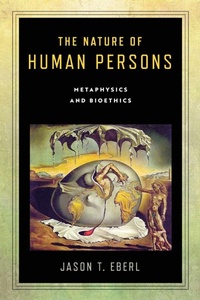
The Nature of Human Persons
Metaphysics and Bioethics
Published on 15. July 2024
Book
Paperback/Softback
422 pages
978-0-268-10774-1 (ISBN)
Description
For a human being to exist, does it require an immaterial mind, a physical body, a functioning brain, a soul?
Is there a shared nature common to all human beings? What essential qualities might define this nature? These questions are among the most widely discussed topics in the history of philosophy and remain subjects of perennial interest and controversy. The Nature of Human Persons offers a metaphysical investigation of the composition of the human essence.
Jason Eberl also considers the criterion of identity for a developing human being-that is, what is required for a human being to continue existing as a person despite undergoing physical and psychological changes over time? Eberl places Thomas Aquinas's account of human nature into direct comparison with several prominent contemporary theories: substance dualism, emergentism, animalism, constitutionalism, four-dimensionalism, and embodied mind theory. These theories inform conclusions regarding when human beings first come into existence (at conception, during gestation, or after birth), how we ought to define death for human beings, and whether (and if so how) human beings may survive death. Ultimately, The Nature of Human Persons argues that the Thomistic account of human nature addresses the matters of human nature and survival more holistically than other theories and offers a cohesive portrait of one's continued existence from conception through life to death and beyond.
Is there a shared nature common to all human beings? What essential qualities might define this nature? These questions are among the most widely discussed topics in the history of philosophy and remain subjects of perennial interest and controversy. The Nature of Human Persons offers a metaphysical investigation of the composition of the human essence.
Jason Eberl also considers the criterion of identity for a developing human being-that is, what is required for a human being to continue existing as a person despite undergoing physical and psychological changes over time? Eberl places Thomas Aquinas's account of human nature into direct comparison with several prominent contemporary theories: substance dualism, emergentism, animalism, constitutionalism, four-dimensionalism, and embodied mind theory. These theories inform conclusions regarding when human beings first come into existence (at conception, during gestation, or after birth), how we ought to define death for human beings, and whether (and if so how) human beings may survive death. Ultimately, The Nature of Human Persons argues that the Thomistic account of human nature addresses the matters of human nature and survival more holistically than other theories and offers a cohesive portrait of one's continued existence from conception through life to death and beyond.
Reviews / Votes
"Readers interested in a sophisticated application of Thomistic thought to contemporary ethics will find this an important book, especially because Eberl avoids the common pitfall of allowing his text to become bogged down in debates over the proper interpretation of Aquinas." -Choice"There are innumerable books in bioethics, but none that take up issues of human anthropology in anything like the depth found in Jason T. Eberl's The Nature of Human Persons." -Christopher Kaczor, author of Abortion Rights: For and Against
"Well-written and carefully argued, with some passages of very insightful Thomistic exegesis, and brings together the fruits of Eberl's long-term research projects in an accessible one-volume work." -Notre Dame Philosophical Reviews
"Eberl brings Thomas Aquinas into conversation with a number of contemporary English-speaking philosophers and seeks to show that Thomas provides a satisfying via media between substance dualism and reductive materialism."-The Thomist: A Speculative Quarterly Review
"The arguments of the text are persuasive, making The Nature of Human Persons: Metaphysics and Bioethics an especially fine contribution to both the bioethics literature and to metaphysical discussions of the human person."-The Review of Metaphysics
"Even those readers less engaged by the details of Thomistic hylomorphism will find much to consider in this extensively documented manuscript."-Journal of the Society of Christian Ethics
"A valuable contribution to contemporary debates about the metaphysics of the human person. Eberl defends Thomism clearly and succinctly, whilst engaging in a rigorous and novel way with his philosophical opponents."-The New Bioethics
More details
Series
Language
English
Place of publication
Notre Dame IN
United States
Target group
Professional and scholarly
Dimensions
Height: 229 mm
Width: 152 mm
Thickness: 25 mm
Weight
682 gr
ISBN-13
978-0-268-10774-1 (9780268107741)
Copyright in bibliographic data and cover images is held by Nielsen Book Services Limited or by the publishers or by their respective licensors: all rights reserved.
Schweitzer Classification
Person
Jason T. Eberl is the Hubert Maeder Chair in health care ethics, professor of health care ethics and philosophy, and director of the Albert Gnaegi Center for Health Care Ethics at Saint Louis University. He is the author of a number of books, including Contemporary Controversies in Catholic Bioethics.
Content
Foreword by Christopher Kaczor
Preface
Acknowledgments
1. What Am I? Questions of Human Nature and Identity
2. This is Us: Hylomorphic View of Human Nature
3. I Think, Therefore...: Varieties of Dualism
4. Thou Art Dust: Varieties of Materialism
5. Starting Out: The Beginning of Human Persons
6. End of Line: The Death of Human Persons
7. Is This All that I Am? Post-Mortem Persons
8. Who is My Sister or Brother? Treating Persons Ethically
List of Aquinas's Works and Abbreviations
Bibliography
Index
Preface
Acknowledgments
1. What Am I? Questions of Human Nature and Identity
2. This is Us: Hylomorphic View of Human Nature
3. I Think, Therefore...: Varieties of Dualism
4. Thou Art Dust: Varieties of Materialism
5. Starting Out: The Beginning of Human Persons
6. End of Line: The Death of Human Persons
7. Is This All that I Am? Post-Mortem Persons
8. Who is My Sister or Brother? Treating Persons Ethically
List of Aquinas's Works and Abbreviations
Bibliography
Index