

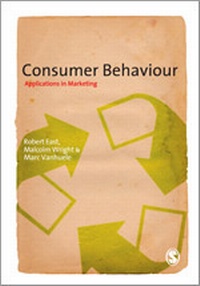
Consumer Behaviour
Applications in Marketing
1st Edition
Published on 19. May 2008
Book
Paperback/Softback
344 pages
978-1-4129-3431-2 (ISBN)
Description
'A wonderful (and very unusual) balance between areas of marketing that are often at odds with each other (or, worse yet, unaware of each other)... I recommend it to any student, researcher, or manager in marketing'
Peter Fader, Frances and Pei-Yuan Chia Professor; and Professor of Marketing, Wharton School, University of Pennsylvania
'Exceptional for the amount of relevant research that is presented and explained. Students who have read and understood this text are likely to be much more of use to industry'
Fergus Hampton, Managing Director, Millward Brown Precis
Written in a focused and accessible form by respected marketing academics, Consumer Behaviour helps readers to develop analytical and evidence-based thinking in marketing and avoid more formulaic approaches that lack the support of research. With a strong focus on the use of research, this book will really appeal to the specific needs of higher-level students.
The book covers important material that is often missing in consumer behaviour texts. For example, whole chapters are devoted to brand loyalty, brand equity, biases in decision-making, word of mouth, the response to price and the effect of advertising. Shorter reviews cover evidence on topics such as loyalty programmes, the response to delay and retail atmospherics. Chapters are quite short and divided into sections. Each chapter contains exercises designed to draw out key ideas and consolidate understanding, and there are suggestions for further reading.
A website to support the book has an Instructor's Manual that offers PowerPoint slides, discussion of exercises, computer programs, a suggested Masters-level course, and a Word file of references to assist students writing assignments.
Peter Fader, Frances and Pei-Yuan Chia Professor; and Professor of Marketing, Wharton School, University of Pennsylvania
'Exceptional for the amount of relevant research that is presented and explained. Students who have read and understood this text are likely to be much more of use to industry'
Fergus Hampton, Managing Director, Millward Brown Precis
Written in a focused and accessible form by respected marketing academics, Consumer Behaviour helps readers to develop analytical and evidence-based thinking in marketing and avoid more formulaic approaches that lack the support of research. With a strong focus on the use of research, this book will really appeal to the specific needs of higher-level students.
The book covers important material that is often missing in consumer behaviour texts. For example, whole chapters are devoted to brand loyalty, brand equity, biases in decision-making, word of mouth, the response to price and the effect of advertising. Shorter reviews cover evidence on topics such as loyalty programmes, the response to delay and retail atmospherics. Chapters are quite short and divided into sections. Each chapter contains exercises designed to draw out key ideas and consolidate understanding, and there are suggestions for further reading.
A website to support the book has an Instructor's Manual that offers PowerPoint slides, discussion of exercises, computer programs, a suggested Masters-level course, and a Word file of references to assist students writing assignments.
More details
Language
English
Place of publication
Thousand Oaks
United States
Target group
College/higher education
Dimensions
Height: 242 mm
Width: 170 mm
Weight
582 gr
ISBN-13
978-1-4129-3431-2 (9781412934312)
Copyright in bibliographic data and cover images is held by Nielsen Book Services Limited or by the publishers or by their respective licensors: all rights reserved.
Schweitzer Classification
Other editions
New editions
Book
01/2013
2nd Edition
SAGE Publications Ltd
€75.70
Article exhausted; check for reprint
Persons
Robert East is emeritus professor at Kingston Business School, Kingston University London and adjunct professor at the Ehrenberg-Bass Institute of the University of South Australia. He trained as a social psychologist and is a postgraduate of London Business School. His research has mainly focused on word-of-mouth patterns where his new evidence has shown that some widely-held beliefs are mistaken. As a teacher of consumer behaviour, he has been keen to deliver knowledge that is useful to students while not over simplifying the subject.
Malcolm Wright is professor of marketing at Massey University, New Zealand, and adjunct professor at the Ehrenberg-Bass Institute of the University of South Australia. He applies empirical principles to marketing problems and has made interrelated discoveries about brand loyalty, the use of probability scales, new product forecasting and optimizing the advertising budget. He has also published many articles critically examining the foundations of popular marketing knowledge.
Marc Vanhuele holds a PhD from UCLA and is professor of marketing at HEC Paris. As expert in consumer information processing, his research focuses on how consumers treat price information. A second field of research is how marketing managers can improve their decision making through better use of quantitative information on the consumer's mind-set. His research has been published in the leading academic journals. He also works as consultant to consumer goods and market research companies.
Malcolm Wright is professor of marketing at Massey University, New Zealand, and adjunct professor at the Ehrenberg-Bass Institute of the University of South Australia. He applies empirical principles to marketing problems and has made interrelated discoveries about brand loyalty, the use of probability scales, new product forecasting and optimizing the advertising budget. He has also published many articles critically examining the foundations of popular marketing knowledge.
Marc Vanhuele holds a PhD from UCLA and is professor of marketing at HEC Paris. As expert in consumer information processing, his research focuses on how consumers treat price information. A second field of research is how marketing managers can improve their decision making through better use of quantitative information on the consumer's mind-set. His research has been published in the leading academic journals. He also works as consultant to consumer goods and market research companies.
Content
PART ONE: INTRODUCTION
Ideas and Explanations in Consumer Research
PART TWO: CONSUMPTION PATTERNS
Customer Loyalty
Brand Knowledge, Brand Equity and Brand Extension
Stationary Markets
Market Dynamics
PART THREE: EXPLAINING DECISON-MAKING
Predicting and Explaining Behaviour
Information Processing and Decision-Making
Consumer Satisfaction and Quality
PART FOUR: MARKET RESPONSE
Consumer Response to Price and Sales Promotions
The Retail Context
Word-of-Mouth Influence
The Response to Advertising
Ideas and Explanations in Consumer Research
PART TWO: CONSUMPTION PATTERNS
Customer Loyalty
Brand Knowledge, Brand Equity and Brand Extension
Stationary Markets
Market Dynamics
PART THREE: EXPLAINING DECISON-MAKING
Predicting and Explaining Behaviour
Information Processing and Decision-Making
Consumer Satisfaction and Quality
PART FOUR: MARKET RESPONSE
Consumer Response to Price and Sales Promotions
The Retail Context
Word-of-Mouth Influence
The Response to Advertising