

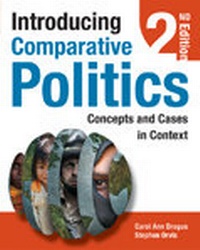
Introducing Comparative Politics
Concepts and Cases in Context
2nd Edition
Published on 2. August 2011
Book
Paperback/Softback
760 pages
978-1-60871-668-5 (ISBN)
Description
Uncomfortable with a strictly thematic approach, or tired of a purely country-by-country organization for your comparative politics course?
Teach the way you want to teach with this innovative hybrid book - fully accessible to students, easy to teach, and satisfying to professors who want to give students a real sense of the questions that drive research in the field. Organized thematically around important concepts in comparative politics - Who rules? What explains political behavior? Where and why? - the book integrates a set of extended case studies in eleven "core" countries. Serving as consistent geographic touchstones, the cases are set in chapters where they make the most sense substantively - not separated from theory or in a separate volume - and vividly illustrate issues in cross-national context.
Features include:
* Core country case studies: Brazil, China, Germany, Japan, India, Iran, Nigeria, Russia, the UK, the U.S., and, new to this edition, Mexico.
* NEW! Methods in Context boxes that model how comparativists do their research and analysis.
* In Context fact boxes that put eye-opening data into thematic context.
* Where and Why? boxes that explore why certain political outcomes occur in some countries but not in others.
* Country and Concept tables that display key indicators for core countries.
Updates and revisions include:
* recent elections around the world and the effects of the global financial crisis and its aftermath,
* authoritarian versus totalitarian regimes,
* ethnic violence,
* racial politics and identity,
* economic globalization,
* executive-legislative institutions, and
* the role of civil society in government.
Teach the way you want to teach with this innovative hybrid book - fully accessible to students, easy to teach, and satisfying to professors who want to give students a real sense of the questions that drive research in the field. Organized thematically around important concepts in comparative politics - Who rules? What explains political behavior? Where and why? - the book integrates a set of extended case studies in eleven "core" countries. Serving as consistent geographic touchstones, the cases are set in chapters where they make the most sense substantively - not separated from theory or in a separate volume - and vividly illustrate issues in cross-national context.
Features include:
* Core country case studies: Brazil, China, Germany, Japan, India, Iran, Nigeria, Russia, the UK, the U.S., and, new to this edition, Mexico.
* NEW! Methods in Context boxes that model how comparativists do their research and analysis.
* In Context fact boxes that put eye-opening data into thematic context.
* Where and Why? boxes that explore why certain political outcomes occur in some countries but not in others.
* Country and Concept tables that display key indicators for core countries.
Updates and revisions include:
* recent elections around the world and the effects of the global financial crisis and its aftermath,
* authoritarian versus totalitarian regimes,
* ethnic violence,
* racial politics and identity,
* economic globalization,
* executive-legislative institutions, and
* the role of civil society in government.
Reviews / Votes
I have never seen such a positive reaction to a textbook fromstudents, honestly. We have had a problem finding a suitable book for
this course. The end of course critiques had been blistering on the
subject of the text. Not this year! -- David Sacko The strength of the Drogus and Orvis text is the integration of
themes and case studies. This approach enhances the analytical
qualities of instruction as the case studies are embedded in thematic
coverage and provide a hands-on illustration of concepts and principles. -- Boyka Stefanova The "Where and Why" feature is a very effective way of
elaborating on a conceptual methodology that is a cornerstone of
comparative analysis without belaboring students with a complex
presentation of the comparative method. -- Dwayne Woods
More details
Edition
2nd Revised edition
Language
English
Place of publication
Washington
United States
Publishing group
SAGE Publications Inc
Target group
College/higher education
Edition type
Revised edition
Dimensions
Height: 254 mm
Width: 203 mm
Weight
1184 gr
ISBN-13
978-1-60871-668-5 (9781608716685)
Copyright in bibliographic data and cover images is held by Nielsen Book Services Limited or by the publishers or by their respective licensors: all rights reserved.
Schweitzer Classification
Other editions
New editions
Stephen Walter Orvis | Carol Ann Drogus
Introducing Comparative Politics
Concepts and Cases in Context
Book
03/2014
3rd Edition
CQ Press
€163.42
Article exhausted; check for reprint
Previous edition
Carol Ann Drogus | Stephen Walter Orvis
Introducing Comparative Politics
Concepts and Cases in Context
Book
10/2008
1st Edition
CQ Press
€69.51
Article exhausted; check for reprint
Persons
Carol Ann Drogus is a retired Professor of Government at Hamilton College. She is a specialist on Brazil, religion, and women's political participation. She taught introduction to comparative politics for more than twenty years, as well as courses on Latin American politics, gender and politics, and women in Latin America. She has written two books and numerous articles on the political participation of women in religious movements in Brazil.
Stephen Orvis is Professor of Government at Hamilton College. He is a specialist on sub-Saharan Africa (Kenya in particular), identity politics, democratic transitions, and the political economy of development. He has been teaching introduction to comparative politics for more than twenty-five years, as well as courses on African politics, nationalism and the politics of identity, political economy of development, and weak states. He has written a book and articles on agricultural development in Kenya, as well as several articles on civil society in Africa and Kenya, and is currently doing research on political institutions in Africa.
Stephen Orvis is Professor of Government at Hamilton College. He is a specialist on sub-Saharan Africa (Kenya in particular), identity politics, democratic transitions, and the political economy of development. He has been teaching introduction to comparative politics for more than twenty-five years, as well as courses on African politics, nationalism and the politics of identity, political economy of development, and weak states. He has written a book and articles on agricultural development in Kenya, as well as several articles on civil society in Africa and Kenya, and is currently doing research on political institutions in Africa.
Content
PART I: A FRAMEWORK FOR UNDERSTANDING COMPARATIVE POLITICS
Introduction
The Big Issues
Comparative Politics: What Is It? Why Study It? How to Study It?
Three Key Questions in Comparative Politics
Plan of the Book
The Modern State
Characteristics of the Modern State
Historical Origins of Modern States
Strong, Weak, and Failed States
Case Studies of State Formation
States and Citizens
Regimes Regimes, Ideologies, and Citizens
States and Identity
The Debate over Identity
Nations and Nationalism
Ethnicity and Religion
Race
States and Markets
The Market, Capitalism, and the State
Key Economic Debates
Globalization: A New World Order or Deja Vu All Over Again?
States and Markets around the World
PART II: POLITICAL SYSTEMS AND HOW THEY WORK
Governing Institutions in Democracies
Institutions Institutions: Executives and Legislatures
Comparing Executive-Legislative Institutions
Judiciary
Bureaucracy
Federalism
Institutions of Participation and Representation in Democracies
Formal Institutions: The Electoral System
Formal Institutions: Political Parties and Party Systems
Civil Society
Contexts
Authoritarian Institutions
Governing Institutions in Authoritarian Regimes
Elections, Parties, and Civil Society in Authoritarian Regimes
Regime Change
The Military in Politics: Coups d'Etat
Revolution
Democratization
PART III: ISSUES AND POLICIES
Globalization, Economic Sovereignty, and Development
Wealthy Countries: Globalization and Economic Sovereignty
Development and Globalization
Welfare, Health, and the Environment When Markets Fail
"Welfare": Social Policy in Comparative Perspective
Health Care and Health Policy
Environmental Problems and Policy
Policies and Politics of Inclusion and Clashing Values
The Debate over Inclusion and Group Rights
Religion: Recognition, Autonomy, and the Secular State
Gender: The Continuing Struggle for Equal Social Status, Representation, and Participation
Glossary
Index
Introduction
The Big Issues
Comparative Politics: What Is It? Why Study It? How to Study It?
Three Key Questions in Comparative Politics
Plan of the Book
The Modern State
Characteristics of the Modern State
Historical Origins of Modern States
Strong, Weak, and Failed States
Case Studies of State Formation
States and Citizens
Regimes Regimes, Ideologies, and Citizens
States and Identity
The Debate over Identity
Nations and Nationalism
Ethnicity and Religion
Race
States and Markets
The Market, Capitalism, and the State
Key Economic Debates
Globalization: A New World Order or Deja Vu All Over Again?
States and Markets around the World
PART II: POLITICAL SYSTEMS AND HOW THEY WORK
Governing Institutions in Democracies
Institutions Institutions: Executives and Legislatures
Comparing Executive-Legislative Institutions
Judiciary
Bureaucracy
Federalism
Institutions of Participation and Representation in Democracies
Formal Institutions: The Electoral System
Formal Institutions: Political Parties and Party Systems
Civil Society
Contexts
Authoritarian Institutions
Governing Institutions in Authoritarian Regimes
Elections, Parties, and Civil Society in Authoritarian Regimes
Regime Change
The Military in Politics: Coups d'Etat
Revolution
Democratization
PART III: ISSUES AND POLICIES
Globalization, Economic Sovereignty, and Development
Wealthy Countries: Globalization and Economic Sovereignty
Development and Globalization
Welfare, Health, and the Environment When Markets Fail
"Welfare": Social Policy in Comparative Perspective
Health Care and Health Policy
Environmental Problems and Policy
Policies and Politics of Inclusion and Clashing Values
The Debate over Inclusion and Group Rights
Religion: Recognition, Autonomy, and the Secular State
Gender: The Continuing Struggle for Equal Social Status, Representation, and Participation
Glossary
Index