

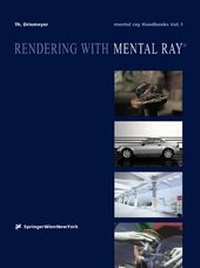
Rendering with mental ray®
Published on 18. May 2000
Book
Paperback/Softback
XI, 515 pages
978-3-211-83403-9 (ISBN)
Description
Written by the mental ray software project leader, this book gives a general introduction into rendering with mental ray(R), as well as step-by-step recipes for creating advanced effects, and tips and tricks for professional users. A comprehensive definition of mental rays scene description language and the standard shader libraries is included and used as the basis for all examples.
More details
Series
Language
English
Place of publication
Vienna
Austria
Publishing group
Springer Wien
Target group
College/higher education
Professional and scholarly
Illustrations
217
44 farbige Abbildungen, 217 s/w Abbildungen
glossary
Dimensions
Height: 27.9 cm
Width: 21 cm
Weight
1480 gr
ISBN-13
978-3-211-83403-9 (9783211834039)
DOI
10.1007/978-3-7091-3697-3
Schweitzer Classification
Other editions
New editions
Thomas Driemeyer
Rendering with mental ray®
Book
11/2005
3rd Edition
Springer
€106.99
Shipment within 10-15 days
Thomas Driemeyer
Rendering with mental ray®
Book
06/2001
2nd Edition
Springer
€85.59
Article exhausted; check for reprint
Additional editions
Thomas Driemeyer
Rendering with mental ray®
E-Book
04/2013
1st Edition
Springer
€85.59
Available for download
Content
1 Overview.- 2 Scene Construction.- 3 Cameras.- 4 Surface Shading.- 5 Light and Shadow.- 6 Volume Rendering.- 7 Caustics and Global Illumination.- 8 Motion Blur.- 9 Contours.- 10 Shaders and Phenomena.- 11 Postprocessing and Image Output.- 12 Geometric Objects.- 13 Instancing and Grouping.- 14 Inheritance.- 15 Incremental Changes and Animations.- 16 Using and Creating Shader Libraries.- 17 Parallelism.- 18 The Options Block.- 19 Quality and Performance Tuning.- 20 Troubleshooting.- Color Plates.- A Command Line Options.- A.1 mental ray.- A.2 Inventor mental ray.- A.3 Environment Variables.- A.4 Image Display: imf_disp.- A.5 Image Copy: imf_copy.- A.6 Image Information: imf_info.- A.7 Image Comparison: imf_diff.- A.8 Create Shader Skeletons: mkmishader.- A.9 Convert Scenes to C: mitoapi.- B The Sphere and Utah Teapot Models.- B.1 NURBS Sphere.- B.2 Utah Teapot.- C Base Shaders.- C.1 Overview.- C.2 Texture Space Mapping.- C.3 Environments.- C.4 Textures.- C.5 Sample Compositing.- C.6 Illumination.- C.7 Data Conversion.- C.8 Geometry.- C.9 Photon.- C.10 Light.- C.11 Shadow.- D Physics Shaders.- D.1 Lens Shader: physical_lens_dof.- D.2 Light Shader: physical_light.- D.3 Materials.- D.4 Photon Tracing.- D.5 Participating Media.- D.6 Photon Tracing in Participating Media.- E Contour Shaders.- E.1 Contour Store Shaders.- E.2 Contour Contrast Shaders.- E.3 Material Contour Shaders.- E.4 Contour Output Shaders.