

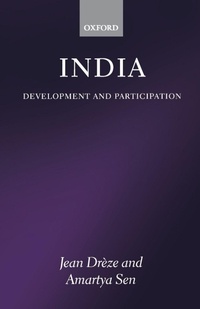
India
Development and Participation
2nd Edition
Published on 22. August 2002
Book
Paperback/Softback
542 pages
978-0-19-925749-2 (ISBN)
Description
This book explores the role of public action in eliminating deprivation and expanding human freedoms in India. The analysis is based on a broad and integrated view of development, which focuses on well-being and freedom rather than the standard indicators of economic growth. The authors place human agency at the centre of stage, and stress the complementary roles of different institutions (economic, social, and political) in enhancing effective freedoms.
In comparative international perspective, the Indian economy has done reasonably well in the period following the economic reforms initiated in the early nineties. However, relatively high aggregate economic growth coexists with the persistence of endemic deprivation and deep social failures. Jean Dreze and Amartya Sen relate this imbalance to the continued neglect, in the post-reform period, of public involvement in crucial fields such as basic education, health care, social security, environmental protection, gender equity, and civil rights, and also to the imposition of new burdens such as the accelerated expansion of military expenditure. Further, the authors link these distortions of public priorities with deep-seated inequalities of social influence and political power. The book discusses the possibility of addressing these biases through more active democratic practice.
In comparative international perspective, the Indian economy has done reasonably well in the period following the economic reforms initiated in the early nineties. However, relatively high aggregate economic growth coexists with the persistence of endemic deprivation and deep social failures. Jean Dreze and Amartya Sen relate this imbalance to the continued neglect, in the post-reform period, of public involvement in crucial fields such as basic education, health care, social security, environmental protection, gender equity, and civil rights, and also to the imposition of new burdens such as the accelerated expansion of military expenditure. Further, the authors link these distortions of public priorities with deep-seated inequalities of social influence and political power. The book discusses the possibility of addressing these biases through more active democratic practice.
Reviews / Votes
Review from previous edition a very meticulous and persuasive analytical picture . . . altogether a model of empirical economics with a heart * Ashok V. Desai, The Book Review * Highly illuminating . . . an exceptionally impressive analysis, rich with implications * Cass R. Sunstein, The New Republic * a fine account of India's achievements and failures . . . it will be a starting point of subsequent discussions on social life in India * Partha Dasgupta, Times Higher Education Supplement *More details
Edition
2nd Revised edition
Language
English
Place of publication
Oxford
United Kingdom
Target group
College/higher education
Professional and scholarly
Edition type
Revised edition
Illustrations
numerous figures and tables
Dimensions
Height: 216 mm
Width: 140 mm
Thickness: 32 mm
Weight
756 gr
ISBN-13
978-0-19-925749-2 (9780199257492)
Copyright in bibliographic data and cover images is held by Nielsen Book Services Limited or by the publishers or by their respective licensors: all rights reserved.
Schweitzer Classification
Other editions
Previous edition
Book
01/1999
Clarendon Press
€93.20
Shipment within 15-20 days
Persons
Jean Dreze is a Visiting Professor at the Delhi School of Economics and an international authority on development economics. His association with India goes back more than twenty years during which time he has studied the issues in India minutely and has authored many books, research papers, and newspaper articles on education, poverty, development, nuclear doctrine, freedom of information, and the Narmada Struggle.; Amartya Sen is the Master of Trinity College, Cambridge, and the winner of the 1998 Nobel Prize in Economic Science. He has been President of the Indian Economic Association, the American Economic Association, the International Economic Association, and the Econometric Society. He has taught at Calcutta, Delhi, Oxford, Cambridge, the London School of Economics, and Harvard.
Content
1. Introduction and Approach ; 2. Economic Development and Social Opportunity ; 3. India in Comparative Perspective ; 4. India and China ; 5. Basic Education as a Political Issue ; 6. Population, Health, and the Environment ; 7. Gender Inequality and Women's Agency ; 8. Security and Democracy in a Nuclear India ; 9. Well Beyond Liberalization ; 10. The Practice of Democracy