

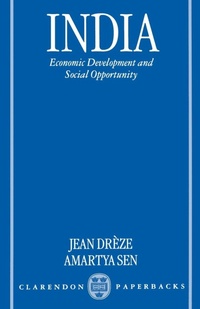
India
Economic Development and Social Opportunity
Published on 28. January 1999
Book
Paperback/Softback
306 pages
978-0-19-829528-0 (ISBN)
Description
This book presents analysis of endemic deprivation in India and the role of public action in addressing the problem. The analysis is based on a broad view of economic development, focusing on human well-being and 'social opportunity' rather than the standard indicators of economic growth.
India's success in reducing deprivation since Independence has been limited. Recent diagnoses of this failure of policy have concentrated on the counterproductive role of government regulation, and on the need for economic incentives to accelerate the economy. Professors Dreze and Sen argue that an assessment of India's failure to eliminate basic deprivations has to go beyond this limited focus, and to take note of the role played in that failure by inadequate public involvement in the provision of basic education, health care, social security, and related fields. Even the fostering of fast and participatory economic growth requires some basic social change, which is not addressed by liberalization and economic incentives. The authors also discuss the historical antecedents of these political and social neglects, including the distortion of policy priorities arising from inequalities of political power. Following on from this, the book considers the scope for public action to address these earlier biases and achieve a transformation of policy priorities.
` ... a fine account of India's achievements and failures ... written throughout in a fine style ... it will be a starting-point of subsequent discussions on social life in India.'
Partha Dasgupta, Times Higher Education Supplement
India's success in reducing deprivation since Independence has been limited. Recent diagnoses of this failure of policy have concentrated on the counterproductive role of government regulation, and on the need for economic incentives to accelerate the economy. Professors Dreze and Sen argue that an assessment of India's failure to eliminate basic deprivations has to go beyond this limited focus, and to take note of the role played in that failure by inadequate public involvement in the provision of basic education, health care, social security, and related fields. Even the fostering of fast and participatory economic growth requires some basic social change, which is not addressed by liberalization and economic incentives. The authors also discuss the historical antecedents of these political and social neglects, including the distortion of policy priorities arising from inequalities of political power. Following on from this, the book considers the scope for public action to address these earlier biases and achieve a transformation of policy priorities.
` ... a fine account of India's achievements and failures ... written throughout in a fine style ... it will be a starting-point of subsequent discussions on social life in India.'
Partha Dasgupta, Times Higher Education Supplement
More details
Language
English
Place of publication
Oxford
United Kingdom
Publishing group
Oxford University Press
Target group
Professional and scholarly
Illustrations
1 map
Dimensions
Height: 216 mm
Width: 140 mm
Thickness: 18 mm
Weight
437 gr
ISBN-13
978-0-19-829528-0 (9780198295280)
Copyright in bibliographic data and cover images is held by Nielsen Book Services Limited or by the publishers or by their respective licensors: all rights reserved.
Schweitzer Classification
Other editions
New editions
Book
08/2002
2nd Edition
Oxford University Press
€77.20
Shipment within 15-20 days
Additional editions
Jean Dreze | Amartya Sen
India: Economic Development and Social Opportunity
Economic Development and Social Opportunity
Book
04/1996
Clarendon Press
€134.70
Shipment within 15-20 days
Persons
Content
1. Introduction ; 2. Economic Development through Social Opportunity ; 3. India in Comparative Perspective ; 4. China and India ; 5. Public Action and Social Inequality ; 6. Basic Education as a Political Issue ; 7. Gender Inequality and Women's Agency ; 8. Well Beyond Liberalization ; Statistical Appendix