

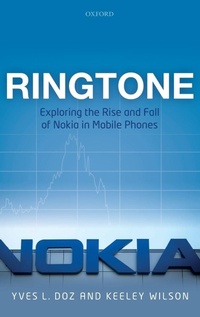
Ringtone
Exploring the Rise and Fall of Nokia in Mobile Phones
Published on 2. November 2017
Book
Hardback
204 pages
978-0-19-877719-9 (ISBN)
Description
In less than three decades, Nokia emerged from Finland to lead the mobile phone revolution. It grew to have one of the most recognizable and valuable brands in the world and then fell into decline, leading to the sale of its mobile phone business to Microsoft. This book explores and analyzes that journey and distils observations and learning points for anyone keen to understand what drove Nokia's amazing success and sudden downfall.
With privileged access to Nokia's senior managers over the last twenty years followed by a more concerted research agenda from 2015, the authors describe and analyze, the various stages in Nokia's journey. The book describes leaders making strategic and organizational decisions, their behavior and interactions, and how they succeeded and failed to inspire and engage their employees. Perhaps most intriguingly, it opens the proverbial 'black box' of why and how things actually happen at the top of organizations.
Why did things fall apart? To what extent were avoidable mistakes made? Did the world around Nokia change too fast for it to adapt? And, did Nokia's success contain the seeds of its failure?
With privileged access to Nokia's senior managers over the last twenty years followed by a more concerted research agenda from 2015, the authors describe and analyze, the various stages in Nokia's journey. The book describes leaders making strategic and organizational decisions, their behavior and interactions, and how they succeeded and failed to inspire and engage their employees. Perhaps most intriguingly, it opens the proverbial 'black box' of why and how things actually happen at the top of organizations.
Why did things fall apart? To what extent were avoidable mistakes made? Did the world around Nokia change too fast for it to adapt? And, did Nokia's success contain the seeds of its failure?
Reviews / Votes
An insightful analysis of a company I thought I knew well. If only Nokia's leadership had had this knowledge earlierbut as we know, this is never the case! Two key takeaways: there is always a human and human relationships in the center and secondly, navigating complexity is of paramount importance going forward. Today more than ever. * Antti Herlin, Chairman of Kone Corporation * Doz and Wilson offer a sharp and insightful analysis of the rise and fall of Nokia. Doz's long-term involvement with Nokia is reflected in the key contribution of the book - a captivating account of the collapse of Nokia's mobile phone business that combines environmental explanations such as creative destruction with a reflection of strategic decisions made at key turning points. A must read for anyone interested in Nokia's recent history. * Eero Vaara, Professor of Organization and Management, Aalto University School of Business * This carefully crafted account of the rise and fall of Nokia provides academics and practitioners alike a clear account of the antecedents of corporate success and also failure. By showcasing the enablers and disablers of this once powerful company readers can perhaps learn to achieve the elusive goal of building organizations that last! * Ranjay Gulati, Jaime and Josefina Chua Tiampo Professor of Business Administration, Harvard Business School * The Authors dig beyond generally accepted wisdom to show that Nokia DID understand all the challenges ahead but crucially lacked the ability to implement the changes required to transition from an entrepreneurial hardware company to an internet platform provider. The rigorous analysis and explanation offer valuable lessons to everyone. * Andrea Cuomo, Executive Vice President, Advanced Systems Technology, STMicroelectronics * Ringtone is an eminently readable and incisive account of the dramatic rise and radical collapse of the Nokia mobile handset business. Its analytics provide valuable lessons well beyond both the case and the field of business strategy. * John Zysman, Professor of Political Science, University of California, Berkeley * Doz and Wilson's cognition-organization-relationships-emotion (CORE) framework serves to construct a convincing explanation for Nokia's dramatic change of fortunes during the early 21st century. Their book will become an indispensable reference for the study of managerial responses to technological disruption. * Robert Burgelman, Edmund W Littlefield Professor of Management, Stanford Graduate School of Business * The book's greatest achievement is a management theory. If you want to learn about the management and development organizations, the book thus offers a very interesting perspective as a case study. * Petri Sajari, Helsingin Sanomat *More details
Language
English
Place of publication
Oxford
United Kingdom
Target group
College/higher education
Professional and scholarly
Dimensions
Height: 240 mm
Width: 161 mm
Thickness: 16 mm
Weight
476 gr
ISBN-13
978-0-19-877719-9 (9780198777199)
Copyright in bibliographic data and cover images is held by Nielsen Book Services Limited or by the publishers or by their respective licensors: all rights reserved.
Schweitzer Classification
Other editions
Additional editions
E-Book
01/2018
1st Edition
OUP eBook
€39.49
Available for download
E-Book
10/2017
1st Edition
OUP eBook
€39.49
Available for download
Persons
Yves Doz is the Solvay Chaired Professor of Technological Innovation at INSEAD. He was Dean of Executive Education (1998-2002) and Associate Dean for Research and Development (1990-5) at INSEAD. His research on the strategy and organization of multinational companies led to numerous publications, including several books, in particular The Multinational Mission: Balancing Local Demands and Global Vision, co-authored with CK. Prahalad (1987) and From Global to Metanational: How Companies Win in the Knowledge Economy co-authored with Jose Santos and Peter Williamson (Harvard Business School Press, 2001). His research work won numerous awards, in particular a Distinguished Scholar Award from the Academy of Management (2003) and an election as "Inaugural Fellow of the Strategic Management Society" (2005). Prof. Doz was elected Fellow of the Academy of Management (2006), and was also nominated by The Economist as one of a handful of European 'Management Gurus'.
Keeley Wilson is Senior Researcher at INSEAD. For almost twenty years Keeley's work in both research and consulting has focused on global innovation strategies, management and processes, strategic alliances, and leadership challenges in complex environments. She has undertaken projects throughout Europe, the USA, and Asia at a wide range of companies including HP, Novartis, Shell, Siemens, Reuters, Schneider, and Xerox.
Keeley Wilson is Senior Researcher at INSEAD. For almost twenty years Keeley's work in both research and consulting has focused on global innovation strategies, management and processes, strategic alliances, and leadership challenges in complex environments. She has undertaken projects throughout Europe, the USA, and Asia at a wide range of companies including HP, Novartis, Shell, Siemens, Reuters, Schneider, and Xerox.
Content
1: A Shooting Star
2: The Planetary Alignment was Right
3: We Were the Only Ones to See It
4: A Rising Star
5: Attracting the Planets
6: A Supernova
7: A Fading Star
8: Toward A New Alignment?
9: The Astronomer's Perspective
Appendix 1: Management Lessons
Appendix 2: Chronology of Key Events by Chapter
Appendix 3: Abbreviations
Appendix 4: Who's Who
Appendix 5: Selected Financial and Personnel Data
Appendix 6: The Research
2: The Planetary Alignment was Right
3: We Were the Only Ones to See It
4: A Rising Star
5: Attracting the Planets
6: A Supernova
7: A Fading Star
8: Toward A New Alignment?
9: The Astronomer's Perspective
Appendix 1: Management Lessons
Appendix 2: Chronology of Key Events by Chapter
Appendix 3: Abbreviations
Appendix 4: Who's Who
Appendix 5: Selected Financial and Personnel Data
Appendix 6: The Research