

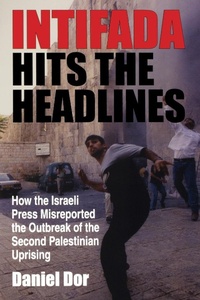
Intifada Hits the Headlines
How the Israeli Press Misreported the Outbreak of the Second Palestinian Uprising
Published on 18. February 2004
Book
Paperback/Softback
200 pages
978-0-253-21637-3 (ISBN)
Description
In this nuanced and detailed study of newspaper reporting during the escalation of the second Intifada in the fall of 2000, Daniel Dor shows how real events are subject to distortion and manipulation by the media. In an analysis of the heart of Israel's media establishment-the newspapers Yediot Ahronot, Ma'ariv, and Ha'aretz-he finds a wide gap between the reality reported by field reporters and the eventual newspaper accounts framed by editors. Led by beliefs, opinions, and emotional responses rather than the facts provided by their reporters, these editors created a platform on which a new and fearful narrative for Israeli-Palestinian relations was built. Yet while Dor demonstrates that the media construct the news rather than simply report it, his sophisticated analysis also shows that no one entity or person is responsible. Rather than a supreme authority, Dor argues, it is the influence of fear, anger, ignorance, and a desire to please and sell newspapers that threatens the freedom of the press in a liberal democracy.
Reviews / Votes
"If more studies like Dor's were published, audiences worldwide might recognize how poorly news is reported and written and take measures to resist. Dor (communication, Tel Aviv Univ.) scrutinized the news coverage of the first month (October 2000) of the Intifada in Israel's three largest dailies, Yediot Ahrenot, Ma'ariv, and Ha'aretz. Using ten parameters (positioning, graphic saliency, headline wording, etc.), he analyzed all material; he then interviewed 18 senior editors, reporters, and senior commentators to discover their rationale for what he called a one-sided, partial, censored, and biased picture of reality. His conclusions are shocking yet not surprising, in the context of subsequent coverage of terrorism and the Iraq War. The contrast between what reporters sent in and what was printed was stark. The editors had their own agendas (obtained from television reports), and though they knew far less about the intricacies of the general picture than senior reporters, they adopted the political and military establishment's judgments to prevent friction with the powers-that-be. The result was public-be-damned journalism that presented the conflict in administratively engineered language, loaded-with-blame (placed on Arafat) commentaries, under apocalyptic and hysterical headlines. Similar studies of television news coverage would likely reveal a situation many times worse. Summing Up: Essential. Upper-division undergraduates through faculty and professionals; general readers.October 2004"-J. A. Lent, Temple UniversityMore details
Series
Language
English
Place of publication
Bloomington, IN
United States
Target group
Professional and scholarly
Product notice
Paperback (trade)
Dimensions
Height: 234 mm
Width: 156 mm
Thickness: 10 mm
Weight
310 gr
ISBN-13
978-0-253-21637-3 (9780253216373)
Copyright in bibliographic data and cover images is held by Nielsen Book Services Limited or by the publishers or by their respective licensors: all rights reserved.
Schweitzer Classification
Person
Daniel Dor teaches in the Department of Communication, Tel Aviv University. A graduate of Stanford University, he has worked as a senior news editor at two of Israel's leading newspapers. He lives in Tel Aviv.
Content
Table of Contents:
Preface
Acknowledgments
1. Introduction
2. "Under Arafat's Baton"
3. "Make No Mistake, Yasser"
4. "The Limits of Restraint"
5. "A Fifth Column"
6. In All Their Murderous Ugliness"
7. "We Have Turned Every Stone"
8. Conclusion
Notes
Bibliography
Index
Preface
Acknowledgments
1. Introduction
2. "Under Arafat's Baton"
3. "Make No Mistake, Yasser"
4. "The Limits of Restraint"
5. "A Fifth Column"
6. In All Their Murderous Ugliness"
7. "We Have Turned Every Stone"
8. Conclusion
Notes
Bibliography
Index