

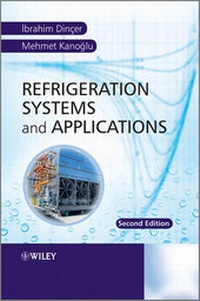
Refrigeration Systems and Applications
2nd Edition
Published on 7. June 2010
Book
Hardback
482 pages
978-0-470-74740-7 (ISBN)
Description
Refrigeration Systems and Applications, 2nd edition offers a comprehensive treatise that addresses real-life technical and operational problems, enabling the reader to gain an understanding of the fundamental principles and the practical applications of refrigeration technology. New and unique analysis techniques (including exergy as a potential tool), models, correlations, procedures and applications are covered, and recent developments in the field are included - many of which are taken from the author's own research activities in this area. The book also includes some discussion of global warming issues and its potential solutions.
* Enables the reader to gain an understanding of the fundamental principles and the practical applications of refrigeration technologies.
* Discusses crucial industrial technical and operational problems, as well as new performance improvement techniques and tools for better design and analysis.
* Includes fundamental aspects of thermodynamics, fluid flow, and heat transfer; refrigerants; refrigeration cycles and systems; advanced refrigeration cycles and systems, including some novel applications; heat pumps; heat pipes; and many more.
* Provides easy to follow explanations, numerous new chapter-end problems and worked-out examples as learning aids for students and instructors.
Refrigeration is extensively used in a variety of thermal engineering applications ranging from the cooling of electronic devices to food cooling processes. Its wide-ranging implications and applications mean that this industry plays a key role in national and international economies, and it continues to be an area of active research and development. Refrigeration Systems and Applications, 2nd edition forms a useful reference source for graduate and postgraduate students and researchers in academia and as well as practicing engineers working in this important field who are interested in refrigeration systems and applications and the methods and analysis tools for their analysis, design and performance improvement.
Reviews / Votes
"This second edition of a reference for students, researchers, and engineers now includes study problems and questions in each chapter, making it appropriate as a textbook. It also contains new energy and exergy analyses." (Book News, September 2010)More details
Edition
2. Auflage
Language
English
Place of publication
Hoboken
United States
Publishing group
John Wiley and Sons Ltd
Target group
College/higher education
Professional and scholarly
Dimensions
Height: 24.4 cm
Width: 16.8 cm
Thickness: 3 cm
Weight
982 gr
ISBN-13
978-0-470-74740-7 (9780470747407)
Schweitzer Classification
Other editions
New editions
Ibrahim Dincer
Refrigeration Systems and Applications
Book
04/2017
3rd Edition
Wiley
€139.50
Shipment within 15-20 days
Previous edition

Ibrahim Dincer
Refrigeration Systems and Applications
Book
05/2003
1st Edition
Wiley
€149.00
Article exhausted; check for reprint
Persons
Ibrahim Dincer is Professor of Mechanical Engineering withinthe Faculty of Engineering and Applied Science at UOIT. Hisresearch interests include energy and energy conversion management,heat and mass transfer, thermodynamics, drying, refrigeration andthermal energy storage. He has received numerous awards forexcellence in research, and is the Editor-in-Chief of the WileyInternational Journal of Energy Research as well as the Elsevierjournal Exergy An International Journal. He has authored orco-authored 5 books Exergy, 2006, Elsevier, Porous Media in Modern Technologies, Springer, 2004, Refrigeration Systems and Applications, Wiley, 2003, Thermal Energy Storage Systems and Applications, Wiley 2002,and Heat Transfer in Food Cooling Applications, Taylor &Francis, 2003. Mehmet Kanoglu is an Associate Professor within theDepartment of Mechanical Engineering at the University of Gaziantepin Turkey. He has authored over 30 international journal andconference papers, and his research interests includethermodynamics in the power and energy industries.
Content
Contents
About the Authors
Preface
Acknowledgements
1. General Aspects of Thermodynamics, Fluid Flow, and Heat Transfer
1.1 Introduction
1.2 Thermodynamic Properties
1.3 Ideal Gases
1.4 Energy Change and Energy Transfer
1.5 The First Law of Thermodynamics
1.6 Refrigerators and Heat Pumps
1.7 The Carnot Refrigeration Cycle
1.8 The Second Law of Thermodynamics
1.9 Exergy
1.10 Psychrometrics
1.11 General Aspects of Fluid Flow
1.12 General Aspects of Heat Transfer
1.13 Conclusions
Nomenclature
References
Problems
2. Refrigerants
2.1 Introduction
2.2 Classification of Refrigerants
2.3 Prefixes and Decoding of Refrigerants
2.4 Secondary Refrigerants
2.5 Refrigerant-Absorbent Combinations
2.6 Stratospheric Ozone Layer
2.7 Greenhouse Effect (Global Climate Change)
2.8 Clean Air Act (CAA)
2.9 Alternative Refrigerants
2.10 Selection of Refrigerants
2.11 Thermophysical Properties of Refrigerants
2.12 Lubricating Oils and Their Effects
2.13 Conclusions
References
Problems
3. Refrigeration System Components
3.1 Introduction
3.2 History of Refrigeration
3.3 Main Refrigeration Systems and Cycles
3.4 Refrigeration System Components
3.5 Compressors
3.6 Condensers
3.7 Evaporators
3.8 Throttling Devices
3.9 Auxiliary Devices
3.10 Conclusions
Nomenclature
References
Problems
4. Refrigeration Cycles and Systems
4.1 Introduction
4.2 Vapor-Compression Refrigeration Systems
4.3 Energy Analysis of Vapor-Compression Refrigeration Cycle
4.4 Exergy Analysis of Vapor-Compression Refrigeration Cycle
4.5 Practical Vapor-Compression Refrigeration Cycle
4.6 Air-Standard Refrigeration Systems
4.7 Absorption Refrigeration Systems (ARSs)
4.8 Conclusions
Nomenclature
References
Problems
5. Advanced Refrigeration Cycles and Systems
5.1 Introduction
5.2 Multistage Refrigeration Cycles
5.3 Cascade Refrigeration Systems
5.4 Liquefaction of Gases
5.5 Steam Jet Refrigeration Systems
5.6 Thermoelectric Refrigeration
5.7 Thermoacoustic Refrigeration
5.8 Metal Hydride Refrigeration Systems
5.9 Solar Refrigeration
5.10 Magnetic Refrigeration
5.11 Supermarket Refrigeration
5.12 Conclusions
Nomenclature
References
Problems
6. Heat Pumps
6.1 Introduction
6.2 Heat Pumps
6.3 Sectoral Heat Pump Utilization
6.4 Heat Pump Applications in Industry
6.5 Heat Sources
6.6 Classification of Heat Pumps
6.7 Solar Heat Pumps
6.8 Ice Source Heat Pumps
6.9 Main Heat Pump Systems
6.10 Vapor-Compression Heat Pump Systems
6.11 Energy Analysis of Vapor-Compression Heat Pump Cycle
6.12 Exergy Analysis of Vapor-Compression Heat Pump Cycle
6.13 Mechanical-Vapor-Recompression Heat Pump Systems
6.14 Cascaded Heat Pump Systems
6.15 Rankine Powered Heat Pump Systems
6.16 Quasi Open Cycle Heat Pump Systems
6.17 Vapor Jet Heat Pump Systems
6.18 Chemical Heat Pump Systems
6.19 Metal Hydride Heat Pump Systems
6.20 Thermoelectric Heat Pump Systems
6.21 Resorption Heat Pump Systems
6.22 Absorption Heat Pump (AHP) Systems
6.23 Heat Transformer Heat Pump Systems
6.24 Refrigerants and Working Fluids
6.25 Technical Aspects of Heat Pumps
6.26 Operational Aspects of Heat Pumps
6.27 Performance Evaluation Aspects of Heat Pumps
6.28 Ground Source Heat Pumps
6.29 Heat Pumps and Energy Savings
6.30 Heat Pumps and Environmental Impacts
6.31 Conclusions
Nomenclature
References
Problems
7 Heat Pipes
7.1 Introduction
7.2 Heat Pipes
7.3 Heat Pipe Applications
7.4 Heat Pipes for Electronics Cooling
7.5 Types of Heat Pipes
7.6 Heat Pipe Components
7.7 Operational Principles of Heat Pipes
7.8 Heat Pipe Performance
7.9 Design and Manufacture of Heat Pipes
7.10 Heat Transfer Limitations
7.11 Heat Pipes in HVAC
7.12 Conclusions
Nomenclature
References
Problems
Appendix A - Conversion Factors
Appendix B - Thermophysical Properties
Subject Index