

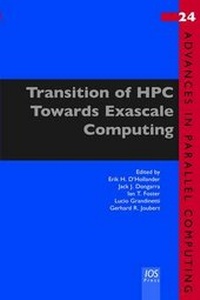
Transition of HPC Towards Exascale Computing
1st Edition
Published on 15. October 2013
Book
Hardback
232 pages
978-1-61499-323-0 (ISBN)
Description
The US, Europe, Japan and China are racing to develop the next generation of supercomputers - exascale machines capable of 10 to the 18th power calculations a second - by 2020. But the barriers are daunting: the challenge is to change the paradigm of high-performance computing.
The 2012 biennial high performance workshop, held in Cetraro, Italy in June 2012, focused on the challenges facing the computing research community to reach exascale performance in the next decade. This book presents papers from this workshop, arranged into four major topics: energy, scalability, new architectural concepts and programming of heterogeneous computing systems.
Chapter 1 introduces the status of present supercomputers, which are still about two orders of magnitude separated from the exascale mark. Chapter 2 examines energy demands, a major limiting factor of today's fastest supercomputers; the quantum leap in performance required for exascale computing will require a shift in architectures and technology. In Chapter 3, scalable computer paradigms for dense linear algebra on massive heterogeneous systems are presented, and Chapter 4 discusses architectural concepts. Finally, Chapter 5 addresses the programming of heterogeneous systems.
This book will be of interest to all those wishing to understand how the development of modern supercomputers is set to advance in the next decade.
The 2012 biennial high performance workshop, held in Cetraro, Italy in June 2012, focused on the challenges facing the computing research community to reach exascale performance in the next decade. This book presents papers from this workshop, arranged into four major topics: energy, scalability, new architectural concepts and programming of heterogeneous computing systems.
Chapter 1 introduces the status of present supercomputers, which are still about two orders of magnitude separated from the exascale mark. Chapter 2 examines energy demands, a major limiting factor of today's fastest supercomputers; the quantum leap in performance required for exascale computing will require a shift in architectures and technology. In Chapter 3, scalable computer paradigms for dense linear algebra on massive heterogeneous systems are presented, and Chapter 4 discusses architectural concepts. Finally, Chapter 5 addresses the programming of heterogeneous systems.
This book will be of interest to all those wishing to understand how the development of modern supercomputers is set to advance in the next decade.
More details
Series
Language
English
Place of publication
London
Netherlands
Publishing group
IOS Press
Target group
Professional and scholarly
ISBN-13
978-1-61499-323-0 (9781614993230)
Copyright in bibliographic data and cover images is held by Nielsen Book Services Limited or by the publishers or by their respective licensors: all rights reserved.
Schweitzer Classification
Other editions
Additional editions
Erik H. D'hollander | Jack J. Dongarra | Ian Foster
Transition of HPC Towards Exascale Computing
E-Book
10/2013
1st Edition
IOS Press,US
€135.99
Available for download