

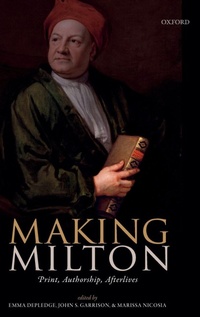
Making Milton
Print, Authorship, Afterlives
Published on 4. March 2021
Book
Hardback
272 pages
978-0-19-882189-2 (ISBN)
Description
This volume consists of fourteen original essays that showcase the latest thinking about John Milton's emergence as a popular and canonical author. Contributors consider how Milton positioned himself in relation to the book trade, contemporaneous thinkers, and intellectual movements, as well as how his works have been positioned since their first publication.
The individual chapters assess Milton's reception by exploring how his authorial persona was shaped by the modes of writing in which he chose to express himself, the material forms in which his works circulated, and the ways in which his texts were re-appropriated by later writers. The Milton that emerges is one who actively fashioned his reputation by carefully selecting his modes of writing, his language of composition, and the stationers with whom he collaborated. Throughout the volume, contributors also demonstrate the profound impact Milton and his works have had on the careers of a variety of agents, from publishers, booksellers, and fellow writers to colonizers in Mexico and South America.
The individual chapters assess Milton's reception by exploring how his authorial persona was shaped by the modes of writing in which he chose to express himself, the material forms in which his works circulated, and the ways in which his texts were re-appropriated by later writers. The Milton that emerges is one who actively fashioned his reputation by carefully selecting his modes of writing, his language of composition, and the stationers with whom he collaborated. Throughout the volume, contributors also demonstrate the profound impact Milton and his works have had on the careers of a variety of agents, from publishers, booksellers, and fellow writers to colonizers in Mexico and South America.
Reviews / Votes
The collection is worth reading for anyone interested in some of the ways in which an old preoccupation in Milton Studies is being reframed and reexamined...This volume is a useful introduction to the conversation as it now stands and to some of the directions it is likely to take in the near future. * Louis Schwartz, Milton Quarterly * Making Milton features an impressive range of essays by well-established and emerging Miltonists ... The collection is unique in its consideration of Milton's complete oeuvre and the mutually beneficial relationships Milton enjoyed with his publishers, peers, and readers ... an important, timely contribution to Milton studies. * P. E. Phillips, CHOICE * This is a capacious and varied collection that touches on many different aspects of Milton's life and legacy ... the volume offers an opportunity to reflect on the nature of authorship and to admire the fluidity and plurality of a writer who made a strong claim to integrity and singularity. * Jason Scott-Warren, Review of English Studies *More details
Language
English
Place of publication
Oxford
United Kingdom
Target group
Professional and scholarly
Illustrations
5 Illustrations
Dimensions
Height: 240 mm
Width: 161 mm
Thickness: 19 mm
Weight
567 gr
ISBN-13
978-0-19-882189-2 (9780198821892)
Copyright in bibliographic data and cover images is held by Nielsen Book Services Limited or by the publishers or by their respective licensors: all rights reserved.
Schweitzer Classification
Other editions
Additional editions
E-Book
03/2021
1st Edition
OUP eBook
€60.99
Available for download
E-Book
03/2021
1st Edition
OUP eBook
€60.99
Available for download
Persons
Emma Depledge is Assistant Professor of English Literature, 1500-1790 at the Universite de Neuchatel. She is the author of Shakespeare's Rise to Cultural Prominence: Print, Politics and Alteration, 1642-1700 (CUP, 2018) and co-editor of Canonising Shakespeare: Stationers and the Book Trade, 1640-1740 (CUP, 2017). She writes the annual review of texts and editions for Shakespeare Survey and is an associate editor for English Studies.
John S. Garrison is Professor of English at Grinnell College, where he teaches courses on early modern literature and culture. His recent books include Shakespeare at Peace (with Kyle Pivetti, Routledge, 2018) and Shakespeare and the Afterlife (Oxford University Press, 2019).
Marissa Nicosia is Assistant Professor of Renaissance Literature at The Pennsylvania State University--Abington College. She is co-editor of Renaissance Futures, a special volume of Explorations in Renaissance Culture (2019), and she has published articles on early modern literature in journals such as Modern Philology, Milton Studies, and The Papers of the Bibliographical Society of America. She is a member of the executive council of the Milton Society of America.
John S. Garrison is Professor of English at Grinnell College, where he teaches courses on early modern literature and culture. His recent books include Shakespeare at Peace (with Kyle Pivetti, Routledge, 2018) and Shakespeare and the Afterlife (Oxford University Press, 2019).
Marissa Nicosia is Assistant Professor of Renaissance Literature at The Pennsylvania State University--Abington College. She is co-editor of Renaissance Futures, a special volume of Explorations in Renaissance Culture (2019), and she has published articles on early modern literature in journals such as Modern Philology, Milton Studies, and The Papers of the Bibliographical Society of America. She is a member of the executive council of the Milton Society of America.
Content
1: Emma Depledge, John S. Garrison, and Marissa Nicosia: What Made Milton?
PART ONE: MILTON AND THE BOOK TRADE
2: Stephen B. Dobranski: Milton and Transcendent Authorship
3: Blaine Greteman: Making Connections with Milton's Epitaphium Damonis
4: Emma Depledge: Repackaging Milton for the Late Seventeenth-Century Book Trade: Jacob Tonson, Paradise Lost, and John Dryden's The State of Innocence
5: Thomas N. Corns: Joseph Addison and the Domestication of Paradise Lost
PART TWO: MILTON'S CONSTRUCTION OF AN AUTHORIAL IDENTITY
6: Noam Reisner: Young Milton's Pauline Temper
7: David Loewenstein: Milton's Ludlow Maske and Remaking English Nationhood
8: Rachel Willie: Inscribing Textuality: Milton, Davenant, Authorship, and the Performance of Print
9: John K. Hale: 'Londini sum natus': The Latin Voice of Milton's Life-Account in Defensio Secunda
10: Antoinina Bevan Zlatar: Milton among the Iconoclasts
11: Kyle Pivetti: 'Do I Amuse You?: Milton's Muse and the Dangers of Erotic Inspiration'
PART THREE: MILTON'S AFTERLIVES
12: Lara Dodds: Making Milton's Bogey: Or, Anne Finch Reads John Milton
13: Angelica Duran: Mexican Miltons
14: Neil Forsyth: Milton's Erotic Dramas
15: Nigel Smith: Milton and Radicalism
16: Elizabeth Sauer: Afterword: Making Milton Matter
Works Cited
PART ONE: MILTON AND THE BOOK TRADE
2: Stephen B. Dobranski: Milton and Transcendent Authorship
3: Blaine Greteman: Making Connections with Milton's Epitaphium Damonis
4: Emma Depledge: Repackaging Milton for the Late Seventeenth-Century Book Trade: Jacob Tonson, Paradise Lost, and John Dryden's The State of Innocence
5: Thomas N. Corns: Joseph Addison and the Domestication of Paradise Lost
PART TWO: MILTON'S CONSTRUCTION OF AN AUTHORIAL IDENTITY
6: Noam Reisner: Young Milton's Pauline Temper
7: David Loewenstein: Milton's Ludlow Maske and Remaking English Nationhood
8: Rachel Willie: Inscribing Textuality: Milton, Davenant, Authorship, and the Performance of Print
9: John K. Hale: 'Londini sum natus': The Latin Voice of Milton's Life-Account in Defensio Secunda
10: Antoinina Bevan Zlatar: Milton among the Iconoclasts
11: Kyle Pivetti: 'Do I Amuse You?: Milton's Muse and the Dangers of Erotic Inspiration'
PART THREE: MILTON'S AFTERLIVES
12: Lara Dodds: Making Milton's Bogey: Or, Anne Finch Reads John Milton
13: Angelica Duran: Mexican Miltons
14: Neil Forsyth: Milton's Erotic Dramas
15: Nigel Smith: Milton and Radicalism
16: Elizabeth Sauer: Afterword: Making Milton Matter
Works Cited