

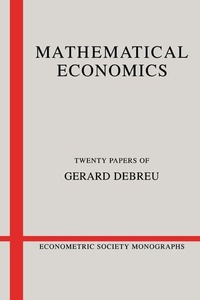
Mathematical Economics
Twenty Papers of Gerard Debreu
Published on 31. October 1986
Book
Paperback/Softback
264 pages
978-0-521-33561-4 (ISBN)
Description
These twenty papers were selected by the author. The book includes a major introduction by Werner Hildenbrand, who assesses Professor Debreu's contribution to economic theory and explains the part played by these papers in the development of the subject.
Reviews / Votes
'This work allows us to see an impressive collection of Debreu's work together as a body ... a very useful reference in both research and teaching.' Journal of Economic LiteratureMore details
Series
Language
English
Place of publication
Cambridge
United Kingdom
Target group
Professional and scholarly
Product notice
Paperback (trade)
Illustrations
Worked examples or Exercises
Dimensions
Height: 229 mm
Width: 152 mm
Thickness: 16 mm
Weight
434 gr
ISBN-13
978-0-521-33561-4 (9780521335614)
Copyright in bibliographic data and cover images is held by Nielsen Book Services Limited or by the publishers or by their respective licensors: all rights reserved.
Schweitzer Classification
Other editions
Additional editions
Book
07/1983
Cambridge University Press
€68.09
Article exhausted; check for reprint
Previous edition
Book
07/1983
Cambridge University Press
€68.09
Article exhausted; check for reprint
Persons
Content
Introduction Werner Hildenbrand; 1. The coefficient of resource utilization; 2. A social equilibrium existence theorem; 3. A classical tax-subsidy problem; 4. Existence of an equilibrium for a competitive economy Kenneth J. Arrow and Gerard Debreu; 5. Valuation equilibrium and Pareto optimum; 6. Representation of a preference ordering by a numerical function; 7. Market equilibrium; 8. Economics under uncertainty; 9. Topological methods in cardinal utiltity theory; 10. New concepts and techniques for equilibrium analysis; 11. A limit theorem on the core of an economy Gerard Debreu and Herbert Scarf; 12. Continuty properties of Paretian utility; 13. Neighboring economic agents; 14. Economies with a finite set of equilibria; 15. Smooth preferences; 16. Excess demand functions; 17. The rate of convergence of the core of an economy; 18. Four aspects of the mathematical theory of economic equilibrium; 19. The application to economies of differential topology and global analysis: regular differentiable economies; 20. Least concave utility functions.