

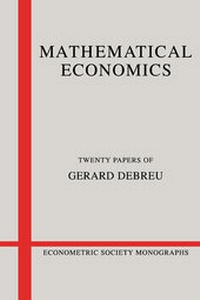
Mathematical Economics
Twenty Papers of Gerard Debreu
Published on 29. July 1983
Book
Hardback
272 pages
978-0-521-23736-9 (ISBN)
Description
These twenty papers were selected by the author. The book includes a major introduction by Werner Hildenbrand, who assesses Professor Debreu's contribution to economic theory and explains the part played by these papers in the development of the subject.
Reviews / Votes
'This work allows us to see an impressive collection of Debreu's work together as a body ... a very useful reference in both research and teaching.' Journal of Economic LiteratureMore details
Series
Language
English
Place of publication
Cambridge
United Kingdom
Target group
Professional and scholarly
Dimensions
Height: 228 mm
Width: 152 mm
Thickness: 16 mm
Weight
479 gr
ISBN-13
978-0-521-23736-9 (9780521237369)
Copyright in bibliographic data and cover images is held by Nielsen Book Services Limited or by the publishers or by their respective licensors: all rights reserved.
Schweitzer Classification
Other editions
New editions
Book
10/1986
Cambridge University Press
€61.10
Shipment within 15-20 days
Additional editions
Book
10/1986
Cambridge University Press
€61.10
Shipment within 15-20 days
Persons
Content
Introduction Werner Hildenbrand; 1. The coefficient of resource utilization; 2. A social equilibrium existence theorem; 3. A classical tax-subsidy problem; 4. Existence of an equilibrium for a competitive economy Kenneth J. Arrow and Gerard Debreu; 5. Valuation equilibrium and Pareto optimum; 6. Representation of a preference ordering by a numerical function; 7. Market equilibrium; 8. Economics under uncertainty; 9. Topological methods in cardinal utiltity theory; 10. New concepts and techniques for equilibrium analysis; 11. A limit theorem on the core of an economy Gerard Debreu and Herbert Scarf; 12. Continuty properties of Paretian utility; 13. Neighboring economic agents; 14. Economies with a finite set of equilibria; 15. Smooth preferences; 16. Excess demand functions; 17. The rate of convergence of the core of an economy; 18. Four aspects of the mathematical theory of economic equilibrium; 19. The application to economies of differential topology and global analysis: regular differentiable economies; 20. Least concave utility functions.