

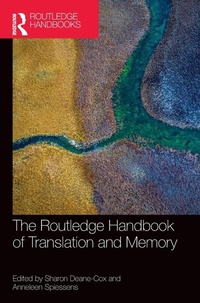
The Routledge Handbook of Translation and Memory
1st Edition
Published on 30. May 2022
Book
Hardback
432 pages
978-0-8153-7215-8 (ISBN)
Description
The Routledge Handbook of Translation and Memory serves as a timely and unique resource for the current boom in thinking around translation and memory. The Handbook offers a comprehensive overview of a contemporary, and as yet unconsolidated, research landscape with a four-section structure which encompasses both current debate and future trajectories.
Twenty-four chapters written by leading and emerging international scholars provide a cross-sectional snapshot of the diverse angles of approach and case studies that have thus far driven research into translation and memory. A valuable, far-reaching range of theoretical, empirical, reflective, comparative, and archival approaches are brought to bear on translational sites of memory and mnemonic sites of translation through the examination of topics such as traumatic, postcolonial, cultural, literary, and translator memory.
This Handbook is key reading for advanced undergraduates, postgraduates and researchers in translation studies, memory studies, and related areas.
Twenty-four chapters written by leading and emerging international scholars provide a cross-sectional snapshot of the diverse angles of approach and case studies that have thus far driven research into translation and memory. A valuable, far-reaching range of theoretical, empirical, reflective, comparative, and archival approaches are brought to bear on translational sites of memory and mnemonic sites of translation through the examination of topics such as traumatic, postcolonial, cultural, literary, and translator memory.
This Handbook is key reading for advanced undergraduates, postgraduates and researchers in translation studies, memory studies, and related areas.
Reviews / Votes
"This valuable and timely collection of essays explores the multiple connections between translation and memory studies. The international contributors offer exciting new ways of looking at the inter-relatedness of translation and memory in a wide range of aspects of human experience. This is an important book."Susan Bassnett, Professor Emerita of Comparative Literature, University of Warwick, UK
More details
Series
Language
English
Place of publication
New York
United States
Publishing group
Taylor & Francis Inc
Target group
Professional and scholarly
Academic
Illustrations
41 s/w Abbildungen, 39 s/w Photographien bzw. Rasterbilder, 2 s/w Zeichnungen
2 Line drawings, black and white; 39 Halftones, black and white; 41 Illustrations, black and white
Dimensions
Height: 250 mm
Width: 175 mm
Thickness: 28 mm
Weight
944 gr
ISBN-13
978-0-8153-7215-8 (9780815372158)
Copyright in bibliographic data and cover images is held by Nielsen Book Services Limited or by the publishers or by their respective licensors: all rights reserved.
Schweitzer Classification
Other editions
Additional editions
Sharon Deane-Cox | Anneleen Spiessens
The Routledge Handbook of Translation and Memory
Book
10/2024
1st Edition
Routledge
€70.80
Shipment within 10-20 days
Sharon Deane-Cox | Anneleen Spiessens
The Routledge Handbook of Translation and Memory
E-Book
05/2022
1st Edition
Routledge
€63.49
Available for download
Sharon Deane-Cox | Anneleen Spiessens
The Routledge Handbook of Translation and Memory
E-Book
05/2022
1st Edition
Routledge
€63.49
Available for download
Persons
Sharon Deane-Cox is Senior Lecturer in Translation Studies at the University of Strathclyde, UK, Assistant Editor of Translation Studies, and member of the Young Academy of Scotland. She has published a monograph on Retranslation (2014), while more recent projects include research on the translation of Holocaust memory, Scottish heritage translation, and interpreter history.
Anneleen Spiessens is an Assistant Professor at Ghent University and is affiliated with the Department of Translation, Interpreting and Communication. Her research focuses on ethical, political, and mnemonic aspects of translation. She is the author of Quand le bourreau prend la parole: genocide et litterature (2016).
Anneleen Spiessens is an Assistant Professor at Ghent University and is affiliated with the Department of Translation, Interpreting and Communication. Her research focuses on ethical, political, and mnemonic aspects of translation. She is the author of Quand le bourreau prend la parole: genocide et litterature (2016).
Content
List of contributors
Introduction
I. Translation and memory of trauma
Translating Holocaust testimony: a translator's perspective
Translating the perpetrator's testimony: Kommandant in Auschwitz (Holocaust) and Une saison de machettes (Rwanda)
Translating collective memory of Beslan: Russian state television news coverage of annual commemorations
Conflicting memories of war interpreting
Translation and colonial memory in East Africa
At the intersection of the writing of translations and memory: bridging communities affected by past conflict
II. End-users
Translated Holocaust poetry and the reader
Travelling memory, transcreation and politics: the case of Refugee tales
Mnemonic entrepreneurship and trans(articu)lation of the Philippine national anthem
Translation, memory, and the museum visitor
Reframing collective memory in museums
Heritage interpretation(s): remembering, translating, and utilizing the past
III. Figuring memory and translation
Re-trans-post: translation as memory in Quebecois culture
Translating trauma in the literary text: violent pasts in Mathias Enard's Zone and its English and German versions
Transcultural counter-memory and translation in contemporary Spanish fiction
Translating counter-memory in Australian Aboriginal texts
Postmemory lost: historiographical meta-fiction Jinling Shishan Chai in translation
Collective and corrective memories of a classic: mapping Oliver Twist's memory in translation
IV. Future trajectories
An archive of hope: translating memories of revolution
Translator memory and archives
The French diplomat and the Omaha shopkeeper: photographs of interpreters, 1873-1910
Translation memory systems
Computer-assisted translation (CAT) tools, translation memory and literary translation
Translation and Inuit memory
Index
Introduction
I. Translation and memory of trauma
Translating Holocaust testimony: a translator's perspective
Translating the perpetrator's testimony: Kommandant in Auschwitz (Holocaust) and Une saison de machettes (Rwanda)
Translating collective memory of Beslan: Russian state television news coverage of annual commemorations
Conflicting memories of war interpreting
Translation and colonial memory in East Africa
At the intersection of the writing of translations and memory: bridging communities affected by past conflict
II. End-users
Translated Holocaust poetry and the reader
Travelling memory, transcreation and politics: the case of Refugee tales
Mnemonic entrepreneurship and trans(articu)lation of the Philippine national anthem
Translation, memory, and the museum visitor
Reframing collective memory in museums
Heritage interpretation(s): remembering, translating, and utilizing the past
III. Figuring memory and translation
Re-trans-post: translation as memory in Quebecois culture
Translating trauma in the literary text: violent pasts in Mathias Enard's Zone and its English and German versions
Transcultural counter-memory and translation in contemporary Spanish fiction
Translating counter-memory in Australian Aboriginal texts
Postmemory lost: historiographical meta-fiction Jinling Shishan Chai in translation
Collective and corrective memories of a classic: mapping Oliver Twist's memory in translation
IV. Future trajectories
An archive of hope: translating memories of revolution
Translator memory and archives
The French diplomat and the Omaha shopkeeper: photographs of interpreters, 1873-1910
Translation memory systems
Computer-assisted translation (CAT) tools, translation memory and literary translation
Translation and Inuit memory
Index