

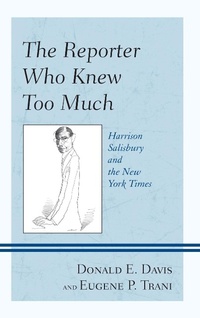
The Reporter Who Knew Too Much
Harrison Salisbury and the New York Times
Published on 25. October 2012
Book
Hardback
292 pages
978-1-4422-1949-6 (ISBN)
Description
During his career at the New York Times, Harrison Salisbury served as the bureau chief in post-World War II Moscow, reported from Hanoi during the Vietnam War, and in retirement he witnessed the Tiananmen Square massacre firsthand. Davis and Trani's engaging biography of the two-time Pulitzer Prize-winning journalist makes use of Salisbury's personal archive of interviews, articles, and correspondence to shed light on the personal triumphs and shortcomings of this preeminent reporter and illuminates the twentieth-century world in which he lived.
Reviews / Votes
Davis (emer., Illinois State Univ., Normal) and Trani (emer., Virginia Commonwealth Univ.), both historians, contribute a highly significant volume, one covering the career of one of the US's leading foreign correspondents. Harrison Salisbury (1908-93) was almost an institution at The New York Times. In a career that spanned his entire adult life, starting at age 20, he had one significant beat after another, covering, for example, Louisiana in the wake of Huey Long's assassination; London during the blitz; wartime and postwar Moscow; the American South during the civil rights struggle; North Vietnam's resistance to American bombing; and the ruthless suppression of demonstrators in Beijing's Tiananmen Square. The "great gadfly" wrote 21 books, including two novels and histories of 20th-century Russia, China, and the Wehrmacht's siege of Leningrad. This careful study, as thorough as it is readable, is grounded in the Salisbury papers at Columbia University, though the authors also rely on other manuscript collections and contemporary dispatches. Particularly revealing is the authors' account of infighting among the Times's top echelon and the politics that deprived Salisbury of a third (well deserved) Pulitzer Prize. Given the attention to Salisbury's first marriage, one wishes for some background on his second. Summing Up: Highly recommended. All readers. * CHOICE * Minnesotan Harrison Salisbury became one of the preeminent newspapermen of the last half of the twentieth century, covering world events for the United Press and the New York Times and editing the Times' influential op-ed page. In rigorous academic style, Davis and Trani examine Salisbury's remarkable and productive life. Salisbury had a journalist's great good fortune to land in the right place at the right time, have the full support of a news organization, know the right people, and possess superior reportorial skills. He served in Moscow at the close of the Stalin era. He covered civil-rights battles in the American South. He reported America's growing involvement in Vietnam and became an early and vocal opponent of the war. By the end of the 1980s he arrived in China in time for the Cultural Revolution and the growing student democratic movement. He also wrote an outstanding history of the Nazi siege of Leningrad. * Booklist * Donald Davis and Eugene Trani undertake the difficult task of bringing to life one of the most prolific American journalists of the second half of the twentieth century. ... Overall, the book succeeds in driving home the authors' message that Salisbury's dedication to journalistic integrity made him one of the premier and respected journalists in the United States, if not the world. The authors further underscore this point through their analysis of Salisbury's personal heroes, who all stood, sometimes alone, for what they believed in. * The Russian Review * The Reporter Who Knew Too Much is most compelling in its meticulous examination of Salisbury's years in the Soviet Union before and after Stalin's death, including the reportage that led to the first of two Pulitzer Prizes. Trani and Davis also fully illuminate the role Salisbury played in the gradual unmasking of U.S. involvement in Vietnam - and the price he paid in the denial of his third Pulitzer by one vote of the publisher-dominated advisory board that overruled a jury of his peers. * The Richmond Times-Dispatch * [The authors] have clearly done their homework in the Salisbury papers, with interviews, and in reviewing the published output of a long career. Salisbury's life was fascinating, filled with ups (such as a Pulitzer in 1955) and downs (being done in by the Johnson administration after his Hanoi reporting), as well as being in the right place at the right time (such as Tiananmen Square in June 1989) even in retirement. In all, a fascinating story. * Communication Booknotes Quarterly * The Reporter Who Knew Too Much would have some use as a supplement to a class that included the history of late-twentieth-century journalism and as an introduction to the life of a great reporter. * Journalism & Mass Communication Quarterly * Davis and Trani have produced a lively, crisp, yet exhaustive account of a towering figure in the history of the New York Times. A man of the left, Harrison Salisbury spoke truth to power selectively, but everyone respected his talent and industry. He was a great figure in 20th century foreign reporting, whether in Moscow, Hanoi or Beijing, in his seventies no less than in his thirties. Salisbury's sharp eye and eloquent pen produced terrific stories and influential books. His life, vividly reflected in The Reporter Who Knew Too Much, was an American saga blending Minnesota idealism, Washington's leading role in the post-WWII world, and Salisbury's hard-nosed realism learned from brushing shoulders with tyrants. As well as a memorable portrait of Salisbury, here is rich detail on struggles within the Times among brilliant editors who saw themselves as priests of an infallible church. -- Ross Terrill, author of Mao, The New Chinese Empire, and Madame Mao The Reporter Who Knew Too Much is a vivid and meticulous tour through the professional and personal life of one of America's great foreign correspondents. Extensively reliant on archival sources, this biography teaches the reader not only about Harrison Salisbury himself, but also about the broader context of Russian and Chinese history, American diplomacy, and perhaps most importantly, the evolution of the American news business. Highly recommended! -- Judyth L. Twigg, Virginia Commonwealth University Harrison Salisbury [...] was well known in Russia during the Second World War, because he sent the best reports on the situation in the Eastern Front to the United Press. The unbiased and courageous reports of Salisbury captured the attention and imagination of people in many countries. This book will be very useful for [...] those who are interested in the great events of the second half of the twentieth century. -- Boris Shiriaev, St. Petersburg University, RussiaMore details
Language
English
Place of publication
Lanham, MD
United States
Product notice
Laminated cover
Dimensions
Height: 235 mm
Width: 157 mm
Thickness: 22 mm
Weight
630 gr
ISBN-13
978-1-4422-1949-6 (9781442219496)
Copyright in bibliographic data and cover images is held by Nielsen Book Services Limited or by the publishers or by their respective licensors: all rights reserved.
Schweitzer Classification
Other editions
Additional editions
Donald E. Davis | Eugene P. Trani
The Reporter Who Knew Too Much
Harrison Salisbury and the New York Times
E-Book
10/2012
1st Edition
Rowman & Littlefield Publishers
€74.59
Available for download
Persons
Donald E. Davis is Professor Emeritus of History at Illinois State University. Davis is the editor of No East or West: The Memoirs of Paul B. Anderson. Davis served as professor of Russian History at Illinois State University from 1964 - 2004, and has authored numerous articles, reviews, papers and opinion pieces.
Eugene P. Trani is President Emeritus and University Distinguished Professor at Virginia Commonwealth University. Trani has authored, coauthored, annotated, and edited eight books and published more than one hundred articles and opinion pieces. An historian of American diplomatic history, Trani is the author of The Presidency of Warren G. Harding. Trani has also written on the role universities play as key drivers of economic development in their communities.
Friends from graduate school at Indiana University, Bloomington, Davis and Trani have co-authored three books: The First Cold War: The Legacy of Woodrow Wilson in U.S.-Soviet Relations (University of Missouri Press), published first in English, then translated and published in Russian and Chinese; Distorted Mirrors: Americans and Their Relations with Russia and China in the Twentieth-Century (University of Missouri Press), also published in Russian and Spanish, and now this significant contribution to the understanding of a major figure in the history of journalism, Harrison E. Salisbury.
Eugene P. Trani is President Emeritus and University Distinguished Professor at Virginia Commonwealth University. Trani has authored, coauthored, annotated, and edited eight books and published more than one hundred articles and opinion pieces. An historian of American diplomatic history, Trani is the author of The Presidency of Warren G. Harding. Trani has also written on the role universities play as key drivers of economic development in their communities.
Friends from graduate school at Indiana University, Bloomington, Davis and Trani have co-authored three books: The First Cold War: The Legacy of Woodrow Wilson in U.S.-Soviet Relations (University of Missouri Press), published first in English, then translated and published in Russian and Chinese; Distorted Mirrors: Americans and Their Relations with Russia and China in the Twentieth-Century (University of Missouri Press), also published in Russian and Spanish, and now this significant contribution to the understanding of a major figure in the history of journalism, Harrison E. Salisbury.