

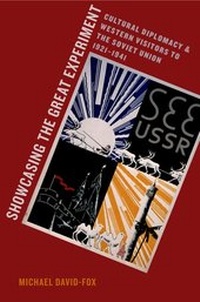
Showcasing the Great Experiment
Cultural Diplomacy and Western Visitors to the Soviet Union, 1921-1941
Published on 12. January 2012
Book
Hardback
416 pages
978-0-19-979457-7 (ISBN)
Description
During the 1920s and 1930s thousands of European and American writers, professionals, scientists, and artists came to record their impressions of the "Soviet experiment". The interwar pilgrimage of these Western intellectuals and fellow-travelers remains one of the most notorious episodes in political and intellectual history.
Showcasing the Great Experiment, incorporating far-reaching analysis of the declassified archival records of the agencies charged with crafting the international image of communism, brings this story into new focus as one of the great cross-cultural and trans-ideological encounters of the twentieth century. While many visitors were profoundly affected by their Soviet tours, so too was the Soviet system itself: the early experiences of building showcases and teaching outsiders to perceive the
future-in-the-making constitute a neglected part of the emergence of Stalinism at home.
This pioneering work of transnational history develops a new framework for understanding how and why many of the twentieth century's greatest writers and thinkers, including Henri Barbusse, Theodore Dreiser, Lion Feuchtwanger, and Andre Gide, among others, ardently defended Stalin's USSR despite the unprecedented violence of its prewar decade. Probing little-known, covert entanglements between far-left and far-right ideological extremes, the work pays special attention to Soviet attempts
to recruit and cooperate with far-right nationalists, including German "National Bolsheviks, " fascist intellectuals, and even members of the Nazi Party.
The Soviet preoccupation with molding Western public opinion resulted in an influential contribution to the history of modern cultural diplomacy. Setting the revolutionary regime's innovations against the context of the treatment of foreigners in Russia from Muscovy on, Showcasing the Great Experiment argues that interwar Soviet methods mobilizing the intelligentsia for the international ideological contest directly paved the way for the cultural Cold War.
Showcasing the Great Experiment, incorporating far-reaching analysis of the declassified archival records of the agencies charged with crafting the international image of communism, brings this story into new focus as one of the great cross-cultural and trans-ideological encounters of the twentieth century. While many visitors were profoundly affected by their Soviet tours, so too was the Soviet system itself: the early experiences of building showcases and teaching outsiders to perceive the
future-in-the-making constitute a neglected part of the emergence of Stalinism at home.
This pioneering work of transnational history develops a new framework for understanding how and why many of the twentieth century's greatest writers and thinkers, including Henri Barbusse, Theodore Dreiser, Lion Feuchtwanger, and Andre Gide, among others, ardently defended Stalin's USSR despite the unprecedented violence of its prewar decade. Probing little-known, covert entanglements between far-left and far-right ideological extremes, the work pays special attention to Soviet attempts
to recruit and cooperate with far-right nationalists, including German "National Bolsheviks, " fascist intellectuals, and even members of the Nazi Party.
The Soviet preoccupation with molding Western public opinion resulted in an influential contribution to the history of modern cultural diplomacy. Setting the revolutionary regime's innovations against the context of the treatment of foreigners in Russia from Muscovy on, Showcasing the Great Experiment argues that interwar Soviet methods mobilizing the intelligentsia for the international ideological contest directly paved the way for the cultural Cold War.
Reviews / Votes
The books analytical framework and wealth of new material creates a rich canvas. ... the book provides an important historiographic and theoretical overview of the period, bringing together a wealth of information and revisiting questions of Soviet-Western intellectual exchange that still remain relevant today. * Ludmila Stern, European History Quarterly * David Fox's marvellous book allows us to see things the way they really were. * Yvonne Howell, Times HIgher Education * One of Michael David-Fox's major contributions is his analysis of the magnetism exerted by the Soviet 'experiment' both on the Left and the Right. * Times Literary Supplement * David-Fox has produced a multi-faceted, subtle, and eminently instructive book. * H-Soz-u-Kult *More details
Language
English
Place of publication
New York
United States
Target group
College/higher education
Professional and scholarly
Illustrations
15 halftones
Dimensions
Height: 242 mm
Width: 164 mm
Thickness: 33 mm
Weight
680 gr
ISBN-13
978-0-19-979457-7 (9780199794577)
Copyright in bibliographic data and cover images is held by Nielsen Book Services Limited or by the publishers or by their respective licensors: all rights reserved.
Schweitzer Classification
Other editions
Additional editions
Michael David-Fox
Showcasing the Great Experiment
Cultural Diplomacy and Western Visitors to the Soviet Union, 1921-1941
Book
03/2014
Oxford University Press Inc
€60.00
Shipment within 15-20 days
Michael David-Fox
Showcasing the Great Experiment
Cultural Diplomacy and Western Visitors to the Soviet Union, 1921-1941
E-Book
12/2011
1st Edition
OUP eBook
€29.49
Available for download
Michael David-Fox
Showcasing the Great Experiment
Cultural Diplomacy and Western Visitors to the Soviet Union, 1921-1941
E-Book
10/2011
1st Edition
OUP eBook
€29.49
Available for download
Person
Michael David-Fox is associate professor at the Edmund A. Walsh School of Foreign Service and the Department of History at Georgetown University. A founding editor of the journal Kritika, he is the author or editor of eight books on Russian, Soviet, and transnational history.
Content
Preface ; Introduction: <"Russia and the West>" in a Soviet Key ; Chapter 1: Cultural Diplomacy of a New Type ; Chapter 2: Going West: Soviet <"Cultural>" Operations Abroad ; Chapter 3: The Potemkin Village Dilemma ; Chapter 4: Gorky's Gulag ; Chapter 5: Hard-Currency Foreigners and the Campaign Mode ; Chapter 6: Stalin and the Fellow-Travelers Revisited ; Chapter 7: Going East: Friends and Enemies ; Chapter 8: Rise of the Stalinist Superiority Complex ; Epilogue: Toward the Cultural Cold War ; Notes ; Bibliography of Archival Collections ; Index