

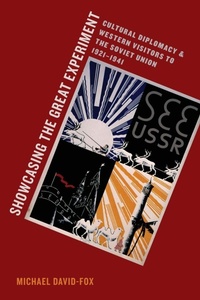
Showcasing the Great Experiment
Cultural Diplomacy and Western Visitors to the Soviet Union, 1921-1941
Published on 6. March 2014
Book
Paperback/Softback
416 pages
978-0-19-937642-1 (ISBN)
Description
During the 1920s and 1930s thousands of European and American writers, professionals, scientists, artists, and intellectuals made a pilgrimage to experience the "Soviet experiment" for themselves. Showcasing the Great Experiment explores the reception of these intellectuals and fellow-travelers and their cross-cultural and trans-ideological encounters in order to analyze Soviet attitudes towards the West.
Many of the twentieth century's greatest writers and thinkers, including Theodore Dreiser, Andre Gide, Paul Robeson, and George Bernard Shaw, notoriously defended Stalin's USSR despite the unprecedented violence of its prewar decade. While many visitors were profoundly affected by their Soviet tours, so too was the Soviet system. The early experiences of building showcases and teaching outsiders to perceive the future-in-the-making constitute a neglected international part of the emergence of Stalinism at home. Michael David-Fox contends that each side critically examined the other, negotiating feelings of inferiority and superiority, admiration and enmity, emulation and rejection. By the time of the Great Purges, these tensions gave way to the dramatic triumph of xenophobia and isolationism; whereas in the twenties the new regime assumed it had much to learn from Western modernity, by the Stalinist thirties the Soviet order was declared superior in all respects.
Drawing on the declassified archival records of the agencies charged with crafting the international image of communism, David-Fox shows how Soviet efforts to sell the Bolshevik experiment abroad through cultural diplomacy shaped and were, in turn, shaped by the ongoing project of defining the Soviet Union from within. These interwar Soviet methods of mobilizing the intelligentsia for the international ideological contest, he argues, directly paved the way for the cultural Cold War.
Many of the twentieth century's greatest writers and thinkers, including Theodore Dreiser, Andre Gide, Paul Robeson, and George Bernard Shaw, notoriously defended Stalin's USSR despite the unprecedented violence of its prewar decade. While many visitors were profoundly affected by their Soviet tours, so too was the Soviet system. The early experiences of building showcases and teaching outsiders to perceive the future-in-the-making constitute a neglected international part of the emergence of Stalinism at home. Michael David-Fox contends that each side critically examined the other, negotiating feelings of inferiority and superiority, admiration and enmity, emulation and rejection. By the time of the Great Purges, these tensions gave way to the dramatic triumph of xenophobia and isolationism; whereas in the twenties the new regime assumed it had much to learn from Western modernity, by the Stalinist thirties the Soviet order was declared superior in all respects.
Drawing on the declassified archival records of the agencies charged with crafting the international image of communism, David-Fox shows how Soviet efforts to sell the Bolshevik experiment abroad through cultural diplomacy shaped and were, in turn, shaped by the ongoing project of defining the Soviet Union from within. These interwar Soviet methods of mobilizing the intelligentsia for the international ideological contest, he argues, directly paved the way for the cultural Cold War.
Reviews / Votes
The books analytical framework and wealth of new material creates a rich canvas. ... the book provides an important historiographic and theoretical overview of the period, bringing together a wealth of information and revisiting questions of Soviet-Western intellectual exchange that still remain relevant today. * Ludmila Stern, European History Quarterly * David Fox's marvellous book allows us to see things the way they really were. * Yvonne Howell, Times Higher Education * David-Fox has produced a deeply researched and original book that invites readers to rethink or revisit some big historiographical questions: continuity and change across the dividing line of 1917, the nature and origins of Stalinism, and the connection between internal and external factors in national development. Of obvious interest to historians of modern Russia, this book will also be read with great benefit by scholars interested in cultural, political, and transnational history. * Robert H. Greene, The Historian *More details
Language
English
Place of publication
New York
United States
Target group
College/higher education
Professional and scholarly
Illustrations
15 halftones
Dimensions
Height: 234 mm
Width: 156 mm
Thickness: 24 mm
Weight
705 gr
ISBN-13
978-0-19-937642-1 (9780199376421)
Copyright in bibliographic data and cover images is held by Nielsen Book Services Limited or by the publishers or by their respective licensors: all rights reserved.
Schweitzer Classification
Other editions
Additional editions
Michael David-Fox
Showcasing the Great Experiment
Cultural Diplomacy and Western Visitors to the Soviet Union, 1921-1941
Book
01/2012
Oxford University Press Inc
€64.38
Article exhausted; check different version
Person
Michael David-Fox is Associate Professor in the Department of History and School of Foreign Service at Georgetown University. He is the author of Revolution of the Mind: Higher Learning among the Bolsheviks, 1918-1929 and a founding editor of Kritika: Explorations in Russian and Eurasian History.
Content
Preface ; Introduction: "Russia and the West" in a Soviet Key ; Chapter 1: Cultural Diplomacy of a New Type ; Chapter 2: Going West: Soviet "Cultural" Operations Abroad ; Chapter 3: The Potemkin Village Dilemma ; Chapter 4: Gorky's Gulag ; Chapter 5: Hard-Currency Foreigners and the Campaign Mode ; Chapter 6: Stalin and the Fellow-Travelers Revisited ; Chapter 7: Going East: Friends and Enemies ; Chapter 8: Rise of the Stalinist Superiority Complex ; Epilogue: Toward the Cultural Cold War ; Notes ; Bibliography of Archival Collections ; Index