

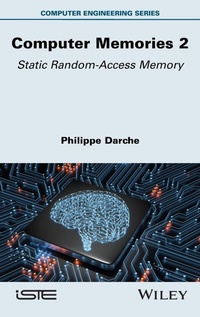
Computer Memories 2
Static Random-Access Memory
1st Edition
Published on 24. March 2026
Book
Hardback
256 pages
978-1-83669-063-4 (ISBN)
Description
Memory, the second function of a computer, has gradually become more complex in order to meet growing needs in terms of capacity, speed, security and energy efficiency. It takes the form of a component or system, such as a memory subassembly or a mass storage device.
For several decades, there has been a strong trend towards integrating memory directly into the processor under the term embedded memory, of which cache memory is a typical example. Understanding its internal mechanisms and interfacing is essential for mastering the operation of a computer and programming it efficiently.
Computer Memories 2 focuses on the static storage cell and its associated component, known as static random-access memory. The first part presents the main temporal characteristics of a generic random-access memory, as well as its electrical and mechanical properties, including aspects related to encapsulation. The second part focuses on the study of the first category of random-access semiconductor memory: asynchronous static memory, commonly referred to by the acronym SRAM (static random-access memory). The book details its temporal, electrical and mechanical characteristics, providing an in-depth understanding of its operation and technical specifications.
For several decades, there has been a strong trend towards integrating memory directly into the processor under the term embedded memory, of which cache memory is a typical example. Understanding its internal mechanisms and interfacing is essential for mastering the operation of a computer and programming it efficiently.
Computer Memories 2 focuses on the static storage cell and its associated component, known as static random-access memory. The first part presents the main temporal characteristics of a generic random-access memory, as well as its electrical and mechanical properties, including aspects related to encapsulation. The second part focuses on the study of the first category of random-access semiconductor memory: asynchronous static memory, commonly referred to by the acronym SRAM (static random-access memory). The book details its temporal, electrical and mechanical characteristics, providing an in-depth understanding of its operation and technical specifications.
More details
Series
Language
English
Place of publication
London
United Kingdom
Target group
Professional and scholarly
Product notice
sewn/stitched
Cloth over boards
Dimensions
Height: 234 mm
Width: 156 mm
Thickness: 16 mm
Weight
540 gr
ISBN-13
978-1-83669-063-4 (9781836690634)
Copyright in bibliographic data and cover images is held by Nielsen Book Services Limited or by the publishers or by their respective licensors: all rights reserved.
Schweitzer Classification
Other editions
Additional editions
E-Book
03/2026
1st Edition
Wiley
€146.99
Available for download
E-Book
02/2026
1st Edition
Wiley-ISTE
€146.99
Available for download
Person
Philippe Darche is Lecturer in Computer Science at the University Institute of Technology (IUT) of Paris - Rives de Seine and Researcher in the Distributed Algorithms and Systems (DeLyS) team at LIP6, Sorbonne University, France. He is also the author of fifteen books on computer architecture.
Content
Quotation ix
Preface xi
Introduction xv
Part 1. Characterization of a Semiconductor Memory 1
Chapter 1. Timing Characterization of a Semiconductor Random-Access Memory 3
1.1. Signal naming convention 3
1.2. Timing diagram 4
1.3. Standardization of memory timing 9
1.4. Measurement of a characteristic time 14
1.5. Fundamental times 14
1.6. Conclusion 20
Chapter 2. Other Characteristics of a Semiconductor Random-Access Memory 21
2.1. Electrical characteristics 21
2.2. Miscellaneous characteristics 30
2.3. Performance measurement 31
2.4. Memory testing 31
2.5. Conclusion 32
Chapter 3. Encapsulation 33
3.1. Generalities 33
3.2. Interconnection technologies 37
2 3.2.1. Micro-wiring 38
3.2.2. Automatic tape transfer 38
3.2.3. Flip-chip technology 38
3.3. Two-dimensional single-chip encapsulation 40
3.3.1. Pin and pad packages 41
3.3.2. Encapsulation on substrate 49
3.4. Advanced integrations 52
3.4.1. Multichip module 52
3.4.2. Associated concepts 53
3.4.3. 2.5D integration 55
3.4.4. Three-dimensional integration 55
3.4.5. 3.5D package 57
3.5. Technical characteristics 57
3.6. Electrical modeling 58
3.7. Memory module 59
3.7.1. Definition 59
3.7.2. Form factor 60
3.7.3. Connectivity 79
3.8. Conclusion 82
Chapter 4. Electronic Aspects of Interfacing 83
4.1. Transmission line 83
4.1.1. Modeling 84
4.1.2. Termination 85
4.2. Possible interconnection types 86
4.3. Reminder on the interface between two logical subassemblies 91
4.4. Equalization 98
4.5. Power supply 99
4.6. The SPMT interface 102
4.7. Conclusion 103
Part 2. Asynchronous Static Random-Access Memory 105
Chapter 5. Internal Organization of a Generic Asynchronous Static Random-Access Memory 107
5.1. Memory cell 108
5.2. General organization 123
5.3. Read amplifier 128
5.4. Basic operations 129
5.5. Layout 132
5.6. Manufacturing technologies 134
5.7. Cell stability 135
5.8. Conclusion 137
Chapter 6. Asynchronous Static Random-Access Memory as a Component 139
6.1. The asynchronous model 140 6.2. Variations on the asynchronous model 147
6.2.1. Serial-access SRAM 147
6.2.2. Backup memory 147
6.3. Conclusion 150 Conclusion 153
Appendices 157
Appendix 1 159
Appendix 2 165
List of Acronyms 171
References 193
Index 209
Preface xi
Introduction xv
Part 1. Characterization of a Semiconductor Memory 1
Chapter 1. Timing Characterization of a Semiconductor Random-Access Memory 3
1.1. Signal naming convention 3
1.2. Timing diagram 4
1.3. Standardization of memory timing 9
1.4. Measurement of a characteristic time 14
1.5. Fundamental times 14
1.6. Conclusion 20
Chapter 2. Other Characteristics of a Semiconductor Random-Access Memory 21
2.1. Electrical characteristics 21
2.2. Miscellaneous characteristics 30
2.3. Performance measurement 31
2.4. Memory testing 31
2.5. Conclusion 32
Chapter 3. Encapsulation 33
3.1. Generalities 33
3.2. Interconnection technologies 37
2 3.2.1. Micro-wiring 38
3.2.2. Automatic tape transfer 38
3.2.3. Flip-chip technology 38
3.3. Two-dimensional single-chip encapsulation 40
3.3.1. Pin and pad packages 41
3.3.2. Encapsulation on substrate 49
3.4. Advanced integrations 52
3.4.1. Multichip module 52
3.4.2. Associated concepts 53
3.4.3. 2.5D integration 55
3.4.4. Three-dimensional integration 55
3.4.5. 3.5D package 57
3.5. Technical characteristics 57
3.6. Electrical modeling 58
3.7. Memory module 59
3.7.1. Definition 59
3.7.2. Form factor 60
3.7.3. Connectivity 79
3.8. Conclusion 82
Chapter 4. Electronic Aspects of Interfacing 83
4.1. Transmission line 83
4.1.1. Modeling 84
4.1.2. Termination 85
4.2. Possible interconnection types 86
4.3. Reminder on the interface between two logical subassemblies 91
4.4. Equalization 98
4.5. Power supply 99
4.6. The SPMT interface 102
4.7. Conclusion 103
Part 2. Asynchronous Static Random-Access Memory 105
Chapter 5. Internal Organization of a Generic Asynchronous Static Random-Access Memory 107
5.1. Memory cell 108
5.2. General organization 123
5.3. Read amplifier 128
5.4. Basic operations 129
5.5. Layout 132
5.6. Manufacturing technologies 134
5.7. Cell stability 135
5.8. Conclusion 137
Chapter 6. Asynchronous Static Random-Access Memory as a Component 139
6.1. The asynchronous model 140 6.2. Variations on the asynchronous model 147
6.2.1. Serial-access SRAM 147
6.2.2. Backup memory 147
6.3. Conclusion 150 Conclusion 153
Appendices 157
Appendix 1 159
Appendix 2 165
List of Acronyms 171
References 193
Index 209