

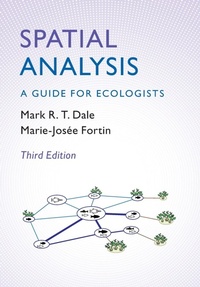
Spatial Analysis
A Guide for Ecologists
3rd Edition
Published on 3. July 2025
Book
Paperback/Softback
416 pages
978-1-009-15867-1 (ISBN)
Description
Designed for researchers in ecology at all levels and career stages, from students and postdoctoral fellows to seasoned professionals, this third edition reflects the significant advances in quantitative analysis of the past decade. It provides updated examples and methods, with reduced emphasis on older techniques that have seen limited use in recent ecological literature. The authors cover new and emerging approaches, including Hierarchical Bayesian analysis and spatio-temporal methods. A key feature is the integration of ecological and statistical concepts, highlighting the critical role that this type of analysis plays in ecological understanding. The book provides up-to-date summaries of methodological advancements in spatial and spatio-temporal analysis, along with insights into future developments in areas such as spatial graphs, multi-level networks, and machine learning applications. It also offers practical examples and guidance to help researchers select, apply, and interpret the appropriate methods.
More details
Edition
3rd Revised edition
Language
English
Place of publication
Cambridge
United Kingdom
Target group
College/higher education
Professional and scholarly
Edition type
Revised edition
Product notice
Paperback (trade)
Illustrations
Worked examples or Exercises
Dimensions
Height: 244 mm
Width: 170 mm
Thickness: 22 mm
Weight
715 gr
ISBN-13
978-1-009-15867-1 (9781009158671)
Copyright in bibliographic data and cover images is held by Nielsen Book Services Limited or by the publishers or by their respective licensors: all rights reserved.
Schweitzer Classification
Other editions
Previous edition
Book
09/2014
2nd Edition
Cambridge University Press
€75.64
Shipment within 15-20 days
Persons
Mark R. T. Dale is Professor of Ecosystem Science and Management at the University of Northern British Columbia, Canada, where he has served in several administrative roles. His research interests are based on the spatial structure of plant communities and include the development of quantitative methods to answer ecological questions. His work on plant community structure and the dynamics of spatial pattern development has led to significant contributions in the application of graph theory and the study of ecological networks. Mark is the author of Applying Graph Theory in Ecological Research (2017) and co-author of Quantitative Analysis of Ecological Networks (2021), both published by Cambridge University Press. Marie-Josee Fortin is a University Professor in the Department of Ecology and Evolutionary Biology at the University of Toronto. She is a Fellow of the Royal Society of Canada and holds a Tier 1 Canada Research Chair in Spatial Ecology. Her research is at the interface of spatial ecology and conservation biology including modelling connectivity in urban environments, ecosystem services, and forest resilience. Marie-Josee is co-author of Quantitative Analysis of Ecological Networks (Cambridge University Press, 2021).
Content
Preface; 1. Ecological processes; 2. Spatial concepts and notions; 3. Spatial analysis of point and quadrat data; 4. Spatial analysis of sample data; 5. Spatial partitioning: spatial clusters and boundary detection; 6. Spatial autocorrelation and inferential tests; 7. Spatial regression and multiscale analysis; 8. Spatio-temporal analysis; 9. Spatial diversity analysis; 10. Points and lines, graphs and networks; 11. Spatial and temporal analysis with multilayer networks; 12. Closing comments and future directions; References; Index.