

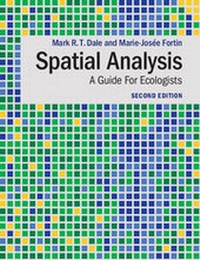
Spatial Analysis
A Guide For Ecologists
2nd Edition
Published on 11. September 2014
Book
Paperback/Softback
454 pages
978-0-521-14350-9 (ISBN)
Description
Nowadays, ecologists worldwide recognize the use of spatial analysis as essential. However, because of the fast-growing range of methods available, even an expert might occasionally find it challenging to choose the most appropriate one. Providing the ecological and statistical foundations needed to make the right decision, this second edition builds and expands upon the previous one by: * Encompassing the basic methods for spatial analysis, for both complete census and sample data * Investigating updated treatments of spatial autocorrelation and spatio-temporal analysis * Introducing detailed explanations of currently developing approaches, including spatial and spatio-temporal graph theory, scan statistics, fibre process analysis, and Hierarchical Bayesian analysis * Offering practical advice for specific circumstances, such as how to analyze forest Permanent Sample Plot data and how to proceed with transect data when portions of the data series are missing. Written for graduates, researchers and professionals, this book will be a valuable source of reference for years to come.
Reviews / Votes
'Spatial Analysis: A Guide for Ecologists is every bit the reference book it was crafted to be, and will be a useful reference for students, researchers and practitioners with all levels of experience.' Ricardo A. Correia, The BiologistMore details
Edition
2nd Revised edition
Language
English
Place of publication
Cambridge
United Kingdom
Target group
College/higher education
Professional and scholarly
Edition type
Revised edition
Product notice
Paperback (trade)
Illustrations
34 Tables, black and white; 71 Halftones, unspecified; 331 Line drawings, unspecified
Dimensions
Height: 246 mm
Width: 189 mm
Thickness: 22 mm
Weight
960 gr
ISBN-13
978-0-521-14350-9 (9780521143509)
Copyright in bibliographic data and cover images is held by Nielsen Book Services Limited or by the publishers or by their respective licensors: all rights reserved.
Schweitzer Classification
Other editions
New editions
Book
07/2025
3rd Edition
Cambridge University Press
€67.40
Shipment within 15-20 days
Additional editions
E-Book
09/2014
Cambridge University Press
€51.49
Available for download
E-Book
09/2014
2nd Edition
Cambridge University Press
€61.99
Available for download

Book
2nd Edition
Cambridge University Press
Unfortunately, price unknown
The article will not be published
Previous edition
Book
04/2005
Cambridge University Press
€71.92
Article exhausted; check for reprint
Persons
Mark R. T. Dale is the Provost of the University of Northern British Columbia, and Professor in the Ecosystem Science and Management Program. His research concerns the effects of interactions between plants on the spatial relationships of plants of different species in a community and the effects of population processes on the development of spatial pattern in the vegetation, as during succession. One main focus of research in the past twenty years has been the analysis of spatial structure in plant communities. Marie-Josee Fortin is Professor of Spatial Ecology in the Department of Ecology and Evolutionary Biology, University of Toronto. Her research focuses on the application of spatial ecology to fields of research such as the conservation biology, ecotone detection, disturbance ecology, organismal dispersal, landscape genetics, and functional connectivity of landscapes. She has been awarded the 2013 Distinguished Landscape Ecologist Award by the United States Chapter of the International Association for Landscape Ecology (US-IALE).
Content
Preface; 1. Spatial concepts and notions; 2. Ecological and spatial processes; 3. Points, lines and graphs; 4. Spatial analysis of complete point location data; 5. Contiguous units analysis; 6. Spatial analysis of sample data; 7. Spatial relationship and multiscale analysis; 8. Spatial autocorrelation and inferential tests; 9. Spatial partitioning: spatial clusters and boundary detection; 10. Spatial diversity analysis; 11. Spatio-temporal analysis; 12. Closing comments and future directions; References; Index.