

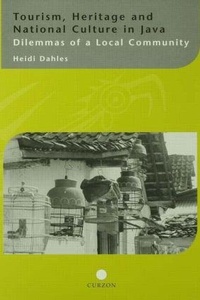
Tourism, Heritage and National Culture in Java
Dilemmas of a Local Community
1st Edition
Published on 19. October 2001
Book
Hardback
284 pages
978-0-7007-1520-6 (ISBN)
Description
Based on anthropological fieldwork in the 1990s, this book provides an ethnographic perspective in its examination of the politics and policies of cultural tourism as they were played out under the Indonesian New Order regime. The successful New Order tourism policy ensured that tourism development both contributed to, and benefited from, increasing economic prosperity and a long stretch of political stability. However, that success has come at a price; the policy to encourage mainly 'high-quality' tourism revolved around carefully constructed and controlled tourist experiences that have led to local inequalities. The failure of this policy is analysed in a detailed case study of the city of Yogyakarta.
More details
Language
English
Place of publication
London
United Kingdom
Publishing group
Taylor & Francis Ltd
Target group
College/higher education
Product notice
sewn/stitched
Cloth over boards
With dust jacket
Dimensions
Height: 240 mm
Width: 161 mm
Thickness: 20 mm
Weight
608 gr
ISBN-13
978-0-7007-1520-6 (9780700715206)
Copyright in bibliographic data and cover images is held by Nielsen Book Services Limited or by the publishers or by their respective licensors: all rights reserved.
Schweitzer Classification
Other editions
Additional editions
Book
06/2015
1st Edition
Routledge
€76.70
Shipment within 10-20 days
E-Book
10/2013
1st Edition
Routledge
€69.99
Available for download
E-Book
10/2013
1st Edition
Routledge
€69.99
Available for download
Person
Authored by Dahles, Heidi
Content
Chapter 1 Tourism, Politics and the Paradox of Culture; Chapter 2 The Politics of Tourism in Indonesia; Chapter 3 Pancasila Tourism in the Heart of Central Java; Chapter 4 Prominent Players in Yogyakarta's Tourism Arena; Chapter 5 The Politics of Guiding; Chapter 6 Blurring the Boundaries; Chapter 7 Local Identity and National Culture; Chapter 8 Epilogue;