

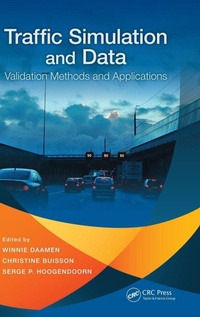
Traffic Simulation and Data
Validation Methods and Applications
1st Edition
Published on 17. September 2014
Book
Hardback
262 pages
978-1-4822-2870-0 (ISBN)
Description
A single source of information for researchers and professionals, Traffic Simulation and Data: Validation Methods and Applications offers a complete overview of traffic data collection, state estimation, calibration and validation for traffic modelling and simulation. It derives from the Multitude Project-a European Cost Action project that incorporates work packages defining traffic simulation practice and research; highway and network modeling; and synthesis, dissemination, and training. This book addresses the calibration and validation of traffic models, and introduces necessary frameworks and techniques. It also includes viable methods for sensitivity analyses, and incorporates relevant tools for application.
The book begins with a brief summary of various data collection techniques that can be applied to collect different data types. It then showcases various data processing and enhancement techniques for improving the quality of collected data. It also introduces the techniques according to the type of estimation, for example microscopic data enhancement, traffic state estimation, feature extraction and parameter identification techniques, and origin-destination matrix estimation. The material discusses the measures of performance, data error and goodness of fit, and optimization algorithms. It also contains the sensitivity analyses of parameters in traffic models.
Describes the various tasks of calibration and validation
Considers the best use of available data
Presents the sensitivity analysis method
Discusses typical issues of data error in transportation system data and how these errors can impact simulation results
Details various methodologies for data collection, sensitivity analysis, calibration, and validation
Examines benefits that result from the application of these methods
Traffic Simulation and Data: Validation Methods and Applications serves as a key resource for transport engineers and planners, researchers, and graduate students in transport engineering and planning.
The book begins with a brief summary of various data collection techniques that can be applied to collect different data types. It then showcases various data processing and enhancement techniques for improving the quality of collected data. It also introduces the techniques according to the type of estimation, for example microscopic data enhancement, traffic state estimation, feature extraction and parameter identification techniques, and origin-destination matrix estimation. The material discusses the measures of performance, data error and goodness of fit, and optimization algorithms. It also contains the sensitivity analyses of parameters in traffic models.
Describes the various tasks of calibration and validation
Considers the best use of available data
Presents the sensitivity analysis method
Discusses typical issues of data error in transportation system data and how these errors can impact simulation results
Details various methodologies for data collection, sensitivity analysis, calibration, and validation
Examines benefits that result from the application of these methods
Traffic Simulation and Data: Validation Methods and Applications serves as a key resource for transport engineers and planners, researchers, and graduate students in transport engineering and planning.
More details
Language
English
Place of publication
Bosa Roca
United States
Publishing group
Taylor & Francis Inc
Target group
College/higher education
Professional and scholarly
Transport engineers and planners, researchers and graduate students in transport engineering and planning.
Illustrations
37 s/w Abbildungen, 14 s/w Tabellen
14 Tables, black and white; 37 Illustrations, black and white
Dimensions
Height: 240 mm
Width: 161 mm
Thickness: 19 mm
Weight
561 gr
ISBN-13
978-1-4822-2870-0 (9781482228700)
Copyright in bibliographic data and cover images is held by Nielsen Book Services Limited or by the publishers or by their respective licensors: all rights reserved.
Schweitzer Classification
Other editions
Additional editions
Winnie Daamen | Christine Buisson | Serge P. Hoogendoorn
Traffic Simulation and Data
Validation Methods and Applications
Book
03/2017
1st Edition
CRC Press
€128.00
Shipment within 10-20 days
Winnie Daamen | Christine Buisson | Serge P. Hoogendoorn
Traffic Simulation and Data
Validation Methods and Applications
E-Book
09/2014
1st Edition
CRC Press
€119.99
Available for download
Winnie Daamen | Christine Buisson | Serge P. Hoogendoorn
Traffic Simulation and Data
Validation Methods and Applications
E-Book
09/2014
CRC Press
€119.99
Available for download
Persons
Winnie Daamen is an assistant professor at Delft University of Technology. Her research interests have developed from pedestrian behavior and modeling into traffic flow theory and simulation of vehicular traffic and vessel traffic. She also studies and predicts encounters of vessels in ports and waterways using similar technologies.
Christine Buisson
is a directrice de recherche at IFSTTAR in Lyon, France. Her current research focuses on detailed freeway traffic flow data collection methods, and on the understanding of how microscopic behavior of driver-vehicle pairs (lane changes, accelerations, etc.) and their variability determines global traffic behavior.
Serge Hoogendoorn
is a professor at Delft University of Technology. In recent years his research has centered on (i) theory, modelling, and simulation of multi-class traffic and transportation networks; (ii) development of methods for integrated control of these networks (regional network management, crowd management); (iii) impact of uncertainty of travel behavior and network operations; (iv) impact of ICT (information, driver support, etc.) on network flow operations, and (v) fundamentals of traffic network dynamics. In all these topics, his work has focused on both recurrent and emergency situations.
Christine Buisson
is a directrice de recherche at IFSTTAR in Lyon, France. Her current research focuses on detailed freeway traffic flow data collection methods, and on the understanding of how microscopic behavior of driver-vehicle pairs (lane changes, accelerations, etc.) and their variability determines global traffic behavior.
Serge Hoogendoorn
is a professor at Delft University of Technology. In recent years his research has centered on (i) theory, modelling, and simulation of multi-class traffic and transportation networks; (ii) development of methods for integrated control of these networks (regional network management, crowd management); (iii) impact of uncertainty of travel behavior and network operations; (iv) impact of ICT (information, driver support, etc.) on network flow operations, and (v) fundamentals of traffic network dynamics. In all these topics, his work has focused on both recurrent and emergency situations.
Content
Introduction. Data collection techniques. Data processing and enhancement techniques. Calibration and validation principles. Sensitivity analysis. Network model calibration studies. Validation. Conclusions. References. Appendices.