

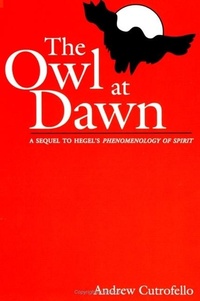
The Owl at Dawn
A Sequel to Hegel's Phenomenology of Spirit
Published on 10. August 1995
Book
Paperback/Softback
196 pages
978-0-7914-2584-8 (ISBN)
Description
A present-day continuation of the philosophical narrative presented in G.W.F. Hegel's Phenomenology of Spirit that confronts every major post-Hegelian philosophical position and arrives at an original reconception of the purpose of dialectical phenomenology.
The Owl at Dawn is a continuation of the narrative of Hegel's Phenomenology of Spirit. Where Hegel's narrative ends with the apotheosis of "absolute knowing," Cutrofello begins with the collapse of this very standpoint. He then develops a continuation of the dialectical movements that lead from the rift between the certainty and truth of absolute knowing, through every major post-Hegelian philosophical position, to a point that represents an original reconception of the telos of dialectical phenomenology.
As the narrative progresses, it becomes clear that two general movements were necessary to supplement the Hegelian story: a working out of gender-theoretic issues and the deconstruction of all truth claims. The result, which Cutrofello calls a "Nietzschean Satyagraha," is an original epistemic and ethical starting point for a systematic philosophy of praxis. Analytic philosophers, continental philosophers, gender theorists, sociologists, and psychoanalytic theorists will all find the major theoretical positions of their disciplines presented and critiqued in this bold philosophical thought experiment.
The Owl at Dawn is a continuation of the narrative of Hegel's Phenomenology of Spirit. Where Hegel's narrative ends with the apotheosis of "absolute knowing," Cutrofello begins with the collapse of this very standpoint. He then develops a continuation of the dialectical movements that lead from the rift between the certainty and truth of absolute knowing, through every major post-Hegelian philosophical position, to a point that represents an original reconception of the telos of dialectical phenomenology.
As the narrative progresses, it becomes clear that two general movements were necessary to supplement the Hegelian story: a working out of gender-theoretic issues and the deconstruction of all truth claims. The result, which Cutrofello calls a "Nietzschean Satyagraha," is an original epistemic and ethical starting point for a systematic philosophy of praxis. Analytic philosophers, continental philosophers, gender theorists, sociologists, and psychoanalytic theorists will all find the major theoretical positions of their disciplines presented and critiqued in this bold philosophical thought experiment.
Reviews / Votes
"A brilliant, original evaluation of post-Hegelian philosophy from the perspective of Hegelian phenomenology." - Lawrence S. Stepelevich, editor, Owl of Minerva"Andrew Cutrofello has attempted what would have seemed to be an impossible task, a sequel to Hegel's Phenomenology. In a fascinating, even gripping narrative, Cutrofello tells the story of post-Hegelian philosophical developments. In the style of the Phenomenology, he stages the engagement of various philosophical positions to show how they are interrelated. This book is as impressive philosophically as it is creative. It is a pleasure to read." - Kelly Oliver, University of Texas at Austin
More details
Language
English
Place of publication
Albany, NY
United States
Target group
Professional and scholarly
US School Grade: College Graduate Student and over
Product notice
Paperback (trade)
Dimensions
Height: 229 mm
Width: 150 mm
Thickness: 12 mm
Weight
263 gr
ISBN-13
978-0-7914-2584-8 (9780791425848)
Copyright in bibliographic data and cover images is held by Nielsen Book Services Limited or by the publishers or by their respective licensors: all rights reserved.
Schweitzer Classification
Person
Andrew Cutrofello is Assistant Professor of Philosophy at Loyola University of Chicago. He is the author of Discipline and Critique: Kant, Poststructuralism, and the Problem of Resistance, also published by SUNY Press.
Content
Acknowledgments
Conceptual Personae
Preface
Why Hegel's Phenomenology of Spirit Requires a Sequel
Why We Need a Sequel to Hegel's Phenomenology of Spirit Satyagraha and the Absolute Standpoint
Introduction
1. (EE.) The Dialectic of Absolute Knowing
A. Independence and Dependence of Absolute Knowing
B. Freedom of Absolute Knowing: The Philosophical Community
2. (FF.) The Dialectic of Materialist Spirit
A. Ethical Materialism
B. Materialist Culture: Anarchy, State, and Dystopia
C. Christian Humanism, Anti-Semitism, and the Unmasking of the Ascetic ideal
3. (AAA.) Consciousness and Self-Consciousness of Language
A. Sense-Certainty of Language
B. Perception of Language. The Face-to-Face Encounter
C. Force and Understanding of Language: The Analyst/Analysand Dialectic
4. (BBB.) Structural Reason
A. Structural Observation
B. Actualization of Structural Reason's Self-consciousness
C. Individuality from the Perspective of Structural Reason
5. (CCC.) "We"
A. Real Socialism. "We, the people."
B. Self-alienated "we": The Symbolic Realm
C. This "We" That Knows It Is Not One
a. The Imaginary View of the World
b. Postmodernist Duplicity
Communicative Rationality. The Differend and its Affirmation
6. (DDD.) Satyagraha
Conceptual Personae
Preface
Why Hegel's Phenomenology of Spirit Requires a Sequel
Why We Need a Sequel to Hegel's Phenomenology of Spirit Satyagraha and the Absolute Standpoint
Introduction
1. (EE.) The Dialectic of Absolute Knowing
A. Independence and Dependence of Absolute Knowing
B. Freedom of Absolute Knowing: The Philosophical Community
2. (FF.) The Dialectic of Materialist Spirit
A. Ethical Materialism
B. Materialist Culture: Anarchy, State, and Dystopia
C. Christian Humanism, Anti-Semitism, and the Unmasking of the Ascetic ideal
3. (AAA.) Consciousness and Self-Consciousness of Language
A. Sense-Certainty of Language
B. Perception of Language. The Face-to-Face Encounter
C. Force and Understanding of Language: The Analyst/Analysand Dialectic
4. (BBB.) Structural Reason
A. Structural Observation
B. Actualization of Structural Reason's Self-consciousness
C. Individuality from the Perspective of Structural Reason
5. (CCC.) "We"
A. Real Socialism. "We, the people."
B. Self-alienated "we": The Symbolic Realm
C. This "We" That Knows It Is Not One
a. The Imaginary View of the World
b. Postmodernist Duplicity
Communicative Rationality. The Differend and its Affirmation
6. (DDD.) Satyagraha