

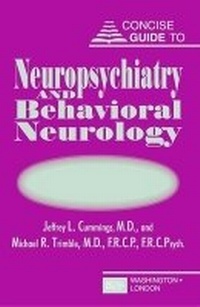
Concise Guide to Neuropsychiatry and Behavioral Neurology
2nd Edition
Published on 30. March 2002
Book
Paperback/Softback
304 pages
978-1-58562-078-4 (ISBN)
Description
Despite dramatic advances in our understanding of the brain and brain disorders, we still have much uncharted territory to explore in neuropsychiatry and behavioral neurology, two rapidly growing disciplines devoted to understanding the behavioral consequences of brain dysfunction and using this information to improve patient care.
The second edition of this popular pocket guide (part of American Psychiatric Publishing, Inc.'s Concise Guides series; it literally fits into the pocket of a lab coat or jacket) is updated throughout, featuring new medications and new diagnostic procedures and criteria. Like the first edition, it presents brief synopses of the major neuropsychiatric and neurobehavioral syndromes, discusses their clinical assessment, and provides guidelines for management, plus a glossary, index, and bibliographies that refer to more extensive reading.
The authors summarize diagnostic and treatment information in easy-to-read tables, including clinical features, underlying pathophysiology, and treatment options for the major neuropsychiatric disorders.
Beginning with several chapters on neuropsychiatric assessment methods, basic neuroanatomic and neurochemical principles, neuropsychiatric symptoms (including unexplained neurological symptoms, such as generalized anxiety, panic, and conversion and dissociative disorders) and syndromes (e.g., frontal lobe, aphasia), and the differential diagnosis of major neuropsychiatric disorders (e.g., depression, mania, psychosis, anxiety), the authors organize subsequent chapters by disease: Visual/visuospatial impairment, which is critical to human survival and most severe with right-brain dysfunction and injury, where it causes a variety of neuropsychiatric symptoms; Disorders of memory (etiology, anatomy, and tests for disorders such as amnesia), epilepsy (especially temporal lobe epilepsy), dementia and delirium (emphasizing the clinical criteria identifying the different dementias), and movement disorders (including Parkinson's disease and hyperkinetic movement disorders and tremors); Stroke (cerebrovascular disease is one of the most common causes of acquired behavior change in adults) and brain tumors (with associated neuropsychiatric morbidity); White matter diseases (e.g., multiple sclerosis), with acquired or hereditary leukoencephalopathies, which can be further classified pathologically or according to the underlying metabolic abnormality; and head injury (e.g., intracranial hematoma, infection, epilepsy) and its sequelae (e.g., personality and cognitive changes, depression, posttraumatic stress disorder)
The final chapter covers the latest treatments, such as neuropsychopharmacology (e.g., antidepressants, antipsychotics, sedative hypnotics, mood-stabilizers, anticonvulsants), electroconvulsive therapy, vagus nerve stimulation, and neurosurgical procedures (i.e., destruction of large tracts of white matter to and from the frontal lobes).
An immediately useful clinical companion for psychiatrists and geriatric psychiatrists, neurologists, and neuropsychologists both within the U.S. and abroad, this volume is also exceptionally practical for students and residents because of its broad scope and easily accessible information.
The second edition of this popular pocket guide (part of American Psychiatric Publishing, Inc.'s Concise Guides series; it literally fits into the pocket of a lab coat or jacket) is updated throughout, featuring new medications and new diagnostic procedures and criteria. Like the first edition, it presents brief synopses of the major neuropsychiatric and neurobehavioral syndromes, discusses their clinical assessment, and provides guidelines for management, plus a glossary, index, and bibliographies that refer to more extensive reading.
The authors summarize diagnostic and treatment information in easy-to-read tables, including clinical features, underlying pathophysiology, and treatment options for the major neuropsychiatric disorders.
Beginning with several chapters on neuropsychiatric assessment methods, basic neuroanatomic and neurochemical principles, neuropsychiatric symptoms (including unexplained neurological symptoms, such as generalized anxiety, panic, and conversion and dissociative disorders) and syndromes (e.g., frontal lobe, aphasia), and the differential diagnosis of major neuropsychiatric disorders (e.g., depression, mania, psychosis, anxiety), the authors organize subsequent chapters by disease: Visual/visuospatial impairment, which is critical to human survival and most severe with right-brain dysfunction and injury, where it causes a variety of neuropsychiatric symptoms; Disorders of memory (etiology, anatomy, and tests for disorders such as amnesia), epilepsy (especially temporal lobe epilepsy), dementia and delirium (emphasizing the clinical criteria identifying the different dementias), and movement disorders (including Parkinson's disease and hyperkinetic movement disorders and tremors); Stroke (cerebrovascular disease is one of the most common causes of acquired behavior change in adults) and brain tumors (with associated neuropsychiatric morbidity); White matter diseases (e.g., multiple sclerosis), with acquired or hereditary leukoencephalopathies, which can be further classified pathologically or according to the underlying metabolic abnormality; and head injury (e.g., intracranial hematoma, infection, epilepsy) and its sequelae (e.g., personality and cognitive changes, depression, posttraumatic stress disorder)
The final chapter covers the latest treatments, such as neuropsychopharmacology (e.g., antidepressants, antipsychotics, sedative hypnotics, mood-stabilizers, anticonvulsants), electroconvulsive therapy, vagus nerve stimulation, and neurosurgical procedures (i.e., destruction of large tracts of white matter to and from the frontal lobes).
An immediately useful clinical companion for psychiatrists and geriatric psychiatrists, neurologists, and neuropsychologists both within the U.S. and abroad, this volume is also exceptionally practical for students and residents because of its broad scope and easily accessible information.
Reviews / Votes
This book would be most useful for medical students or resident physicians, who can use it for review and carry it conveniently for reference, but it could also be of value for other practitioners who regularly work with individuals with neurological disorders and their psychopathological sequelae.This is a very useful and easy to read manual that the clinician can use on a daily, quick reference basis. This book is written in a very practical, user-friendly format differentiating itself from other books in this category.
More details
Edition
Second Edition
Language
English
Place of publication
VA
United States
Target group
College/higher education
Professional and scholarly
US School Grade: College Graduate Student and over
Edition type
New edition
Dimensions
Height: 165 mm
Width: 107 mm
Thickness: 15 mm
Weight
227 gr
ISBN-13
978-1-58562-078-4 (9781585620784)
Copyright in bibliographic data and cover images is held by Nielsen Book Services Limited or by the publishers or by their respective licensors: all rights reserved.
Schweitzer Classification
Other editions
New editions
John J. Barry | Sepideh Bajestan | Jeffrey L. Cummings
Concise Guide to Neuropsychiatry and Behavioral Neurology
Book
07/2022
3rd Edition
American Psychiatric Association Publishing
€65.00
Article not available at the moment
Persons
Jeffrey L. Cummings, M.D., is Augustus S. Rose Professor of Neurology and Professor of Psychiatry and Biobehavioral Science at the UCLA School of Medicine in Los Angeles, California.
Michael R. Trimble, M.D., F.R.C.P., F.R.C.Psych., is Raymond Way Professor in Behavioral Neurology at the Institute of Neurology in Queen Square in London, England.
Michael R. Trimble, M.D., F.R.C.P., F.R.C.Psych., is Raymond Way Professor in Behavioral Neurology at the Institute of Neurology in Queen Square in London, England.
Content
Introduction to the Concise GuidesSeriesPrefaceChapter 1. Neuropsychiatric assessmentChapter 2. Behavioral neurobiologyChapter 3. Neuropsychiatric symptoms and syndromesChapter 4. Unexplained neurological symptomsChapter 5. Frontal lobe syndromesChapter 6. Aphasia and related syndromesChapter 7. Visual, visuospatial, and right-brain disordersChapter 8. Memory and its disordersChapter 9. Epilepsy and limbic system disordersChapter 10. Dementia and deliriumChapter 11. Movement disordersChapter 12. Stroke and brain tumorsChapter 13. White matter diseases and inborn errors of metabolismChapter 14. Head injury and its sequelaeChapter 15. Treatments in neuropsychiatryGlossaryIndex