

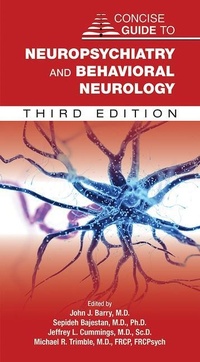
Concise Guide to Neuropsychiatry and Behavioral Neurology
3rd Edition
Will be published approx. on 26. July 2022
Book
Paperback/Softback
416 pages
978-1-61537-409-0 (ISBN)
Description
For nearly 30 years, the Concise Guide to
Neuropsychiatry and Behavioral Neurology has been an indispensable
companion for clinicians caring for patients struggling with everything from
delusions and hallucinations to aphasia and stroke.
This third edition
combines all of the scientific rigor of its predecessors with a renewed
emphasis on kind, empathetic care. It has been updated to account for the
development of new techniques in brain imaging; improvement in
electrophysiological methods to better detect epilepsy and sleep disorders;
and a growing list of blood and spinal fluid biomarkers that have
revolutionized diagnostic capability.
Readers will benefit from
guidance on novel treatments and improved therapies for a range of disorders
that includes
* Memory disorders
* Movement disorders
* Brain tumors
*
Substance related disorders
* HIV neurocognitive disorders
A
wealth of tables throughout the book will help busy clinicians quickly
reference relevant information, regardless of the patient's presentation.
And an extensive list of recommended readings opens the door to further
study.
As useful for trainees as it is for the experienced
practitioner, the Concise Guide to Neuropsychiatry and Behavioral
Neurology, Third Edition offers the latest science and expert
guidance to both achieve accurate diagnosis and undertake effective
management of patients with complex neuropsychiatric and neurobehavioral
disorders.
Neuropsychiatry and Behavioral Neurology has been an indispensable
companion for clinicians caring for patients struggling with everything from
delusions and hallucinations to aphasia and stroke.
This third edition
combines all of the scientific rigor of its predecessors with a renewed
emphasis on kind, empathetic care. It has been updated to account for the
development of new techniques in brain imaging; improvement in
electrophysiological methods to better detect epilepsy and sleep disorders;
and a growing list of blood and spinal fluid biomarkers that have
revolutionized diagnostic capability.
Readers will benefit from
guidance on novel treatments and improved therapies for a range of disorders
that includes
* Memory disorders
* Movement disorders
* Brain tumors
*
Substance related disorders
* HIV neurocognitive disorders
A
wealth of tables throughout the book will help busy clinicians quickly
reference relevant information, regardless of the patient's presentation.
And an extensive list of recommended readings opens the door to further
study.
As useful for trainees as it is for the experienced
practitioner, the Concise Guide to Neuropsychiatry and Behavioral
Neurology, Third Edition offers the latest science and expert
guidance to both achieve accurate diagnosis and undertake effective
management of patients with complex neuropsychiatric and neurobehavioral
disorders.
Reviews / Votes
This book serves as a useful guide for clinicians to betterappreciate a variety of neuropsychiatric manifestations and syndromes and to
generate a more expansive differential diagnosis when evaluating patients
with psychopathology. The authors' goal of consolidating the wealth of
information in this field into a more easily accessible format is both a
worthy and well-executed objective.
Strengths of this work include
clinically high-yield comparative tables, diagnostic algorithms, and
multiple figures correlating neuropsychiatric syndromes with various
etiologies throughout. The writing is succinct yet informative and easily
accessible for quicker reference when needed. The inclusion of specific
assessments that may be used to evaluate different frontal lobe syndromes
offers an example of the breadth of useful information in this book.
Shortcomings include rare typos and lack of color in anatomic diagrams. The
section on limbic encephalitis offers useful updates regarding the most
common identified antibodies, but the addition of a more comprehensive table
with other currently identified antibodies may have strengthened this
section.
This guide to neuropsychiatry and behavioral neurology is an
excellent book with a multitude of clinical pearls in a format that is easy
to carry and reference. -- Andrew Bartholomew, B.S., M.D. * Doody *
More details
Edition
Third Edition
Language
English
Place of publication
VA
United States
Target group
Professional and scholarly
US School Grade: College Graduate Student and over
Edition type
Revised edition
Product notice
Paperback (trade)
Illustrations
33 Figures; 96 Tables, unspecified
Dimensions
Height: 206 mm
Width: 112 mm
Thickness: 21 mm
Weight
380 gr
ISBN-13
978-1-61537-409-0 (9781615374090)
Copyright in bibliographic data and cover images is held by Nielsen Book Services Limited or by the publishers or by their respective licensors: all rights reserved.
Schweitzer Classification
Other editions
Additional editions
John J. Barry | Sepideh Bajestan | Jeffrey L. Cummings
Concise Guide to Neuropsychiatry and Behavioral Neurology
E-Book
05/2022
3rd Edition
American Psychiatric Association Publishing
€52.99
Available for download
Previous edition
Jeffrey L. Cummings | Michael R. Trimble
Concise Guide to Neuropsychiatry and Behavioral Neurology
Book
03/2002
2nd Edition
American Psychiatric Association Publishing
€73.23
Article exhausted; check for reprint
Persons
John J. Barry, M.D., is Fellowship Director of
Neuropsychiatry and Behavioral Neurology, Director of the Neuropsychiatry
Clinic, Co-Director of the Individual Psychiatry Clinic, and Professor of
Psychiatry and Behavioral Sciences in the Department of Psychiatry and
Behavioral Sciences at Stanford University School of Medicine and Stanford
University Hospital in Stanford, California.
Sepideh N. Bajestan,
M.D., Ph.D., is Chief of Neuropsychiatry Services, Associate
Director of the Neuropsychiatry and Behavioral Neurology Fellowship,
Co-Director of the Individual Psychotherapy Clinic, and Clinical Associate
Professor in the Department of Psychiatry and Behavioral Sciences at the
Stanford University School of Medicine in Stanford,
California.
Jeffrey L. Cummings, M.D., Sc.D., is Director
and a Research Professor for the Chambers-Grundy Center for Transformative
Neuroscience, Department of Brain Health, School of Integrated Health
Sciences at the University of Nevada Las Vegas in Las Vegas, Nevada.
Michael R. Trimble, M.D., FRCP, FRCPsych, is Emeritus Professor
in Behavioural Neurology at the Queen Square Institute of Neurology,
University College London, in London, United Kingdom.
Neuropsychiatry and Behavioral Neurology, Director of the Neuropsychiatry
Clinic, Co-Director of the Individual Psychiatry Clinic, and Professor of
Psychiatry and Behavioral Sciences in the Department of Psychiatry and
Behavioral Sciences at Stanford University School of Medicine and Stanford
University Hospital in Stanford, California.
Sepideh N. Bajestan,
M.D., Ph.D., is Chief of Neuropsychiatry Services, Associate
Director of the Neuropsychiatry and Behavioral Neurology Fellowship,
Co-Director of the Individual Psychotherapy Clinic, and Clinical Associate
Professor in the Department of Psychiatry and Behavioral Sciences at the
Stanford University School of Medicine in Stanford,
California.
Jeffrey L. Cummings, M.D., Sc.D., is Director
and a Research Professor for the Chambers-Grundy Center for Transformative
Neuroscience, Department of Brain Health, School of Integrated Health
Sciences at the University of Nevada Las Vegas in Las Vegas, Nevada.
Michael R. Trimble, M.D., FRCP, FRCPsych, is Emeritus Professor
in Behavioural Neurology at the Queen Square Institute of Neurology,
University College London, in London, United Kingdom.
Content
Chapter 1. Neuropsychiatric Assessment
Chapter 2.
Behavioral Neurobiology
Chapter 3. Symptoms and Syndromes
Chapter 4.
Unexplained Neurological Syndromes
Chapter 5. Frontal Lobe
Syndromes
Chapter 6. Aphasia and Related Syndromes
Chapter 7.
Visual, Visuospatial and Right and Left Brain Disorders
Chapter 8.
Memory and Its Disorders
Chapter 9. Epilepsy and Limbic System
Disorders
Chapter 10. Delirium
Chapter 11. Dementia
Chapter 12.
Movement Disorders
Chapter 13. Stroke
Chapter 14. Brain
Tumors
Chapter 15. White Matter Diseases
Chapter 16. Head
Injury
Chapter 17. Substance Related Disorders
Chapter 18. Autism
Chapter 19. Endocrine Disorders - Thyroid and Adrenal
Chapter 20.
Limbic Encephalitis
Chapter 21. HIV Neurocognitive Disorders
Chapter
22. Treatment of Neuropsychiatric Disorders
Chapter 23. Interventional
Neuropsychiatry
Chapter 2.
Behavioral Neurobiology
Chapter 3. Symptoms and Syndromes
Chapter 4.
Unexplained Neurological Syndromes
Chapter 5. Frontal Lobe
Syndromes
Chapter 6. Aphasia and Related Syndromes
Chapter 7.
Visual, Visuospatial and Right and Left Brain Disorders
Chapter 8.
Memory and Its Disorders
Chapter 9. Epilepsy and Limbic System
Disorders
Chapter 10. Delirium
Chapter 11. Dementia
Chapter 12.
Movement Disorders
Chapter 13. Stroke
Chapter 14. Brain
Tumors
Chapter 15. White Matter Diseases
Chapter 16. Head
Injury
Chapter 17. Substance Related Disorders
Chapter 18. Autism
Chapter 19. Endocrine Disorders - Thyroid and Adrenal
Chapter 20.
Limbic Encephalitis
Chapter 21. HIV Neurocognitive Disorders
Chapter
22. Treatment of Neuropsychiatric Disorders
Chapter 23. Interventional
Neuropsychiatry