

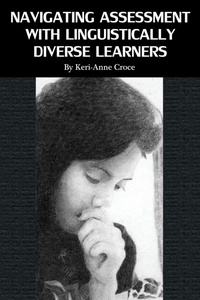
Navigating Assessment with Linguistically Diverse Learners
Published on 29. March 2017
Book
Paperback/Softback
140 pages
978-1-68123-825-8 (ISBN)
Description
This book addresses how to assess and instruct students while also honoring their cultural and linguistic backgrounds. Many individuals want to support their multilingual learners but do not have the language skills to work in a bilingual or dual-language setting. The chapters in this book examine assessment in classrooms where English is the language of instruction; yet, students are also encouraged to communicate in multiple languages.
The thesis of this book revolves around the idea that linguistically diverse learners may engage in critical thinking in ways that we may not anticipate. Students who are learning in an additional language do not need to "catch up." Assessment should instead measure the new ways that students are interacting with the world. This book helps you discover the many ways to help students develop as critically thinking readers, writers and speakers.
There is a scarcity of research addressing literacy among linguistically diverse learners within math and science. The information contained in this book will hopefully advance a dialogue between teachers and linguistically diverse students as they read and write multiple genres together. This book also encourages teachers, family, and community members to come together to form supportive environments where best practices are fostered.
Some of the questions addressed by this book:
1. How do I determine a student's strengths and needs if he or she is not talking in class in any language?
2. Do I teach monolingual and multilingual learners to read in similar ways?
3. How can I support my students as they read math word problems?
4. What do students need to know about the structures of science texts?
5. How should we develop math and science literacy assessments?
6. Should I have specific language goals for students as speakers?
The thesis of this book revolves around the idea that linguistically diverse learners may engage in critical thinking in ways that we may not anticipate. Students who are learning in an additional language do not need to "catch up." Assessment should instead measure the new ways that students are interacting with the world. This book helps you discover the many ways to help students develop as critically thinking readers, writers and speakers.
There is a scarcity of research addressing literacy among linguistically diverse learners within math and science. The information contained in this book will hopefully advance a dialogue between teachers and linguistically diverse students as they read and write multiple genres together. This book also encourages teachers, family, and community members to come together to form supportive environments where best practices are fostered.
Some of the questions addressed by this book:
1. How do I determine a student's strengths and needs if he or she is not talking in class in any language?
2. Do I teach monolingual and multilingual learners to read in similar ways?
3. How can I support my students as they read math word problems?
4. What do students need to know about the structures of science texts?
5. How should we develop math and science literacy assessments?
6. Should I have specific language goals for students as speakers?
More details
Language
English
Place of publication
Charlotte
United States
Publishing group
Emerald Publishing Inc
Target group
Professional and scholarly
Dimensions
Height: 234 mm
Width: 156 mm
Thickness: 8 mm
Weight
225 gr
ISBN-13
978-1-68123-825-8 (9781681238258)
Copyright in bibliographic data and cover images is held by Nielsen Book Services Limited or by the publishers or by their respective licensors: all rights reserved.
Schweitzer Classification
Other editions
Additional editions
Keri-Anne Croce
Navigating Assessment with Linguistically Diverse Learners
E-Book
01/2017
1st Edition
Information Age Publishing
from
€62.33
Available for download
Content
Acknowledgments.
Introduction.
Chapter 1. Understanding Linguistically Diverse Learners' Early Development.
Chapter 2. Understanding Linguistically Diverse Learners' Continuing Development.
Chapter 3. Linguistically Diverse Learners Reading and Writing Math.
Chapter 4. Linguistically Diverse Learners Reading and Writing Science.
Chapter 5. Linguistically Diverse Learners Developing as Speakers During Math and Science Discussions.
Chapter 6. School Teachers, Family, and Community Members Helping to Shape Assessment.
Appendices.
References.
Author Biography.
About the Illustrator.
Subject Index.
Introduction.
Chapter 1. Understanding Linguistically Diverse Learners' Early Development.
Chapter 2. Understanding Linguistically Diverse Learners' Continuing Development.
Chapter 3. Linguistically Diverse Learners Reading and Writing Math.
Chapter 4. Linguistically Diverse Learners Reading and Writing Science.
Chapter 5. Linguistically Diverse Learners Developing as Speakers During Math and Science Discussions.
Chapter 6. School Teachers, Family, and Community Members Helping to Shape Assessment.
Appendices.
References.
Author Biography.
About the Illustrator.
Subject Index.