

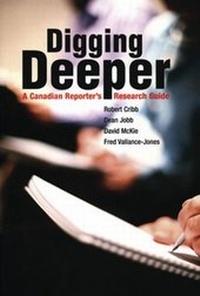
Digging Deeper
A Canadian Reporter's Research Guide
Published on 1. March 2006
Book
Paperback/Softback
288 pages
978-0-19-542127-9 (ISBN)
Description
"Digging Deeper" is a comprehensive manual of investigative techniques and a guide filled with practical tips on how to find information on the public record in Canada. Too often, journalists and other researchers take the lead from others, allowing governments, corporations, and other organizations to define the news, deciding what is newsworthy and how a story will be told. "Digging Deeper" shows how investigative journalists escape the 'handout mentality' by thinking independently and developing the research techniques necessary to produce investigative reports. Award-winning investigative journalists discuss how to develop story ideas, how to develop research strategies, and how to pitch stories to editors and producers. Individual chapters offer practical tips on how to research individuals, businesses, and public institutions, including how to use freedom of information laws to access information on the public record. Following the paper trail may lead to other avenues for investigation: surveillance and undercover work.
The chapter on interviewing explores who to prepare for interviews, techniques for gathering information from an interview, and how to deal with difficult or reluctant sources. Finding information is only half the battle. The authors also discuss how to effectively catalogue, index, and organize the vast amounts of information collected during the course of an investigation. They show how Computer Assisted Reporting (CAR) can be used to extend the reporter's research capabilities. And finally, the authors show how to bring it all together: how to use the results of research to write investigative pieces for print, radio, and television for maximum impact and audience interest.
The chapter on interviewing explores who to prepare for interviews, techniques for gathering information from an interview, and how to deal with difficult or reluctant sources. Finding information is only half the battle. The authors also discuss how to effectively catalogue, index, and organize the vast amounts of information collected during the course of an investigation. They show how Computer Assisted Reporting (CAR) can be used to extend the reporter's research capabilities. And finally, the authors show how to bring it all together: how to use the results of research to write investigative pieces for print, radio, and television for maximum impact and audience interest.
More details
Language
English
Place of publication
Canada
Target group
Professional and scholarly
Illustrations
1 table and 39 black and white screen captures
Dimensions
Height: 228 mm
Width: 153 mm
Thickness: 16 mm
Weight
395 gr
ISBN-13
978-0-19-542127-9 (9780195421279)
Copyright in bibliographic data and cover images is held by Nielsen Book Services Limited or by the publishers or by their respective licensors: all rights reserved.
Schweitzer Classification
Other editions
New editions
Book
09/2010
2nd Edition
Oxford University Press, Canada
€51.98
Article is exhausted; no reprint
Persons
Content
Preface; Part I: Getting Started; 1. Introduction to Investigative Journalism; 2. The Nuts and Bolts of Investigations; Part II: The Key Primary Resources; 3. Building a Foundation: Gathering Information Already Published; 4. Using Public Records; 5. Accessing Laws and Justice Systems; 6. Digging into the Past: Using Historical Resources; Part III: Getting to the Heart of the Matter: Specific Investigations; 7. Researching and Finding People; 8. Getting People to Talk: The Art of the Interview; 9. Following the Money: Business and Finance Investigations; 10. Getting Behind Closed Doors: Using Freedom of Information Laws; Part IV: Putting It All to Work; 11. Computer-Assisted Reporting; 12. Organizing, Writing, and Libel-proofing the Investigative Story; Appendix 1: Using Spreadsheets; Appendix 2: Using Database Managers; Appendix 3: Resources for Business Investigations; Index