

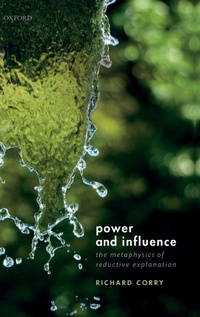
Power and Influence
The Metaphysics of Reductive Explanation
Published on 31. July 2019
Book
Hardback
256 pages
978-0-19-884071-8 (ISBN)
Description
The world is a complex place, and this complexity is an obstacle to our attempts to explain, predict, and control it. In Power and Influence, Richard Corry investigates the assumptions that are built into the reductive method of explanation--the method whereby we study the components of a complex system in relative isolation and use the information so gained to explain or predict the behaviour of the complex whole. He investigates the metaphysical presuppositions built into the reductive method, seeking to ascertain what the world must be like in order that the method could work. Corry argues that the method assumes the existence of causal powers that manifest causal influence--a relatively unrecognised ontological category, of which forces are a paradigm example. The success of the reductive method, therefore, is an argument for the existence of such causal influences. The book goes on to show that adding causal influence to our ontology gives us the resources to solve some traditional problems in the metaphysics of causal powers, laws of nature, causation, emergence, and possibly even normative ethics. What results, then, is not just an understanding of the reductive method, but an integrated metaphysical worldview that is grounded in an ontology of power and influence.
Reviews / Votes
Corry's book is probably the most important volume on dispositions since Alexander Bird's Nature's Metaphysics: Laws and Properties (2007). His new theory's methodology and content is extraordinarily well-thought through. His showing how the account promotes solutions to general questions in metaphysics and ethics, rather than criticising competing theories, is particularly valuable. * Kristina Engelhard, Notre Dame Philosophical Reviews * Power and Influence: The Metaphysics of Reductive Explanation is a well-developed approach to an important topic, and provides many important considerations not only for those interested in reduction, powers, and metaphysical explanation, but also for those working in the areas of causation and emergence to which Corry applies his framework. * Anais Rebecca White, BJPS Review of Books *More details
Language
English
Place of publication
Oxford
United Kingdom
Target group
College/higher education
Dimensions
Height: 240 mm
Width: 161 mm
Thickness: 18 mm
Weight
549 gr
ISBN-13
978-0-19-884071-8 (9780198840718)
Copyright in bibliographic data and cover images is held by Nielsen Book Services Limited or by the publishers or by their respective licensors: all rights reserved.
Schweitzer Classification
Other editions
Additional editions
E-Book
07/2019
1st Edition
OUP eBook
€58.99
Available for download
E-Book
07/2019
1st Edition
OUP eBook
€58.99
Available for download
Person
Richard Corry is Lecturer in Philosophy at the University of Tasmania. His main area of research is the metaphysics of science, particularly the place of time and causation in modern physics. He is also interested in exploring what philosophy of science can contribute to real-world issues, such as the public debate around climate change. He is editor, with Huw Price, of Causation, Physics, and the Constitution of Reality (Oxford 2007), and author, with David Coady, of The Climate Change Debate: An Epistemic and Ethical Enquiry (Palgrave 2013). He has also published articles on the philosophy of mind and the ethics of consumer responsibility.
Content
1: Introduction 2: Taking Apart the World 3: Causal Influence 4: Causal Power 5: Putting Things Together: The Assumptions of Reduction 6: Macroscopic Power and Influence 7: Laws of Nature 8: Causation 9: Causal Models 10: Emergence and the Failure of Reduction 11: Influentialism: A New Type of Moral Theory?