

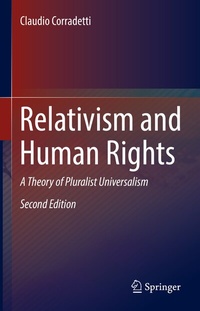
Relativism and Human Rights
Description
More details
Other editions
Additional editions
Previous edition
Person
Claudio Corradetti is Associate Professor of Political Philosophy at the University of Rome Tor Vergata. He has been an undergraduate student at Oxford University and at the University of London, where he has obtained a Ma Philosophy. Once back in Italy, he has gained a doctoral degree at LUISS Guido Carli, Roma. Claudio has been trained also in law, having obtained a Diploma in European Public Law and an admission to the advanced seminars in international public law at the Hague Academy. Among his teaching records, he has taught at the University of Oslo and at the University of Graz, Austria.
He is a founder and co-chief director of the journal 'Jus Cogens. A Critical Journal of Philosophy of Law and Politics', Springer. Claudio has published extensively in Human Rights, Transitional Justice, the Frankfurt School and Immanuel Kant for Oxford University Press, Routledge, Sage, Cambridge University Press etc.Content
Preface second edition.- Introduction second edition.- Part I.- 1 Cognitive Relativism and Experiential Rationality.- 1.1 Beyond Cognitive and Linguistic Relativism.- 1.2 Epistemic Relativism Refuted.- 1.3 The Experiential Validity of the Cognitive System.- 1.3.1 Judgement and Truth.- 2 Beyond Moral Relativism and Objectivism.- 2.1 Forms of Moral Relativism.- 2.2 The Two Horns of the Dilemma: Relativism versus Objectivism.- 2.2.1 Harman's Inner-Judgments Relativism.- 2.2.2 The Limits of Nagel's Objectivism in Morality.- 2.3 Wong's Mixed Position: the Idea of Pluralistic Relativism.- 2.4 Discursive Dialectic of Recognition.- Part II.- 3 Human Rights and Pluralisitc Universalism.- 3.1 From Purposive Action to Communicative Action.- 3.1.1 Discursive dialectics and the processes of subjectivization.- 3.2 The Priority of Recognition and the Formal System of Basic Liberties .- 3.3 Human Dignity as an orienting principle of the universal system of human rights.- 3.3.1 Human Dignity as a Juridical Principle.- 3.3 The Exemplar Validity of Human Rights.- 3.4 Deliberative Constraints and Pluralistic Universalism.- 4 The Legal Dimensions of Human Rights.- 4.1 The Source and the Content Validity of Law.- 4.2 The Structure and Function of Human Rights.- 4.3 Transplantability and Legal Commensurability.- 4.4 What is Wrong in the Democratic Peace Theory.- Bibliography.- Index of names.- Index of topics.