

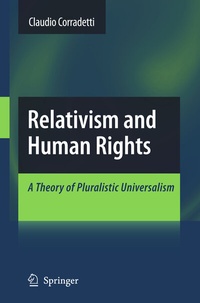
Relativism and Human Rights
A Theory of Pluralistic Universalism
Published on 19. October 2010
Book
Paperback/Softback
XVI, 170 pages
978-90-481-8234-3 (ISBN)
Description
When he nished writing, he raised his eyes and looked at me. From that day I have thought about Doktor Pannwitz many times and in many ways. I have asked myself how he really functioned as a man; how he lled his time, outside of the Polymerization and the Indo- Germanic conscience; above all when I was once more a free man, I wanted to meet him again, not from a spirit of revenge, but merely from a personal curiosity about the human soul. Because that look was not one between two men; and if I had known how completely to explain the nature of that look, which came as if across the glass window of an aquarium between two beings who live in different worlds, I would also have explained the essence of the great insanity of the third Germany. PRIMO LEVI [If this is a man, pp. 111-112, in, If this is a man and The truce, trans. S. Woolf, Abacus, London, 1987] If all propositions, even the contingent ones, are resolved into identical propositions, are they not all necessary? My answer is: certainly not. For even if it is certain that what is more perfect is what will exist, the less perfect is nevertheless still possible. In propositions of fact, existence is involved. LEIBNIZ [Samtlic ¨ he schriften und briefe vol VI pt 4 Deutsche Akademie der Wissenschaften, 1449A VI 4] We live in a rule-constrained world.
Reviews / Votes
From the reviews:
"Claudio Corradetti's book is a thoughtful attempt to find an adequate theoretical foundation for human rights. Its approach is interdisciplinary in nature, drawing on issues in analytical philosophy as well as contemporary political theorists, and the result is a densely argued text aimed at scholars . ." (Andrew Lambert, Metapsychology Online Reviews, Vol. 14 (3), January, 2010)More details
Edition
Softcover reprint of hardcover 1st ed. 2009
Language
English
Place of publication
Dordrecht
Netherlands
Target group
Professional and scholarly
Research
Illustrations
XVI, 170 p.
Dimensions
Height: 23.5 cm
Width: 15.5 cm
Weight
296 gr
ISBN-13
978-90-481-8234-3 (9789048182343)
DOI
10.1007/978-1-4020-9986-1
Schweitzer Classification
Other editions
New editions
Book
11/2021
2nd Edition
Springer
€106.99
Article exhausted; check different version
Additional editions
Book
04/2009
Springer
€128.39
Shipment within 15-20 days
Content
Introduction.
PART ONE. 1. COGNITIVE RELATIVISM AND EXPERIENTIAL RATIONALITY. 1.1 Beyond Cognitive and Linguistic Relativism. 1.2 Epistemic Relativism Refuted. 1.3 The Experiential Validity of the Cognitive System. 1.4 Judgement and Truth.
2. BEYOND MORAL RELATIVISM AND OBJECTIVISM. 2.1 Forms of Moral Relativism. 2.2 The Two Horns of the Dilemma: Relativism versus Objectivism. 2.2.1 Harman's Inner-Judgments Relativism. 2.2.2 The Limits of Nagel's Objectivism in Morality. 2.2.3 Wong's Mixed Position: the Idea of Pluralistic Relativism. 2.3 Discursive Dialectic of Recognition: for a Post-Metaphysical Justification of the Ethical Life.
PART TWO. 3. HUMAN RIGHTS AND PLURALISTIC UNIVERSALISM. 3.1 From Purposive Action to Communicative Action. 3.2 The Priority of Recognition and the Formal System of Basic Liberties. 3.3 The Exemplar Validity of Human Rights. 3.4 The Deliberative Constraints and Pluralistic Universalism.
4. THE LEGAL DIMENSIONS OF HUMAN RIGHTS. 4.1 The Source and the Content Validity of Law. 4.2 The Structure and Function of Human Rights. 4.3 Transplantability and Legal Commensurability. 4.4 What is Wrong in the Democratic Peace Theory? A Defence of International Legal Pluralism.
References.
PART ONE. 1. COGNITIVE RELATIVISM AND EXPERIENTIAL RATIONALITY. 1.1 Beyond Cognitive and Linguistic Relativism. 1.2 Epistemic Relativism Refuted. 1.3 The Experiential Validity of the Cognitive System. 1.4 Judgement and Truth.
2. BEYOND MORAL RELATIVISM AND OBJECTIVISM. 2.1 Forms of Moral Relativism. 2.2 The Two Horns of the Dilemma: Relativism versus Objectivism. 2.2.1 Harman's Inner-Judgments Relativism. 2.2.2 The Limits of Nagel's Objectivism in Morality. 2.2.3 Wong's Mixed Position: the Idea of Pluralistic Relativism. 2.3 Discursive Dialectic of Recognition: for a Post-Metaphysical Justification of the Ethical Life.
PART TWO. 3. HUMAN RIGHTS AND PLURALISTIC UNIVERSALISM. 3.1 From Purposive Action to Communicative Action. 3.2 The Priority of Recognition and the Formal System of Basic Liberties. 3.3 The Exemplar Validity of Human Rights. 3.4 The Deliberative Constraints and Pluralistic Universalism.
4. THE LEGAL DIMENSIONS OF HUMAN RIGHTS. 4.1 The Source and the Content Validity of Law. 4.2 The Structure and Function of Human Rights. 4.3 Transplantability and Legal Commensurability. 4.4 What is Wrong in the Democratic Peace Theory? A Defence of International Legal Pluralism.
References.